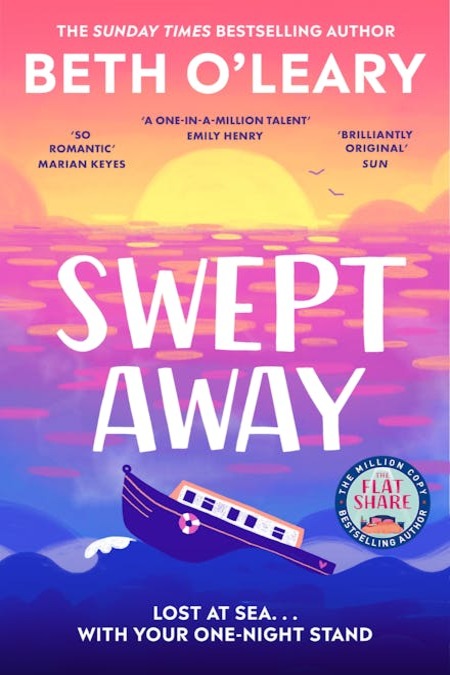
(courtesy Hachette Australia)
As premises go, the one what washes through Swept Away by Beth O’Leary is a doozy.
We are meant to believe, and honestly you will trust us, that two people can retire to a houseboat for a one-night stand and find themselves, the next day, floating to their horror in the middle of the North Sea, the northeastern town harbour from which they have floated way too far behind.
If that sounds like an hilariously fantastical premise, in many ways it is but O’Leary absolutely makes it work, investing an out-there idea with a huge amount of emotional groundedness, the execution of this idea helped along hugely by two brilliantly and fulsomely drawn central characters who make the unbelievable feel wholly and affectingly believable.
We meet two main characters together the morning after the night before; Lexi, grieving her mum and not thrilled with the course of her life, fell into the arms of Zeke the night before, looking for some fun in a trying time, and Zeke, though looking for love after some poor relationship decisions in the past, decides for someone as compelling as Lexi that he will break his own rules about one-night stands.
It’s all meant to be a one-and-done thing; that is, until a failed rope and a slipped mooring mean that rather than kissing each other goodbye and leaving the marina to lead wholly separate lives, the two temporary lovers, though not so temporary now really, spend nearly a fortnight trying to stay afloat and alive.
‘Right. I guess I’ll … adjust.’
Her eyes sharpen again. ‘You won’t need to adjust,’ she says, turning her back to me again. ‘Because any minute now, we’re getting off this boat.’
What starts out as two people lost in life, love and the general messiness of being alive soon becomes one of the most extraordinary love stories you will ever read.
While the early interactions between Lexi and Zeke are laced with witty retorts, argy-bargy and not a little panic – fair enough; they are on a houseboat, designed for gentle jaunts down peaceful English canals, in the middle of the North Sea with no sign of anyone coming soon to rescue them – a classic enemies-to-friend trope sparking with fury and vitality soon plays out and the two begin to realise they may have more in common than they think.
It’s certainly the mother of all second dates, or is it a hugely long first date, and as the not even a three-hour cruise plays out (yes, I had to thrown in a Gilligan’s Island reference because why the hell not?) Lexi and Zeke discover that though they come from markedly different backgrounds, they have a whole lot more in common than they thought.
It helps, of course, that they have lots of time to talk; they may be short of supplies and the houseboat may be showing alarming signs of leaking, but talking? That’s not in short supply and as they open their hearts to each other, a rare and powerful love story plays out that feels far more real than just about anything I’ve read in a romantically comedic novel.

There is a rawness to Lexi and Zeke’s conversations.
While the temptation in romcoms must always be to have endlessly witty and snappy conversation, the kind that would make Hepburn and Tracy proud, and it is a joy in so many smartly written novels, a novel like Swept Away benefits greatly from centering its out-there premise with a deeply human love story that mostly plays it pretty straight.
There are some moments of real levity, wit and charm, and certainly you fall in love with these characters because they are so good at spinning some furiously funny and clever lines, and they act as two people who, as their finely-honed and stratospherically high defenses start to come down, actually are surprised to find they like each other.
It’s pure romcom gold and it works because, sheer survival aside, they are so high on adrenaline that witty repartee is pretty much an inevitable outcome.
But O’Leary also zooms in movingly on the stripped back emotional reality of a situation where, witty quips and funny comebacks aside, their lives are in real danger and her commitment to playing Swept Away less for laughs and more for stark humanity in real and present danger really works.
As Swept Away progresses, what starts out as two people, post-shock, riffing off each other on a sizzling current of panicked nervous energy, soon becomes a meshing of souls in a connection so profound they realise it will last way beyond them getting back to shore.
He’s right: I’d tell myself, He doesn’t mean me. Nobody ever does. Except … maybe Zeke. Maybe this beautiful, gentle, extraordinary man really does look at me and feel lucky. The thought is so tempting I can hardly bear it.
‘Come on,’ I say, taking his hand. ‘Aren’t we meant to be strolling?’
Assuming, of course, they actually get back to shore.
There are a real and scary moments where it looks like they won’t make it out alive.
Your natural inclination with a book of this kind is that they must, they surely must, because how can all that life-changing, soul-affirming, real self-revealing love not live on and on and completely reorient the two people lucky enough to have found each other in the most extraordinary of circumstances?
Surely it must, it must!
But O’Leary makes no guarantees and this clever sophisticated and desperately heartfelt novel, which defies the seeming frivolity of its premise – surely it will play like some sort of riotous slapstick comedy? No, no, it does not – at every compellingly readable turn, employs a real seriousness of people and authenticity of humanity that have you wondering exactly how it will all play out.
It’s hands down one of my books of the year, and yes, I am well aware it’s only February and surely I’m jumping the gun when some 120 books still await my reading pleasure this year, but the brilliance of Swept Away is that it takes a premise that could easily have sprung a thousand lightweight comedic holes and serves up a story of real emotional import and impact, a love story for the ages that is a love letter to the power of connection and raw authenticity to heal wounds and to set those it has healed on the path to something far, far better, assuming, of course, they survive the catalyst event in the first place.