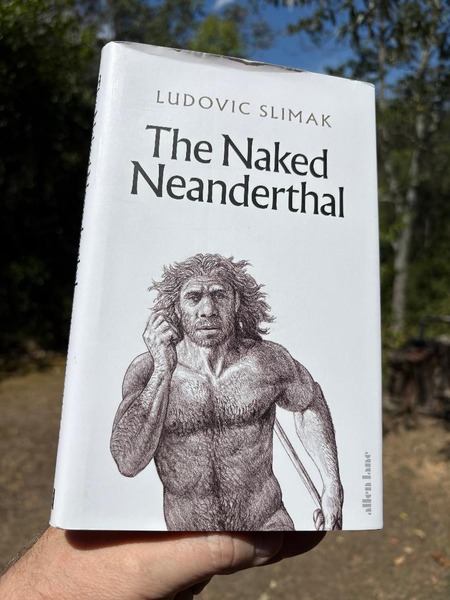
This book was read at Kalimna, Yeranda cottages, near Dungog in early January 2026
It is perhaps inevitable that we filter everything we see through our well-entrenched worldview.
Try as we might to look beyond what we intrinsically know and understand, and it is to course possible to do that, and quite successfully too, we almost always try to fit what we see and learn into a prism of existing knowledge and understanding.
In his illuminating book, The Naked Neanderthal, Ludovic Slimak, who has spent three decades working in the caves of France and the Iberian peninsula and in the Arctic Circle to decode who the Neanderthals were, challenges the idea that this now-extinct branch of humanity, which disappeared suddenly some forty thousand years ago, were like us, just different.
It’s an intriguing and alluring idea and certainly one that many researchers in the field, and thus the media, have promoted, interpreting findings of artwork and tools and the occasional weapon as proof that Neanderthals, whose vestigial DNA is present in many people living today, were simply another similar variant of humanity.
It’s certainly a step up from the old prevailing idea that Neanderthals were inferior to us, brute cavemen who were intellectually, artistically and culturally our lessers and who died out because they simply couldn’t compete Homo sapiens are they swept remorselessly, like a colonising wave, into Europe some forty millennia ago.
So, points at least that we somewhat see them as equals.
It is not so much a war of ideas as a war of ideologies, in which neither camp can advance without getting more and more bogged down in the mud – and I am not talking about the mud of the caves, unfortunately. So, was the Neanderthal a human somewhere between nature and culture, or a gentleman of the caves?
Unfortunately, notes, Slimak, who at all times in his sometimes repetitive and stolid book – mostly it rings with the fervency and passion of someone talking about what they love and value most but sometimes the author gets lost in the weeds of his own considerable knowledge – argues that we cannot see Neanderthals as simply us but different.
In challenging this motion, which comes from a very good place which is to rehabilitate these early people, who first appeared in the archeological record some half a million years ago, Slimak points to the fact that many of the discoveries we have made in the caves of Spain, France and Croatia have been interpreted using a sapiens bias.
Slimak argues and with real passion and knowledge that he believes Neanderthals, while part of the human family like Denisovans and a Flores man, had a distinct way of viewing the world and that we must do our best to put aside our sapiens filter and see their remarkable intelligence as wholly their own.
They may have had weapons and art but it is clear when Slimak deconstructs what has actually been discovered, and sometimes haphazardly and messily so – many of the earliest discoveries were made 150 years when archeological techniques weren’t as careful or well-executed as they are today – that they placed completely different emphases on these hallmarks of civilisation.
It could be any, says Slimak, that Homo sapiens were so easily able to overtake and supplant Neanderthals over their core homeland of Eurasia with such brutal speed and efficiency because we simply viewed weapons, for instance, in a totally different way.
The sapiens mindset has always been fantastically inventive and ceaselessly efficient and this may have given them the edge over a people who privatised things completely differently.
Of course, notes Slimak, no one, not even he as an expert in the field, can be sure of any assertions made on the available evidence, but it is clear at least that Neanderthals and sapiens were, though both undeniably human, not as alike as many like to romantically think.
He points particularly to the art that has been discovered in places frequented by Neanderthals which has been viewed through lens of sapiens who use their artistic output to express their ego-driven place in the world, something Slimak isn’t sure really mattered to their extinct “cousins”.
In fact, much of the art from feathers and shells to artwork on the walls may not even be by the Neanderthals and simply be present in the same place they were or accumulated there by them for reasons that have nothing to do with what we see an art.
Instead of a search for significant objects or actions, a structural approach to these past societies gives us an insight into the possible existence of ritual. Rites of passage into adulthood, ritual handling of the bodies of the dead. This is what defines the creature as a humanity. But our humanity? I wouldn’t bet on it.
Whether Slimak is right or not isn’t the issue here, though of course he is an expert in the field and someone who has rigorously fought the sapiens-isatin of Neanderthals research so he has more chance of being right than many other people.
He acknowledges, and with a refreshing candour and vigour, that there’s so much we can’t know for certain, and even when we find tantalising clues like the same stone tool methods that Neanderthals used in caves dating to 28,000 years ago in the Arctic Circle, we cannot know for sure that they existed long after their supposed date of extinction.
What is becoming increasingly apparent is that the Neanderthals, while close to us in many ways, were not us in many ways that we see as important and while it’s comforting for us and our sense of ego-driven humanity that they be like us rather than not, that may not have been the case at all.
In learning about these vanished people we have the chance he reasons to learn more about us and how we approach the world and to appreciate that while we have powerfully impressive ways of seeing life, the universe and everything, that they aren’t the whole story.
The Naked Neanderthals is a wholly fascinating read that takes us deep into his history and into the depths of what it means to be human, and asks us to try and view those who are not us, not through our lens but through theirs, and in so doing, not only learn to appreciate who they really were, but perhaps learn more about ourselves too, which can only be a good thing in a great many ways.