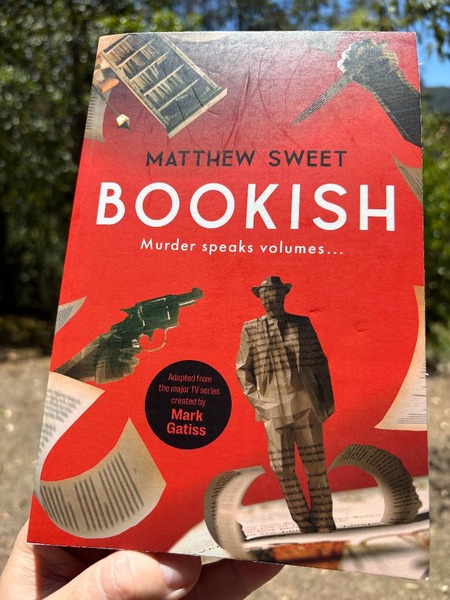
This book was read at Kalimna, Yeranda cottages, near Dungog in early January 2026.
In the usual course of pop culture back and forth, a TV or streaming show would be watched in that medium, and then, the eager viewer would turn, if they were so inclined, to the book upon which it was based, the idea being not only to get more of the story that the visual medium can fully convey but to spend time with characters and places they have come to love.
But while that is the usual way of things, it’s not the only one.
If you’re an inveterate reader, the usual way to approach these sorts of stories is book first, and TV/streaming adaptation later – not everyone is a fan of this approach; there’s a dedicated band of readers for whom books are the only thing and any other mediums are the entertainment devil – but sometimes there is not a book to start with as is the case with Bookish, a TV series created by Mark Gatiss, which existed, for a time at least, purely as a piece of televisual storytelling.
But reflecting a trend that reached its height in the 1970s and 1980s, though it existed before and after this time, Bookish has been turned into a book, rather appropriately, by Matthew Sweet, giving those who loved the show another chance to relive it.
The interesting thing for this reviewer is that he never watched the TV series; not because it didn’t interest him – the premise of a bookshop owner in 1946 London solving crimes in concert with the police sounds delightful and very much in my wheelhouse – but because it wasn’t available to him on the multitude of streaming platforms at his paid disposal.
When they reached the end of the lane, they stopped and faced each other.
‘Book,’ said Mrs Book.
‘Mrs book,’ said Book.
It was a moment of courtly solicitude, which, having been concluded, sent them both into the fog, in entirely separate directions.
Deciding that reading the TV series was preferable to not seeing the show at all – I’m an eclectic consumer of stories and there’s no snobbery for me about whether it’s in book form (though that’s my lifetime favourite medium) or movie or TV – I picked up a copy of Bookish and after some time languishing on my 600-string TBR, it finally made it to the reading pile for my annual week away in the Australian bush where there’s no interest, no TV and the only option, rather blissfully, is to read.
And what a wonderful addition to the reading selection for this soul restorative week away it was.
While it makes it very clear that London in the almost immediate aftermath of the end of World War Two is a place of bombed-out neighbourhoods, rationing and sundered lives, Bookish nevertheless feels like an inventive escape from the dreariness of life, capturing much of the playfulness of the Agatha Christie school of crime solving storytelling.
“Playful” may seem like a strange word to use when talking about these stories, since death by violent misdeed is hardly a thing of jollity or lighthearted fun; far from it, it’s awful and neither Christie nor her many heir apparent pretend otherwise.
But thanks to judicious use of lead characters with idiosyncratic wit, poise and a desire to do the right thing, the usual tide course of their lives be damned, these stories, and Bookish very much belongs in this camp, contain an air of escapism that serves much the same purpose as romcoms or fantasies; that is, they offer a certainty of ending, of justice being served and neat endings being realised in a world where these are normally quite thin on the ground.
Containing three sets of murderous mysteries, all of them set on or interesting with 158 Archangel Lane, London, Bookish places us front and centre with Mr Book, a man who runs a rather eccentric bookshop named Book’s (no, not a typo; think about it) where ordering the volumes for sale alphabetically takes a considerable second seat to the weird but oddly successful system in its proprietor’s head.
When he’s not selling valuable secondhand titles, or buying the same, Mr Book, who is married to Trottie, the owner of the wallpaper shop next door, with whom he has a highly successful if unconventional marriage – quite why it is unconventional must be left to the reading but it speaks volumes about the bigotry and backward social attitudes of the time, at least so far as they extend to one crucial aspect of being human and to whom you’re attracted – helps the police and in particular Superintendent Bliss to solve crimes from a wholly different angle.
He joins a long line of idiosyncratic crime solving protagonists including Sherlock Holmes, Hercule Poirot and even good old Jessica Fletcher who were pillars of society in their own way but who dared to challenge fight accepted way of doing things with quite successful results.
Sure, they have their detractors, those Book seems to have far fewer than would appear to be standard, but because they get results where the usual authorities can’t, they draw a loyal and devoted following from people who simply want to see justice done.
Book and Trottie heard him stumble down the stairs. They heard the harsh sound of the bell, the door being slammed shut. They heard the silence that followed.
What makes Bookish such a delight is how warmhearted it is with Book gathering around him a found family of oddball souls who need him as much as he needs them.
Trottie is how best friend and number one supporter, and his saviour in one key aspect of his life, but the bookshop also counts among its family, ginger biscuit chomping Dog – for a literary man, Book’s devoted best good boy is rather prosaically named – true crime enthusiast and sometime bookseller Nora, who aims to be a writer (no surprises what the genre will be) and twenty-something Jack, newly released from prison, who is given a new lease on life and in turn who gives Book a chance to right a wrong from his past.
No matter what happens to Book, and there are some hairy moments on the path to justice being done in all three interlinked stories, all off which build the wonderful world of Book and his gloriously supportive found family of misfits and oddballs, and those on the margins of a society with fixed ideas about what’s acceptable and what is not, Bookish feels like it is a bath a big warm and a bracing dose of unrelenting reality.
The two go together quite beautifully in the novel, and you have to imagine the series which this reviewer is now hugely looking forward to seeing.
Life doesn’t always grants all the desires of our heart, and society often works hard to keep them from us too, but Bookish is a delightful journey into what happens when when justice is served, secrets are held close while some see the light of day, and when, at least in a small but important part of postwar London, a bookshop owner and those he gathers around them, can be themselves and make at least their part of the world feel like home.