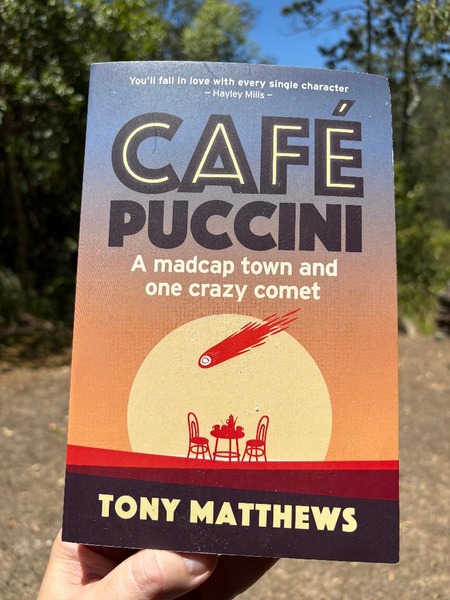
This book was read at Kalimna, Yeranda cottages, near Dungog in early January 2026.
If we’re honest, most of us live in fairly ordinary, decidedly unexciting cities or towns where everyone is as reasonably straight down the line as you can expect the contrarily idiosyncratic human race to be.
They mow their lawns, they go to work, come home from work, watch some TV, go to sleep and get up to do it all over again; it’s comforting in its familiarity and pretty much what we’re all used to.
But in the quirky, hugely quirky in fact, town of Wellsprings, Queensland – its exact location isn’t specified but it’s within driving distance of Brisbane and this is in the 1950s without the benefit of modern motorways – ordinary is the outlier, an exception to a townspeople who seem to go out of their way to defy garden variety expressions of humanity.
This of course means that Café Puccini by Tony Matthews, which sets its wildly adventurous story in the town is going to be anything but a humdrum tale of life in a cookie cutter small town.
And so it comes to pass, the adventures of its eccentrically heartwarming residents filling the pages of the novel with a narrative that takes some fairly hilarious twists and turns while also managing to be quite moving at times too.
It’s the full gloriously loopy spectrum of humanity on display, all of which makes for a hugely enjoyable read about individuality, community, forgiveness, and the end and the beginning of things.
It had taken Duff some considerable time before he head become used to the old man’s ways. But living with a local legend did have its advantages, among them was the certain knowledge that no two days would ever be the same.
Powering the storyline of Café Puccini are massively entertaining characters whom Matthews brilliantly imbues with real humanity, rendering them as far more than the generator of zany and slapstick goings-on.
That could easily have been the case of course; some very funny comedic novels ultimately suffer because while the jokes hit the spot in the instant you read them, the characters simply aren’t fully rounded enough to elicit any kind of emotional response.
And that matters in a novel like Café Puccini which is seeking not just to make you laugh but to care about the people at the heart of some fairly outlandish but meaningful moments which are funny, yes, but which also carry a reasonable amount of meaning and import too.
Take Cactus Bob, a man who survived being taken into a death roll by a monstrously large saltwater crocodile and who lives in a cottage that’s falling down around him, surrounded by clapped-out furniture and appliances and a gaggle of geese, tortoises and other creatures.
A genial if excitable fellow, Cactus Bob expects nothing much from the purchase of a reconditioned black-and-white TV from the town’s trader Ah Sow, who does sometimes feel like a racial caricature too far but who is presented as a wily figure of comic relief, especially when some elements of the story get a little more serious, than being able to watch some diversionary entertainment around him with his family of birds and animals around him.

(courtesy drtonymatthews.weebly.com)
What Cactus Bob gets is a rolling series of messages, beginning with WARNING, WARNING, WARNING a comet is going to demolish your house, which seem to be coming from aliens? That can’t be right though since they don’t exist?
Or do they?
We’re left wondering through much of Café Puccini about whether little green men, only a decade or so after Roswell, New Mexico are trying to mysteriously save Cactus Bob from a second possible spectacular death or whether it’s some sort of elaborate practical joke by Ah Sow.
While Bob, and some others who may or may not believe him, try to work out if aliens are sending warning messages about an incoming highly destructive comet, Angelo, the proprietor of the eating establishment that gives the novel its delightfully musical name, is struggling to work out how to react to some altogether unexpected developments.
He has been waiting and saving for 13 long years to bring his wife to Australia from Italy but when she arrives, both of them awash in excitement and anticipation, the hoped-for reunion doesn’t pan out anything like the way they thought it would.
While you might question why Angelo’s wife Bianka doesn’t just explain the situation, her refusal to explain things straight away gives the novel some real emotional heft as well as touching on a key thread of Australia’s brilliantly complex and complicated immigrant history.
Funny Café Puccini may be in a gently goofy kind of way, channeling a very Jonas Jonasson kind of vibe, but it also does a beautiful job of exploring the start of Australia’s mostly successful story of multiculturalism.
Cactus rode home that evening with a heavy heart. Even Honker, Zipperhead and Mama were subdued but they were probably just exhausted after a day of chasing around with a bunch of happily screaming children and also from gobbling loads of Cactus-cake, of course — but that almost goes without saying.
Adding to the mix of characters in this sweetly comedic book are a Zulu millionaire married to a Norwegian woman, both of them dreamers and risk takers who decide that Wellsprings must have an observatory on the edge of town, a Scottish boat builder who moves from the UK to Australia at the age of 70 to build a new life which seems to involve a boat-shaped house which his relatives in England worry is a quixotic act too far, and a 99-year-old Turkish war veteran who is determined to reach 100 and have fun doing it (with his nephew Duff’s help).
Café Puccini is full to the brim with romance of some very weird but heartwarming kinds, the power of forgiveness to fix even the most dire of problems and the power of community to deal with all manner of problems including a comet which may or may not be coming to wipe out Cactus Bob and his ragtag, thoroughly unique family.
As you read all the idiosyncratically strange but very human adventures of a town of oddballs, misfits and eccentric individuals, what strikes, apart from hos funny their stories are, is how grounded it all is too – here are real people who might be far from ordinary but who simply what the kind of happiness, fulfillment, hope and love that we all do.
Café Puccini is an unalloyed comedic joy that makes the most of the odd people at the core of highly entertaining stories, making us laugh but also giving us grounded meaning too, all while while shining a light on Australian society at the time which was a world apart and a haven for all kinds of lost souls looking for a place to call home.