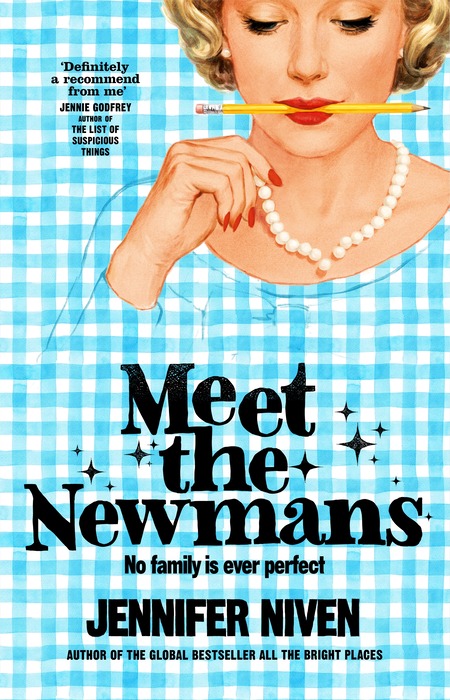
(courtesy Pan Macmillan Australia)
As ideals go, perfection has to be one of the most laughably impossible.
Granted all ideals dance somewhere in the land of blue sky implausibility, cosily inspiring ideas that would be wondrously good if they made it from hope to actuality but which never quite manage the leap, or at least not in the way idealists would have them do.
But perfection, battling against a world which appears to be uniformly flawed and broken, is likely the most impossible to realise of them all, and yet in the world of Meet the Newmans by Jennifer Niven, it’s what drives the world of “America’s Favourite Family”, whose real and fictional lives are inextricably intertwined on what was once of the country’s highest rated TV shows.
But after 12 years on air, and an earlier decade or so on the radio, the perfectionistic Leave it to Beaver / My Three Sons, and a decade, the 1960s, which is challenging long-held norms and ideals, the Newmans are looking more than a little twee and outdated, their near-calamitous fall in the ratings reflecting the fact that they no longer resemble the world outside the TV studio.
Dinah Newman won’t come out and say it but she’s is chafing at the fact that she has little more to do than cook and clean and impart cheery homilies to her husband Del and sons Guy and Shep, 21 and 16 respectively in 1964 which is when Meet the Newmans is set.
Their very own home played their TV home, just like the Newmans played themselves. The whole thing was as bizarre as it was revolutionary. What sort of people would volunteer for such a life?
But Del, with whom she remains very much in love though it’s questionable if he feels the same – they are not antagonistic as a couple and affection remains but they have drifted apart and Dinah doesn’t know how to repair the divide – is very much the man in charge of the show in a society where women still have no control over their finances, reproductive rights and a whole host of other things over which men have unquestioned domain.
It looks like the show will go on much as it has always has, closing out the last two episodes of the twelfth season, and most likely the last one ever, in typical cheesy, squeaky clean fashion.
That is until Del ends up in a coma following a car accident in a part of Los Angeles in the opposite direction from where he lives and works, and Dinah and the boys have to work out what to do in the face of the void that Del’s absence creates.
At first, in consultation with the family’s business partner, Sydney, its very much business as usual, but after exits an unsettling interview with ambitious, forward-thinking report, Juliet Dunne, and reads The Feminine Mystique, the book the journalist leaves behind, she openly begins to question many of the strictures that control her life.
At first, she doesn’t think there’s much on a practical level she can do to enact any real or lasting change, but after talking with Juliet, Dinah begins to wonder whether Del’s injuries, no matter how horrific, might just have a silver lining to them.
(courtesy Pan Macmillan Australia)
As 43-year-old Dinah begins her journey to being her own person and openly defies the misogyny that is everywhere around her and which heavily, if not completely circumscribes her life, Meet the Newmans becomes a headily empowering story of what happens when one person openly questions the status quo.
Or, rather, make that three people.
As Dinah upends the applecart, so too does older son Guy, whose love life does not fit the prevailing norm, and pop singing sensation Shep, the two boys suddenly realising they have it within themselves to live the lives they want and not the ones dictated to them.
Not all of this upending of their hitherto staid and ordered lives goes to plan nor does it stay within the lanes, with messy consequences spilling out everywhere, but each member of the Newman family, and yes, this eventually includes Del but not until the revolution is well and truly underway, discovers that saying “NO” is liberating, enlivening and quite possibly the best thing that has ever happened to them.
While Meet the Newmans is in many ways a feminist manifesto, powerfully yet charmingly focusing on the barriers that, sadly, women still face today in many respects, it is also a love letter to the power of taking charge of your life and telling the naysayers and the arbiters of what is acceptable and what is not exactly where they can stick their firm and unyielding opinions.
Part of her [Dinah] hoped the Times would publish the version of the interview Juliet showed her. The real version. In some ways, it would have been a relief. So much of what Dinah hated about being a Newman was the pretense. It would be nice not to pretend anymore.
The brilliance of Meet the Newmans though is that it is not angry to the point of being a ranty, angry, fist-shaking mess.
Yes, it makes some very powerful points, ones that are critical in the 1960s but still need saying today – why can’t women act and live exactly like men? Why is anything that departs from the heteronormative standards so evil, and why can’t you just your life as you want if you are nor harming the abilities of others to do the same? – but it does in charmingly warmhearted and grittily nostalgic ways, very much a case of a spoonful of sugar making the medicine go down.
Wonderfully written, with characters that sparkle and come alive, and dialogue that zings and crackles and angrily and humourously pops depending on the scene, Meet the Newmans is a gem of a novel and already one of the best books to emerge in 2026.
Sharing much of the same narrative feel as Lessons in Chemistry by Bonnie Garmus, but very much its own wondrously good piece of powerfully persuasive and hugely likeable storytelling joy, is a fantastically well told story of liberation, empowerment and aliveness.
It is bursting to the seams with brilliant storytelling that vividly recalls a bygone era, both the good and the bad, which asks us if, regardless of the age but especially in the highly restrictive one in which the Newmans find themselves imprisoned, that we owe to ourselves to always question the orthodoxy of the world in which we leave and to forge lives that matter to us and which will ultimately set us free if we stay true to them, no matter what others may say.