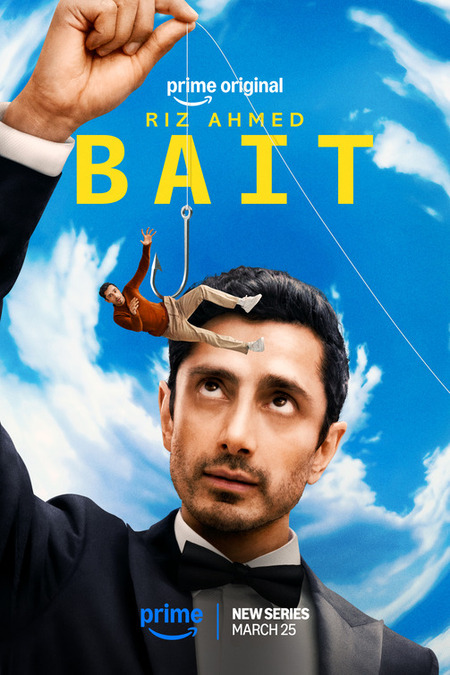
(courtesy IMP Awards)
If you have so much as stepped out of your house at any point in your life, and the odds are good you have, you will have definitely come into contact with the socially toxic tendrils of a narcissist.
You know the type – people who overwhelm a room when they enter it, all braggadocio and swagger, every action, every utterance, timed to make them look good, to advance their interests and to draw the centre of gravity in any situation back to them.
They aren’t always unlikable; in fact, many of them have such palpable charisma and temporary likeability (and it’s “temporary” that’s key here) that it’s easy to get taken in by them at first.
But as Bait, the creative streaming child of celebrated, Bafta and Oscar-winning British actor Riz Ahmed, makes hilariously but often poignantly and brashly clear, that magic spell of charismatic dominance all too often gives away to the ugly selfishness that lies within and those drawn like moths to a self-reinforcing flame are the ones who get burnt.
Of course, the narcissists are fairing too well either and are often undone by their own actions but so skilled and practiced are they at distorting reality and skewing things in their transient favour, that they look as if they have emerged unscathed from the hell of their own making.
On paper at least, Shah Latif (Riz Ahmed) has all this dreams coming true.
He is the apple of his mother Tahira’s (Sheeba Chaddha who owns every scene she is in) and manages to charm his father Parvez (Sajid Hasan) enough to get by and with the life-long backing of his cousin Zulfi (Guz Khan), who has been raised as Shah’s sibling along with Guz’s sister Q (Aasiya Shah), he has enough protective self belief to have gone from rapper to an actor who is now a serious contender to be the next James Bond.
He has the world at his feet.
But when his initial audition for the part of Bond goes south, due mainly to panic attacks which rob him of his lines and the thespian bravado needed to make such an iconic part work, Shah spirals into an ever tightening and unhinged vortex of doubt and past trauma that rise up to meet him, it seems at every turn.
Bait reflects, semi-autobiographically at least, Ahmed’s own life with the actor reportedly up for the role of Bond in 2016 but as the actor explained in a piece on NPR, what the series tackles is actually far more personal, something the actor says is common to all of us.
[Showrunner Ben Karlin and I] felt, early on in the show, you needed to see just how mean Shah’s inner voice can be about him,” Ahmed says. “I think actually there’s a lot of Shah in all of us, more than we like to admit. … The gap between that public self and the messy vulnerability of our private selves is often huge.
The show, which takes its title from a word that has multiple meanings with the British context referring to attention-seeking and obvious self-promotion and also online trolling, while in Arabic and Urdu it means “home” and “loyalty” respectively, explores the yawning gulf between who we present ourselves as and who we are in private in ways that graphically illustrate how deep the divide can be.
Shah may present as a man who has it all in hand, and who, thanks to his narcissistic self belief believes he knows better than his agent or his loving, rambunctiously dysfunctionally close British Muslim family, but in truth, he is close to falling apart, something that happens rather spectacularly when he begins to doubt he can realise his ambition.
Key to the high watchability of Bait which hilariously funny and terrifyingly dark, sometimes in the same scene, its narrative and emotional dexterity a thing of raw and dazzling beauty much of the time, is that while Shah pretty much loses it and leaves a trail of familial and social destruction in his wake, with his career, such as it is, hanging perilously in the balance, he is relatably, honestly and, contrary to what you might expect, likably human.
It’s Ahmed’s honesty about the human condition, that the public persona and the inner self rarely find harmonious accommodation with itself, that really makes Bait sing.
While it more than ably tackles themes of representation and implicit racism inherent in a Britain that still tries to stand tall on its colonial heritage, where Bait really flies is when it drills deep down into what makes us human and why we often act upon our own interests even when we think we are advancing them.
While the events of the show do spiral into surreality at times, especially when Shah has a breakdown a longtime in the making and ends up do caustically nasty self-therapy to a pig’s head – all will be explained in the show which makes liberal and humourously but bitingly use of a number of celebrities including Patrick Stewart as the accusatory voice of said pig – it is, in the end a show about coming to the end of yourself and hoping and praying there is, in fact, something there.
Shah thinks he has cause to wonder about whether anything of value lies at the end of the very demented rainbow of professional promise he runs down over six arrestingly good, near-pitch perfect 25-minute episodes, and it’s his massive, very public self doubt, lived out over social media and some very awkwardly difficult filmed moments, that forms the beating heart of Bait.
Whatever your level of self belief, Bait has a lot to say on a great many things – it doesn’t execute flawlessly on all of them but it’s fantastic to see the show give it shot – and chief among them is how we navigate what it means to be human, how we often falls into the acidly nasty gulf between public and private selves, and how epiphanies, however they come to you, need to be heeded if life is to ever realise the potential we all believe and hope it holds.
Bait streams on Prime Video.