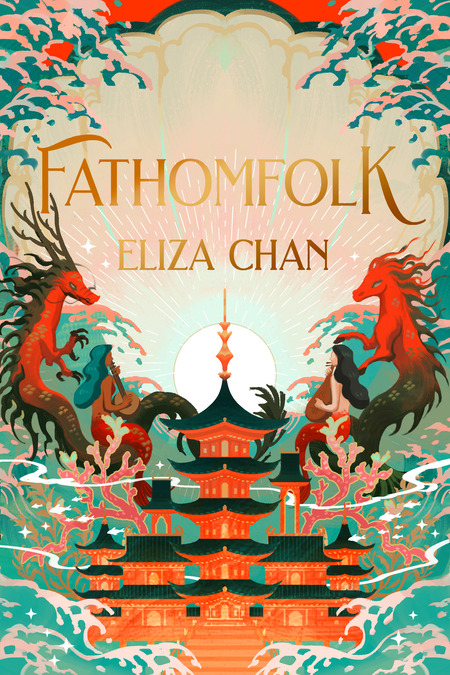
(courtesy Hachette Australia)
Imagination is the power source behind any great fantasy novel but as anyone who has read many books in the genre will attest, not all imaginative minds are created equal.
Having just finished the gloriously clever storytelling that is Fathomfolk by Eliza Chan, it is well and truly safe to say that the imagination firing up the narrative-spinning neurons of the author’s mind are among the very best out there.
Fathomfolk is, by any measure, one of the most fantastically enthralling works this reviewer has read in some time, a book so good that before I was even halfway through, I stopped into my favourite bookstore in Sydney and picked up the just-released sequel, Tideborn.
That’s the reader equivalent of commissioning further seasons of a TV show before the first has finished its run, and its testament to how ingeniously imaginative the novel is, and how awe-inspiringly good its world-building, character development and narrative momentum are.
There is honestly nothing to fault here, and much of the pleasure of reading this seriously thoughtful novel is how well it brings so many players and issues and storyline elements into play without putting one foot, or flipper, wrong.
And that takes some seriously talent; it’s all too easy in a story this blockbuster-level impressive to have things get sidelined or missed but Chan keeps all her balls in the air with admirable dexterity, the story at once deeply moving and “human” (loosely used given how many of the characters are not) and yet full to the brim with mesmerisingly thrilling action and intrigue.
Was that a threat? A warning? Her throat tightened a little, making it difficult to swallow. Her overreactive imagination was seeing menace where perhaps there was only a gauche kumiho puffing himself up. Regardless, she wished she’d punched him in his smug little face.
Fathomfolk is set in the city of Tiankawi, a semi-submerged city in Asia, or at least this reality’s version of the continent, where humans and the titular fathomfolk of kelpies, sirens, seawitches, dugongs, sea dragons and kappas to name just some of the many underwater folk name-checked, all live together.
If you were expecting that sentence to finish with “… in perfect harmony”, a Disneyified tale of different worlds slotting together like expertly assembled social IKEA, then think again, because Fathomfolk takes a deep dive, and quite literally for many of the characters, into a world where racism and brutalistic bigotry rule the lives of many of the people.
The humans, by and large, rich and poor, detest the fathomfolk, almost all of whom live on the impoverished margins of society where the police and border guards treat them as an annoyance at best and a malignant scourge at worst.
The waters they swim in when they can are polluted and have lost much of the verdant liveliness that once made them astonishingly beautiful places in which to live, and they are forced to live up in Tiankawi itself, a place with steampunk majesty and verve but which functions only because it exploits and uses in the cruellest ways people already dispossessed of their aquatic homes and in many cases the vibrant cultures they gave rise to and sustained for millennia.

(courtesy official author site)
In this brewing toxically social brew, lives Mira, a half-human, half-siren chief of police, a woman of great integrity and honesty who has made the greatest of sacrifices (to reveal what it is is impossible without a major excursion into spoiler territory) to look after her mother Trish, and who is in a relationship with Kai, a sea dragon who is the ambassador from the one of the underwater realms, Yonakuni.
Theirs is a deeply loving and mutually supportive relationship, even if other more cynically ambitious players see it as a way for Mira to climb a social ladder she has no right to be on in the first place, and one that sustains Mira as she daily faces challenges to her power from human power players, among them the politically ambitious human Serena who has spent a great deal of time and effort engineering her husband to almost the very stop of the political food chain in Tiankawi.
Serena, who holds a gigantically enthralling secret of her own, is a force to be reckoned with but like Mira she is also someone who is proof that while the system might grudgingly accept you because it’s convenient, it can, just as easily, toss you aside.
Given their places in the upper echelons of power they are constantly banging up against each other, a dynamic that only amps in speed and impact when Kai’s sister, Nami, is sent to the city on a mission from her mother who is eager to avoid scandal at home because of her daughter’s proclivity for criminally inclined social action.
The sky groaned. The noise thrummed through Cordelia’s body, turning her skin markings into black and white flashing waves. Kai said something else, but his voice was lost in the noise, the rainwater sliding down her forehead and blurring her vision.
Nami’s arrival into Tiankawi doesn’t set off the flashpoint between fathomfolk revolutionaries and the established order, but it does throw into graphic relief for many of the characters how many lies they have told themselves to live in a city where inequality isn’t just entrenched, it’s poisonously, endlessly cruelly oppressive.
Delving thoughtfully and with rich humanity into saliently current issues such as migration, refugees, multicultural integration, environmental degradation and grindingly nasty social inequality, Fathomfolk does what any great fantasy novel should do and shines a wholly unflattering light on the cancerous darkness at the heart of almost all societies.
While Tiankawi on paper sounds like a magical Little Mermaid idyll, the truth is far from that, and the novel expends a great deal of worthwhile and deftly executed time exposing how far from the cosy ideal the city is and how all this inequality is leading to a violent showdown that will serve no one well.
Luxuriously realised, poignantly honest and full of as much love and community as it is violence and depravity, Fathomfolk is a superbly brilliant debut, a novel that takes on a huge amount of intensely thoughtful social commentary while allowing itself to be gorgeously and immersively imaginative in ways that will take your breath away, no matter how much fantasy books you might have read.
As nuanced as it is blockbuster big, Fathomfolk is one of those novels that make you glad you read, scratching with cleverness, and knack for great characters and perfectly pitched storytelling, that reading itch you never knew you had, and delivering one of the best fantasy novels to come along in quite some time.