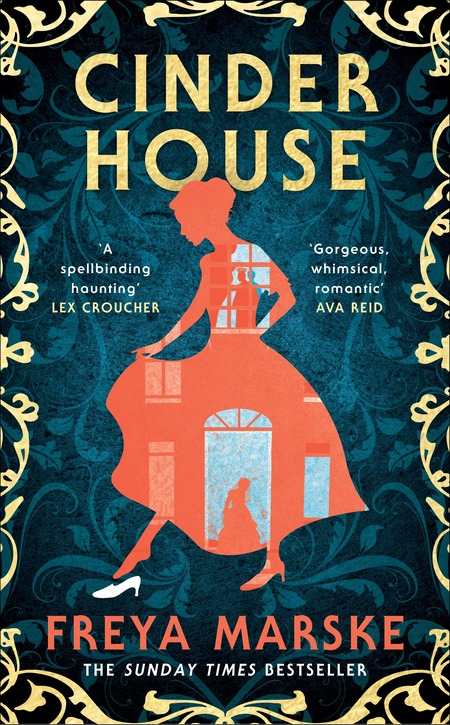
(courtesy Pan Macmillan Australia)
Retellings of classic tales are often quite illuminating, revealing aspects of the original story that simply didn’t register because of the familiarity attached to their ubiquitous status.
We become so used to the beats and tropes of the story, to the well-known elements that define it, and in our Disneyfied age, to adaptations of the story, that all the vitality and yes, even shock, because many of those old fairytales do not stint on the brutality of humanity and its capacity for bad as much as good, is lost, becoming almost a comfort rather than a sage lesson.
The beauty then of a masterful retelling, and that is certainly true of Cinder House by Freya Marske, is that it strips away all of the accumulated dulling of narrative impact and revives the story, the newly added parts of the story revealing elements of the fairytale long lost to time.
And all of it happens in just 130 pages or so of a novella that packs a huge amount of storytelling punch into an elegantly thin spread of beautifully written pages.
It’s impressive work, with expansive world-building, fully-formed characterisation, loss, gains, hopes and dreams and bestial cruelty and transformative friendship and kindness all finding a well-told place in Cinder House which sings with the songs of the worst and better angels of our nature alike.
To read this novella is to feel what the original story of Cinderella must have really felt like to a first-time listener.
So Ella existed, if not lived, and let words expand her world when no amount of magic seemed likely to do so. And for a while that was enough.
No. Not enough. But something.
The brilliance is that Marske manages to includes all of the elements with which we are familiar without once feeling like she’s simply ticking some very reader-expectant boxes.
You get the poor downtrodden stepchild at the mercy of a cruel stepmother and narcissistic stepsisters, the ball and the prince, the shoes and the fairy and the chance of a life changed forever.
But while Cinder House has all the parts of the story that will ring true and clear with just about anyone, it goes further, so much further, bringing real, vibrant humanity back into play, with all of these well-worn elements re-attaining a vibrancy that repeated tellings have dulled to a repetitive unmoving shine.
Ella, she is now known, comes alive with a poignancy and a life lust that will make you fall in love in a way you never thought you could with this over-familiar protagonist.
What might stop you in your tracks at first, but in all the right ways, is that Ella is a ghost, murdered at sixteen and tied for all time it seems to her dead father’s house which possesses a magic all its own; Ella can’t move beyond its boundaries and any changes to the house affect her deeply, something her stepsisters and stepmother soon cotton onto and cruelly use for their own purposes.
Ella is the house and the house is Ella and the poor benighted girl soon resigns herself to being nothing more than a spectral servant to her rapaciously ambitious step family.

(courtesy Pan Macmillan)
Then something magical happens; well, actually a lot of magical things in fact, including the ability to leave the boundaries of the house and see the world – suddenly, the long-sheltered and very dead Ella can see ballet and theatre and restaurants and soak herself in the noisy, alluring cacophony of life.
Though she grieves not being able to partake in it all to some degree, she is grateful that even though the people around her can’t see her that she can see them, and that in some limited way at least, she is part of the world.
There are limits including the house drawing her back into itself at midnight without fail, but it’s a small price to pay for freedom and life, especially after a day spent slaving away for her ungratefully malevolent family.
A meeting with a fairy charm-seller takes Cinder House to the ball that we know so well but while Ella comes alive, literally as she is able to seen, to eat, to talk with others and to meet Prince Jule who is looking for a wife from among the ladies of the kingdom, this is not the ball you know well.
It is so very much better, far more vibrantly alive that any telling of Cinderella has ever conveyed, and ripe with a nuanced love of life, of love, of community and of what it means to be connected to the pulsing, thrilling rhythm of a world of possibilities and hope.
Ella made eye contact with Greta, whose mouth was open in the start of something, and then the pull of the house turned to the snap of elastic and Ella was gone.
Quite how this lusciously hopeful story ends but suffice to say humanity and magic doing a reviving dance that utterly transforms Ella’s world, and while it shares some heartbeats with the original tale, it has so much newness and life to it that you will be thrilled by it in ways the fairytale has long lost the ability to impart.
Reading Cinder House is to have a story reborn, a character revived, rather spectacularly and yet intimately and beautifully, and to feel what it’s like to have life literally ripped out from under you, to have your afterlife corrupted and controlled and to finally find a way forward when friendship and community and justice finally have a place in your life after death.
It’s a profoundly special story that will have your heart singing, not least because of the tenacity and intelligence and hope of Ella who sparkles with life and whose battle to make something of her life after life will inspire anyone who has ever felt the world is against them.
Ella is no passive protagonist, and while she has much arrayed against her, she is made of strong, enduring stuff and it’s this inner steel of character and her love and lust for life in the face of impossible odds that will make Cinder House really come alive for you.
Cinder House is a novella retelling that warms the heart, sorrows the soul and dances between what is forever lost and what might be forever found, and it will stay in your heart long after you turn the last page, a story where happy endings are still possible long after the darkness of death has descended and where you can still find your people and your home even when it seems like they are gone forever.