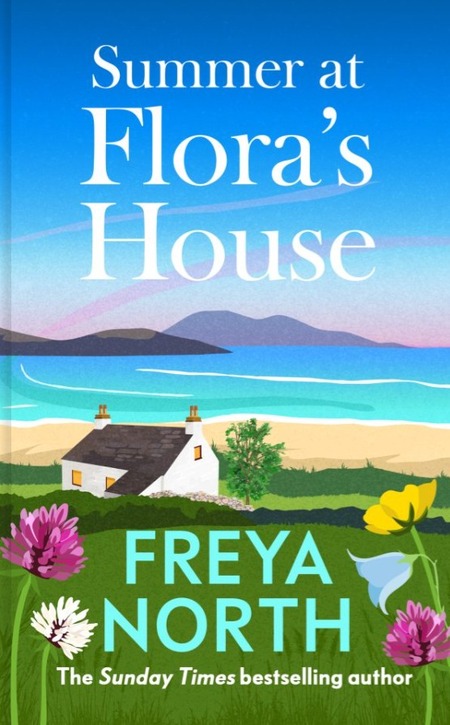
(courtesy official author site)
There is something so deeply, soul-caressingly soothing about the Flora’s House series of novellas by gifted author Freya North.
Each perfectly-pitched instalment including Christmas at Flora’s House and Spring at Flora’s House, and which now includes Summer at Flora’s House – the final book, Autumn at Flora’s House, is due to be published in October this year – do a calmingly evocative job of taking us into the wild beauty and close-knit community vibes of Harris, the southern and more mountainous part of Lewis and Harris, the largest island in the Outer Hebrides of Scotland.
It is a wild and remote place perched on “the edge of the Atlantic”, and so far in the series it has been a place where harried and lost souls, caught in the endless pell-mell of modern life, can finally take a breath and deal with pressing issues in their life.
That’s often not their intention, at least consciously when get off the ferry to the island, but soon enough the quiet atmosphere of the place, and its startlingly arresting beauty slows them right down, physically and emotionally, and they are able to take a deep look inside at what really ails them and maybe, just maybe, what they need to do fix it.
Or begin to fix it, anyway.
This is very much what happens to burnt out corporate refugee Liza, who takes much needed time off work to holiday in Harris at Flora’s House and to paint the small, delicate wildflowers and plants that carpet it.
I sit down and hug my knees and I look at everything, trying so hard to absorb it all in my brain but soon enough I’m not focusing on anything. I’m simply content to be in this moment. I sense Jamie sitting nearby and I experience a novel sensation of sharing peace, quiet and awe.
Burdened by familial expectation and the driven sense of professional ambition that it’s given rise to, Liza is desperate to shed the workaday life she has left behind, albeit temporarily, and simple be alone with her art, cooking what she wants and sleeping for as long as her body needs it.
She is desperately in need of a complete change of pace, and though she arrives feeling frazzled and highly charged, treating her vacation with the same intensity she does her career, which leaves little time for fun, relaxation and other life pursuits, she soon finds herself slowing down and appreciating the stunning beauty of a landscape full of wide sweeping, sugar-fine beaches and “the famous machair bursting with wildflowers”.
She is joined on the island, though the two do not meet in the best of circumstances, by Jamie, a gifted landscape photographer, for whom Harris has long been a refuge.
Sent there for six weeks each summer when he was a child by an abusive stepfather and a clearly unengaged mother, Jamie has always found the island to be a sanctuary, a quietly verdant place where he can lose himself in the rugged beautiful landscape and in the long-held relationships with its people including his treasured aunt.
He is keen to keep Harris to himself and to spend his time there doing the quietly nourishing things that have always brought him solace, but then he meets Liza, and while they clash at first, it becomes clear to them both, though they are loathe to admit it at first, that they are two lost souls meant for each other.

(courtesy official author site)
What is remarkable about all of North’s Flora’s House series but especially Summer at Flora’s House, is how so much happens in the quiet moments many of us would think have no real impact of meaning.
As someone who has found real peace and solace holidaying in the Australian bush at a lovely wooden cabin with no internet and plenty of birds and trees, I can readily identify with how the delicate push-and-pull of small town community life and the unhurried rhythms of the natural world can soothe a breaking soul.
Both times when I lost my parents three and a half years apart, places in Australia like Harris helped me heal, and that is very much what happens for Liza and Jamie, separately and then together, as they discover that questioning their current place in life and the attitudes and accommodations that underpin it, is something that they need to do if their lives are to have any real meaning beyond their brief sojourns on Harris.
North takes her time setting up who Liza and Jamie are, what they are effectively running from, and what it is they need to walk to, and along with her evocatively meditative descriptions of people and place, brought alive with a poetically thoughtful sense that there is time to tell the tale even in a novella of 124 pages, she infuses Summer at Flora’s House with a calming feeling of life being reassessed and lines redrawn.
I stand and pad around this little cottage, trailing my fingertips over wood and wall, hard surfaces and soft, the warm and the cool. My senses are alert. I press myself close to the old stone and I lay my cheek against it. Everything fits into place. It strikes me that you don’t need to be kissed by someone to know, without a doubt, that in their mind they’ve kissed you. I give a sudden laugh into the stillness of the room and I say out loud I know you Jamie, I know you.
Roughly alternating chapters between Jamie and Liza, North takes us on a warmly poignant and heartwarmingly grounded through the darkness and light that fills the lives of people like Liza and Jamie who comes to understand they need far more of the latter and far less of the former.
Refreshingly, North doesn’t pretend that these kinds of epiphanies immediately change the course of a person’s life.
It is clear, of course, that allowing yourself to drop the harried, stressed baggage of everyday life is far easier in a place where the natural world and a slower pace of life are impossible to deny, and certainly Jamie and Liza both slowly discover that that is exactly what they want to do, but while they own the truth of what they want at their heart of hearts, the steps to realising those truths is far more gradual.
In fact, by the end of Summer at Flora’s House while all the indications are that the two have not only made a peace with who they are at their very essence, but need each other in ways neither thought possible or doable, North is comfortable with leaving the narrative indicating what might happen rather than guaranteeing it will.
It is a calmly joyous and richly meditative read in which while a LOT goes on, the big shifts in heart and soul are disguised in the poetically thoughtful pace of the storyline, and while the focus is clearly on Jamie and Liza, Summer at Flora’s House is a perfect balm for the frenzied soul of readers too and you can’t help but reach the end of this perfectly told novella feeling like you, like the protagonists, might finally get a chance to catch your breath too.