(courtesy IMP Awards)
While time has moved on for this reviewer in many emphatically life-altering ways, one thing that hasn’t changed is the boisterous love my inner-five-year-old has for dinosaurs.
Like many millions, likely billions of people across the globe, I am as fascinated by these prehistoric creatures now as I was when I was a child, and so, the idea that another TV/streaming series was in the offing was a source of high anticipatory excitement.
To be honest though, and this likely had more to do with my stressed-out brain on the day – tiredness and stress do not make for objective, or even reasonably subjective, opinion forming – I spent the first few minutes of the Morgan Freeman-narrated four-part series, The Dinosaurs (prosaic naming maybe, but you know up front what you’re getting!) wondering if we really need another nature documentary style series so soon after gems like Prehistoric Planet, which relatively recently released its third season.
Treasonous thoughts perhaps for a veteran dino lover but banished fairly rapidly by a series which decided to take a long-term view of the dinosaurs’ rise and fall, and by long-term, they definitely mean long-term, kicking off at 235 million years ago during the Triassic Period when a single continent barren continent named Pangea shaped all life on the planet.
Here we meet rhynchosaurs (Hyperodapedon), Tanystropheus, Luperosuchus and Marasuchus, who are reptiles and not strictly speaking dinosaurs at all; they are usually given short shrift, if they are mentioned at all, and it’s easy to assume that all reptiles are dinosaurs and vice versa.
This is just one example of the revelatory nature of The Dinosaurs which serves up a long-range timeline of the terrible lizards and does it so deeply and extravagantly that even if you are a lifelong reader and watcher of all things dinosauric, you will still find things to impress and startle you.
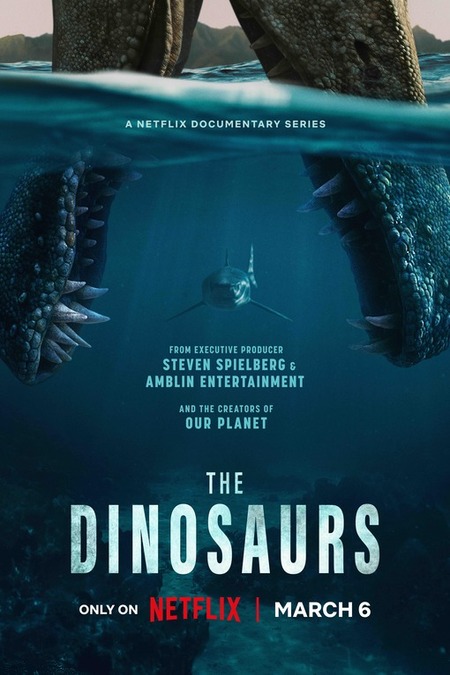
Take for example the way in which, during the Cretaceous period about 125 million years ago, Spinosaurus dinosaurs, which have made their presence felt in a number of the Jurassic Park and World movies including 2025’s Jurassic World: Rebirth, used to go out and hunt sharks by lying in wait and pretending to be part of the underwater landscape.
Or how Allosaurus, roaming 153 million years ago in the Jurassic Period, used to fight while hunting for Stegosaurus, arguably one of the most famous dinosaurs out there.
This raises one other admirably point of difference for The Dinosaurs.
While it does of course feature the most famous dinosaur of all, Tyrannosaurus Rex, focusing in on the maternal aspects of a predator known more for its hunting than its nurturing, they are far from the main game in town, with the series spending far more time on lesser known species like the armour-headed Pachycephalosaurus or the vast diversity of the sauropods, giants with massive bodies and long, massively high necks.
It’s this willingness to give lesser known species a well-deserved and fascinating place in the spotlight, and to take the time to set them in the timeline of the rise and fall of the dinosaurs that really sets The Dinosaurs apart and makes it compelling viewing from just about every angle.
The series explains how at the very start of the rise of the dinosaurs, their meteoric and long-dominant domination of life on earth was by no means assured with many emergent dinosaur species competing for space with the much bigger ancient reptiles which ruled the roost at that point.
That in itself is a revelatory punctuation point – so dominant were dinosaurs for almost 170 million years that you simply assume their rise to being the most memorable group of animals to ever beat the odds on planet earth and defy endless extinction events (until, of course, they didn’t) was pretty much for a foregone conclusion.
They had advantages of course such as the development of feathers which enabled them to survive the kind of cold which hobbled the then-far more dominant ancient reptiles (one thing that emerges again and again is how rapid environmental change on a still geographically developing planet ended so much life while other creatures a leg up to flourish).
While the events of 66 million years ago when an infamous asteroid hit earth off the coast of Mexico and ended the dinosaurs’ reign in catastrophically emphatic fashion understandable capture the public imagination, and dominate much of the discussion around dinosaurs, The Dinosaurs spends relatively little time here.
While the four-episode run is bookended with this narrative full stop for the dinosaurs, it allocates far more of its lavishly delivered time on telling us how things began and what happened before it all ended.
And that, really, is likely the most refreshing part of the whole undertaking.
While you can’t help but watch on in fascinated horror as Morgan Freeman details how the asteroid’s arrival destroyed life on earth at the time – save for the smaller dinosaurs, which became the birds we know today, and the mammals who survived quite nicely, thank you very much – and how species like fearsomely armoured species like Ankylosaurus, Pachycephalosaurus and Triceratops and their chief predator T-rex met their earthquake and fire ravaged end, what is even more compelling is how the dinosaurs got to such a point of dominance in the first place.
Despite a long-held assumption that dinosaurs were in terminal decline by 66 million years ago, and that the asteroid simply hastened the inevitable, recent evidence suggests they were as healthily on top of the chain of life as ever, and that their rise to this enviable position had given them the evolutionary smarts to dominate for a good while longer.
Whether they would have done that is a point of pure conjecture, but what is not in doubt, thanks to the meticulously arresting dominance of The Dinosaurs, is that the terrible lizards we know and love were an evolutionary force to be reckoned with, their rise and fall a thing of impressive achievement which this remarkable does justice to in ways that no documentary series has ever achieved before.
The Dinosaurs streams on Netflix.