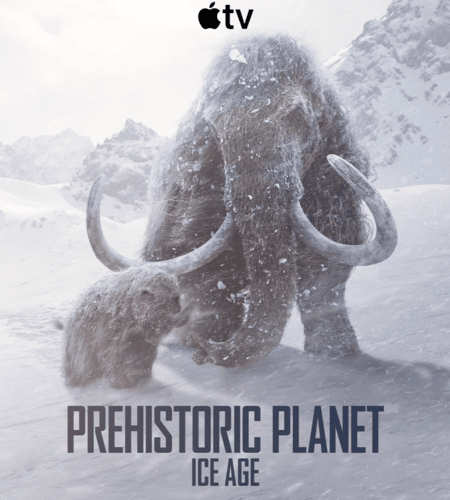
(courtesy AppleTV)
Losing yourself in a documentary is one of life’s great, often unsung, pleasures.
If they’re done well, and many are, they are gateways to magical places of knowledge and experience, a chance to find yourself somewhere you’ve never been or to get lost in the rapture and wonder of discovering places and times you are otherwise would never be familiar with.
Case very much in point is Prehistoric Planet: Ice Age, the third season of a series which, in the footsteps of Walking With Dinosaurs, uses the magic of CGI to bring a time and a place to life in ways that would otherwise, quite naturally, be impossible.
The genius of Prehistoric Planet: Ice Age‘s approach is that it acts as if we are witnessing life alive and kicking now; it’s not of course, and the documentary doesn’t pretend otherwise, referencing timeframes in the millions and hundreds of thousands of years, but so real are the depictions of cave bears and hyenas, woolly mammoths and sabre-toothed cats that you feel as if they are inhabiting the here and how.
In some cases, that’s a very good thing.
So huge were some of the megafauna such as the The Giant Short-Faced Bear or Gigantopithecus, a towering species of prehistoric gorilla that people were dwarfed by them well and truly. (Even so, as the final episode of the series “The Big Melt” makes soberingly clear, once humanity, the greatest predator of all, got going, not even these mighty animals stood a chance with many driven to extinction under our watch.)
But safe in front of our screens, and with these animals countless millennia in the past, we can sit back and enjoy watching the great eternal struggle between predator and prey, but this time with supersized animals who dominated the landscapes in which they lived.
Fascinatingly, if you think the Ice Age, or ice ages really with a wave of something like eight of them coming and going and disrupting the ebb and flow of forest and grasslands and desert in ways that made it hard to survive for many animals, were just all about the ice, then think again.
What Prehistoric Planet: Ice Age reveals in episodes two and three, “New Lands” and “Deserts”, is that with so much water tied in massive glaciers that covered most of the northern hemisphere, there was precious little left over down south with regions like Australia losing their forests to ever-increasing deserts.
For someone like this reviewer who devours prehistory, this was a revelation, one which, when you stop and think about it makes perfect sense; there’s only so much water to go around and if lots of it ends up in one environment, then others will inevitably have to change and adapt.
Quite how this push-and-pull of water affected the world’s various environments over millions of years was enthralling, with Prehistoric Planet: Ice Age patiently and thoughtfully taking viewers through the rise and fall of forests, of grasslands and deserts and letting you luxuriate in all the various lifeforms from giant armadillos (Glyptotherium) to hairy rhinos (Elasmotherium) to elephant birds (Aepyornis) who lived through this extraordinary time in the Earth’s long and wildly varied history.
Brought to life by cutting edge and an eschewing of the current bombastic trend in documentaries to overdo narration and action when facts can rather impressively speak for themselves without the need for shouty tabloid-y augmentation, Prehistoric Planet: Ice Age is a quiet joy and a revelation, an excursion into a world long gone that nevertheless sheds a fascinating spotlight on our own time by reminding us how resilient and endlessly alive and expansive life can be.
Prehistoric Planet: Ice Age streams on AppleTV.
Another wonderful clip …