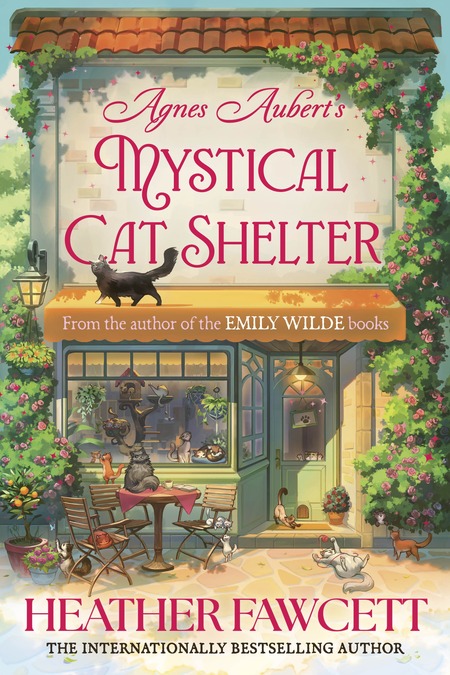
(courtesy Hachette Australia)
The Emily Wilde trilogy by Heather Fawcett – read my reviews of Emily Wilde’s Encyclopaedia of Faeries, Emily Wilde’s Map of the Otherlands and Emily Wilde’s Compendium of Lost Tales – are a delight to read.
Not only do they offer vividly imaginative escapism and an original steampunk-influenced sense of distinct time and place, but they are also gritty and human, offering battles not only between good and evil characters but within the characters themselves who must best their own inner demons at the same time as they are pushing up the better angels of their nature.
They are clever, rich and highly rewarding reads on all kinds of levels, and the good news is that Agnes Aubert’s Mystical Cat Shelter is very much in that camp, a novel which takes us to an indeterminate, magic-filled time period that seems to be later than the nineteenth century but only just and which delivers up a forthright eponymous protagonist who is strong and capable, sassy and smart.
And also gloriously, happily fallible; Fawcett writes strong female characters particularly but she’s also mindful that even the strongest of characters have feet of clay and the judicious employing of these fallibilities adds so much richness and depth to her lead characters.
The even better news is that Agnes is also intensely, delightfully likeable, someone who has committed her time and money to rescuing cats of the streets of Montreal and giving them a new home, no matter what the naysayers may think.
He watched me, his gaze full of suppressed but perfectly transparent eagerness, and I gazed back, at a loss. The place was perfect, yes–terribly, ominously perfect, and my every instinct told me to thank Yannick politely, walk out of the shop, and never return. I felt as if were being drawn towards something dark and inexorable, like a leaf nearing a cataract.
As you turn the first page of Agnes Aubert’s Mystical Cat Shelter, Agnes is facing a very real and existential threat to her continuing mission.
Her rented premises and lodging have been heavily damaged by a fight between magicians – the world-building is immaculately evocative with magic an accepted if often disliked part of the city that Agnes and her devoted and grounding sister Élise inhabit – and she needs a new place to call home for her and her cats before the cold has anymore of a deleterious effect.
After inspecting a good many premises, which are deemed unsuitable for one reason or another, Agnes finds a shop in an upmarket district which is not only perfect for her needs but suspiciously cheap.
Is there some catch underlying a deal that seems too good to be true?
It turns out there is, of course, with a grief-stricken Agnes, still mourning the loss of her beloved husband to an unspecified disease, discovering that the shop, still strewn with the luxury clothes and baking oven of previous, hastily-departed tenants, belongs to the most infamous dark magician of all – Havelock Renard.
His workspace and home are located in a multi-level cellar beneath the shop, attracting all kinds of strange characters who aren’t there to adopt cats, and his angry sister Valérie who seems to have a beef with her brother who is aptly described on the backcover blurb as “self-absorbed and infuriatingly handsome”.

So, yes, dear readers, there is also a fun romcom element at work in Agnes Aubert’s Mystical Cat Shelter.
But like everything else in this masterfully written novel where good and evil are not evil remotely what they seem including Renard who turns out to be more a creation of gossipy myth and legend than an actually terrible magician.
That’s not to say he isn’t immensely powerful and there is more than one moment when his gifts, sourced from a mysterious magical realm, come to Agnes’ rescue in quite selfless ways that indicate Renard is not the person he is often said to be.
What really makes Agnes Aubert’s Mystical Cat Shelter fun is that while many people, in fact just about everyone is terrified of Renard’s sort of-deserved but not really reputation, Agnes is not the least bit fazed by him, and while she may find herself flummoxed and thrown at times, that often has more to do with the fact that she finds herself liking him more than she cares to admit.
The sizzle and tension between these two compelling and hugely enjoyable characters adds so much energy to the novel, and affords the story the chance to illustrate over and over that we are always better getting to know someone as they really are rather than accepting what is said about them as gospel.
Certainly Agnes’ fearlessness, driven as much by necessity as personality, lights up much of the dialogue but as noted, Fawcett also gives her moments of vulnerability and concern, leavening out her character with real, narrative-enhancing humanity.
‘You shouldn’t be here when I return,’ he said at last. ‘I don’t know what state I’ll be in, given how deep I must go.’
I nodded, my heart thundering in my throat. I didn’t want him to leave. ‘Havelock.’ I said, but stopped myself there–it would only unsettle him further. ‘We’ll see each other again,’ I finished.
He gave me one last frown. The he stepped through the door and was gone.
If you are a cat lover, then there’s much to love there too.
The welfare of the cats in her charge matters greatly to Agnes – she works closely with a trusted vet to desex as much feral cats as she can and to capture and rehome those who can no longer live on the streets; she is also the “owner” (we know that’s a loose term when it comes to cats) of His Majesty, Banshee and Thoreau and the way Fawcett brings their personalities alive and weaves them into the story is a joy.
Agnes Aubert’s Mystical Cat Shelter is a novel that understands the world can be a dark place and life can be tough, but which also celebrates the fact that blood and found family, and by the end of the novel, there’s a wondrously good group of people supporting Agnes including, of course, Renard, can go a long way to mitigating the loss, grief and setbacks that the simple act of being alive can inflict on us.
It is a balm to the soul in many ways, not only because it offers vibrant and luminously happy escapism, connection and hope, but because it stares the very worst of things in the eye and dares them to overwhelm love, faith and family & friendship, once again, as many of Fawcett’s books have done, showing how powerful these things can be and how lives steeped in them will always triumph, no matter the forces arrayed against them.