(courtesy Hachette Australia)
Even though the books of Agatha Christie were my entry way into adult reading, thanks to the insightful thoughtfulness of father, an inveterate reader himself, I spent many years away from the crime genre for reasons I can’t fully explain.
My way back to the genre came courtesy of some gritty but beautifully human novels like Tipping Point by Australian author Dinuka McKenzie, among others, and it has continued with quirkily cosy crime books by a host of very talented writers including now, rather happily, British writer Fergus Craig.
The first question you might have when you encounter the cosy crime sub-genre is how on earth can something so terribly violent be even remotely part of a warm-and-fuzzy setting? Surely the two are inimical to each other?
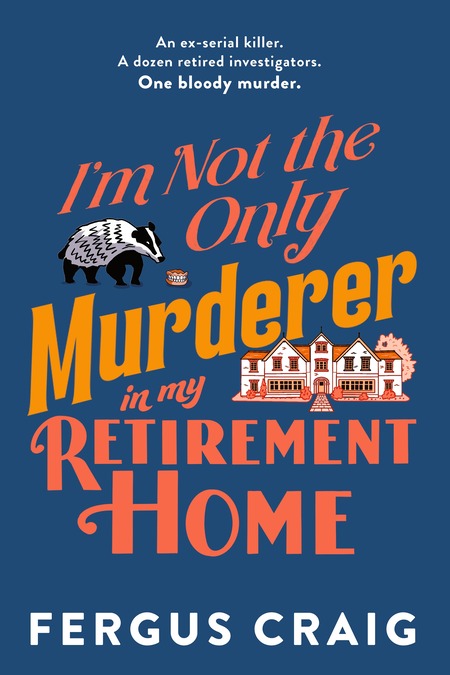
Strictly speaking yes but as novels like I’m Not the Only Murderer in My Retirement Home by Fergus Craig makes gloriously and happily clear, it’s the crime itself that feels cosy but the people around it, with the novels celebrating in a set of circumstances where dislocations and endings of the most horrific kind feature prominently, that it is possible to tell stories of connection and beginning.
And for those stories to actually feel like a hug, a reassuring pat on the back that life might be dauntingly overwhelmingly at times, especially when you are check-by-jowl with its brutally early finish, but there is a possibility for redemption and hope to feature prominently too.
Catherine raised her voice. ‘Please … what on earth are you both talking about?’
Margaret turned to Catherine. ‘Carol from baking is a convicted serial killer.’
One character who knows a thing or two about hanging onto hope in the face of a thousand reasons not to is Carol, the protagonist of I’m Not the Only Murderer in My Retirement Home who, as the novel starts is settling into her plush new home in a retirement community in Hampstead, London.
It is a new beginning for her on all kinds of levels but most notably because Carol is not your average retiree and her move into Sheldon Oaks – the name is the thing with these communities isn’t it? Reassuringly lovely but also comfortingly vague too – marks a fresh start for the ex-serial killer, newly released into the community after 35 exemplary years in prison.
The important thing to note here about Carol is that she presented as basically a good person; sure, she killed seven people that the legal system knows about, but each and every one of those people were a blight on the good name of humanity (does it have one? Current news would suggest not but for the purposes of this review, let’s say “yes”) and she simply took it into her able hands to dispatch of all of them and make the world, as she sees it, a little better.
However, as I’m Not the Only Murderer in My Retirement Home kicks into comedically inspired gear, and Carol relishes a life of cafe brunches and Friday baking catch-ups with friends, words leaks of her past and, let’s just say, it doesn’t go down well because people it seems are squeamish, if not downright afraid, of living with serial killers, even retired ones.
No sooner has Carol’s past come crashing unceremoniously and quite unwelcomingly into her present, causing ex-policeman Geoffrey who knows things and isn’t afraid to talk about them, ex-barrister and high-achieving UK Government minister Margaret and details oriented one time forensic pathologist Catherine to step way back out of Carol’s orbit, than someone is rather inconveniently murdered.
It’s devastating for Carol but even though it cuts her to the core, she is a capable woman of manifestly independent and talented means who knows that if she is going to get her friends back and remove herself from the top of the list of suspects at the home, that she’s going to have to get to the bottom of who is killing whom as quickly as she possibly can.
It’s all very grim and emotional on one level but Craig also has a great deal of fun with the setting, the events and the characters – how could someone dying at a retirement by means quite foul surrounded by residents who are all onetime professional high achievers and, ahem, a serial killer not be ripe for some deftly placed humour and amusing satire?
While some cosy crime novels can come across as little twee and try-hardy-y, I’m Not the Only Murderer in My Retirement Home manages to be both funny and heartfelt, charming and somewhat gritty as it casts a quietly damning eyes over the weird contrariness that is humanity.
A flash of lightning and the, a split second later, thunder. The heavens opened. The group headed indoors, none of them able to move quickly enough to avoid a soaking, and Carol was, in that moment at least, grateful not to be part of the gang.
In fact, much of I’m Not the Only Murderer in My Retirement Home does a smart, amusing job of skewering the way in which people define themselves by their jobs or chosen occupations like, yes, serial killing while acknowledging that maybe, quite possibly, that’s not the end of the story.
And that perhaps what you once were is not who you are now, and that it’s entirely possible that all you want to do now is settle back in a nice chair, watch some comfort chair and eat the cheesecake on the dessert menu so they keep making the wholly satisfying sweet treat.
You may not want to be embroiled in a murder investigation nor have your newly-minted social circle race away from you like you’re a flea carrying the Black Death but that’s how life, in all its idiosyncratic wonder goes at times, and if you’re Carol, and you likely aren’t, you just have to make the best of it.
And so Carol does, and while this review can’t even cover even a small part of the investigation lest spoilers and red herrings and unwarranted assumptions spill out like too many possessions in an overstuffed closet, it’s safe to say that I’m Not the Only Murderer in My Retirement Home is not only a cracker of a crime novel, with all the social commentary and intriguing mystery that usually comes along with these stories, but a lovely explorations of new beginnings (even in old age), hope renewed and the power of connection to make things better even in the face of life seeming to get much worse.