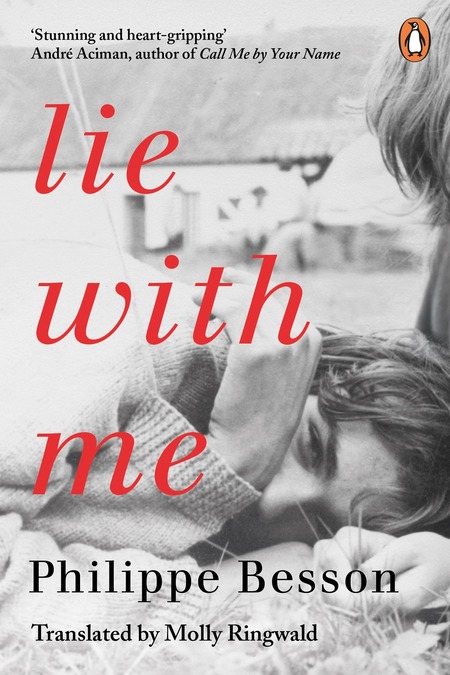
(courtesy Penguin Books Australia)
While it’s an immutable fact that we exist in the here and now, for better or worse, we are always living in the past to some extent.
It’s impossible not in many ways since who we were and what we did are intrinsically woven into the fabric of our being and are carried forward with each step into the present and future.
The key issue is not then whether the past is with us, because it inherently it is, but how we are going to live with it day by day, especially when we are dogged by considerable regret over some trauma in the past that occupies more than its agreed share of real estate in our heart and mind.
That’s the central dynamic at play in Philippe Besson’s emotionally resonant and beautifully, tightly told novella, Lie With Me (translated by Molly Ringwald) which takes us into the past of a French writer, Philippe, who finds himself thrown quickly and roughly back to a late teenage love affair when he spots someone who looks like the spitting image of his hidden high school lover Thomas.
He is at the height of his literary fame and in the middle of yet another interview with a journalist about his latest work, the answers flowing rote from him in a way that suggests a professional who knows what needs to be said and says it without even thinking or contemplating too deeply.
He [Thomas] hasn’t spotted me yet, still not having quite joined the party. He casually lights a cigarette, looks around, and is quickly joined by a couple of friends from his class I noticed earlier … Immediately it makes me think of the world I’m excluded from, the friendships he’s developed, all the ordinary days that have nothing to do with me … I’m from a world that is underground, unique and invisible. Ordinarily this would make me feel happy, but tonight it makes me feel like a fool.
This surface state of affairs is ripped asunder when Philippe sees the young man walk past him, and in an instant, he is taken back to a time when he was head-over-heels in lust with a local farm boy called Thomas who has to hide his homosexuality from a rural family who only see a commitment to the land, and the heteronormative marriage that always accompanies it, as the things that matter.
Philippe, born to intellectual and loving parents and the dux of his small country high school near Bordeaux in France, has no such constraints, born into a liberal and accepting, if demanding, family environment, and treated at school as aloof and not part of the schoolyard fabric in any meaningful way.
But as Phillipe grapples with his past racing unceremoniously up to meet his present at the start of Lie With Me, all of the struggles and great sadness of the past have to be reckoned with all over again, the present having to accommodate all kinds of thoughts and feelings of regret and loss that never really went away.
The identity of this young man who triggers this collision of the past and present must be left to the reading of Lie With Me but suffice to say, his presence is a profound one, reminding Philippe of a time when love towered high and impactfully over his life and when he came into his own as a young gay man who suddenly understood what it is to be loved and love back, however small the expression.

(courtesy Simon & Schuster)
The beauty of Lie With Me with me is that even though it is short in length, it allows itself the luxury of living intimately and deeply in what it is like to find your person, to connect with them on a level so profound that they never really leave your heart or are far from your thoughts, and to forever regret that they could journey with them away from your hometown.
That they will live separate lives is almost pre-ordained by Thomas who says to Philippe at the start that he is someone who leaves, who must leave – it’s rendered as an inescapable fact and even Philippe, deep down, knows that what Thomas quietly prophesises is going to come to pass – while Thomas is someone who, by dint of his upbringing and family must stay (though that has its own unexpected twists and turns as it turns out).
Through three distinct passages of time, we see the two young men fall deeply in love – Thomas may hold back but it emerges in small and vitally important ways that this connection matters as much to him as it does to Philippe – almost find each other again before life decides for them what their particular ending will be.
While that cannot be revealed lest Lie With Me loses the potency and impact of a heart-stopping final act, what is certain that what Philippe sees as a one-and-done deal is nothing of the sort for either men.
I think of all the men I met in bookstores, men who confided in me about having lied for years and years, before finally resolving to leave everything to start all over again (they will recognize themselves if they read these lines). Thomas never found their courage.
That is the beauty and the great sadness of Lie With Me.
Try as we might to move the past to somewhere manageable and liveable with, and as any decent therapist will tell you, that can be done to an extent where we can function in the present without the heavy shackles of what came before weighing us fatefully down, the reality is that the past never really leaves us.
It is always there, always easily summoned to the surface of the present and always a passenger to whatever and wherever the future may hold; that truth doesn’t strike Philippe completely until he sees the young man who is the spitting image of his onetime (and forever?) lover and it comes rushing back from a hiding place that Philippe likely assumed was buried far below but which was truthfully circling nanoseconds away from present reality.
Besson does an exemplary and quite moving job of allowing us to see and experience what it is like for his lead character to grapple with the sudden and quite unexpected intrusion of youthful passion and hope into a well settled and neatly circumscribed present and as Lie With Me progresses to its arrestingly emotional but nuanced and quietly expressed end (though no less impactful for that), we are given front row seats to how what was once vital and real can be exactly so again, finding a place many years later in the present and demanding that it be dealt in a way that will allow the future to be its own thing but never without the shadow of the past lingering somewhere near it.