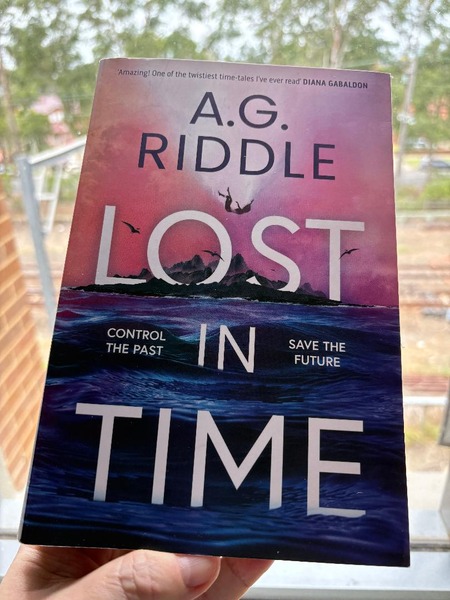
An escapee from the depth of this reviewer’s TBR – 2026 is supposed to be the year of the much-neglected reads though so far 13 new books have been bought so who knows who well this will go – Lost in Time by A. G. Riddle comes with a doozy of a premise.
Set in what feels like a slightly alternate timeline to the one we live and read in, the novel splits its time between the present day, where a form of time travel is allowing governments to send prisoners far away from current society (and save on prison costs, no doubt), and 201, 320, 641 BC where all of the continents of the world have fused into one landmass, Pangea, now populated by a cohort of prisoners who don’t survive long with some fairly late Paleozoic and early Mesozoic era dinosaurs to contend with.
As premises go, the one on which Lost in Time is so imaginatively audacious that diving into it feels like being guaranteed the mother of all escapist rides with some very cool timey-wimey adventuring and some multiversal fun to be had.
And to a large extent, Lost in Time delivers, serving up a story of wrong conviction, long-term justice and familial closeness that twists and turns like you wouldn’t believe and which subverts any and all narrative expectancy with zestfully gleeful intent.
The story centres around two people – quantum physicist Sam Anderson who is sent some 200 million years back into Earth’s past for a crime he didn’t commit, and his daughter Adeline who, in 2027 is grappling with who’s behind the murder that sent her father back time for what is a certain death sentence and who is working feverishly to bring him back, if she can, before he dies.
‘I fear that Nora was just the start. That they got rid of her for a reason we can’t see. And that the same thing is going to happen to others. Maybe you. Or Elliott. Or Adeline. When I’, gone, the killer will still be here.’
The first two-thirds of Lost in Time are split between Sam trying to survive hungry dinosaurs, other prisoners who have mentally not handled being alone in the far distant past all that well and the challenging conditions which make his survival unlikely (though, of course, you suspect he will pull through because it’s that kind of story), and Adeline trying to work out which of his colleagues and friends is really the perpetrator of the murderous crime that may have doomer her father.
So far, so reasonably straightforward with chapters alternating between Sam’s quest for survival and Adeline playing amateur industrial spy and mystery-solving sleuth where everyone, as you might expect, is the one whodunnit.
As storylines go, this is all pretty entertaining though you do get the sense that the story is a small “p” plot being spun into something far larger and bigger but not always with enough heft to deliver fully on the premise.
In many ways, Lost in Time could have been slimmed down with more action pumped into Sam’s desperate grasping for life in a period of Earth’s history where almost every living thing seems to want to end it, and more tension given over to Adeline trying to get to know her father’s colleagues better so she can work out who’s hiding what.

(courtesy official A. G. Riddle site)
For a book with a big massive premise, Lost in Time doesn’t always feel as big it should.
Sure, it’s cool being back on Pangea with Sam and the descriptions of prehistoric life and the environment in which they live are often vividly brought to life, making it feel as if you are reading some sort of Walking With Dinosaurs: The Prequel.
For all of Sam’s near misses and messy scrapes with death and starvation, there’s a certain fun to be had with having a person back in prehistoric jungles and deserts, and Riddle acquits himself well for the most part, even if Sam’s perilous situation doesn’t drag on a bit at the end and overstay its welcome slightly, almost as if it is narratively treading water until Adeline has got all her pieces in place.
Back in 2027, Adeline starts strongly, and certainly after one particularly emphatic and super clever narrative exclamation point which cannot be revealed because *spoilers*, you get the sense you are on a super adrenalised ride to something quite revelatory.
In that respect, Lost in Time definitely delivers with its second half well and truly going to town with a premise which knows there’s a lot of imaginative fun to be had with time travel which, because it doesn’t exist (or does it?), can manifest itself in a thousand very clever plotline twists and turns.
‘I hope that doesn’t change anything’, Constance said.
‘It doesn’t,’ Adeline whispered. ‘The past is the past.’
But she wondered if it did, if Constance’s secret was the piece she was looking for–if it somehow connected to Nora’s murder in a way she didn’t yet understand.
Rather curiously, for all of it swell executed dark mystery solving, prehistoric shenanigans and inter-personal diving and dashing, Lost in Time feels a little hollow.
Rationally, that shouldn’t be the case with quite a lot going on, all of which offer up escapist delights aplenty, and there are times when you ask yourself why it is you’re not reacting more substantially to some wondrously clever narrative elements and thrillingly OTT ideas.
In the end, while Lost in Time does have a lot of very cool parts to it and you are often swept along in action that pellmells with gusto and gumption, there’s not a lot left over at the end.
You are meant to feel horrified that Sam is in peril and Adeline is desperate to save him, and that after the death of her mother, she literally has no other family left besides her barely-used younger brother, but even when events transpire that should have you fearful for what’s going to happen to these two people, you still feel not much of anything.
It’s a case of all kinds of whizbang narrative elements that in and of themselves are brilliantly conceived and competently executed with a blockbuster bravura that engages you fully if superficially not really generating much of an emotional response, though you know they’re supposed to because Riddle keeps stressing how awful it all is, which for a story like Lost in Time to really stick the landing and leave an impact is a deficit that ultimately makes this hugely readable fun but without much of a soul of any kind.