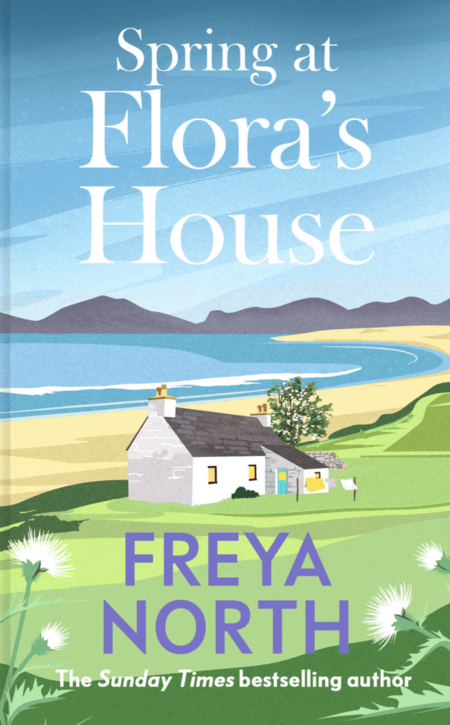
(courtesy official Freya North site)
Identity is a powerful driver for every person alive.
Not all of us may acknowledge it outright, but whether we emphatically embrace the dogma of a religion, the fervency of fandom of a football team or we live and breathe artistic expression in all its forms, we are seeking some sense of self, a hat upon which to hang our lives and give it well-defined and highly personal meaning.
While that isn’t immediately an obvious defining characteristic of the three young American men who arrive on the Isle of Harris, far up in the Outer Hebrides chain of islands off the coast of northwestern Scotland, it soon becomes clear that JB, Drew and most especially, Taylor, whose mum is from the island, are looking for some better defined sense of who they are.
In Spring at Flora’s House, the second book of her Flora’s House series (the first is Christmas at Flora’s House), Freya North takes us on an exceptionally thoughtful and meaningful journey as three young men, still in the invincible, often drunk magic of their early twenties, discover that the island on which they plan to run their own, highly specialised marathon, may have more to say on their lives beyond that point than they might ever have imagined.
Or perhaps at least one of them has with Taylor arriving on Harris with four pieces of the island’s iconic Harris Tweed and a whole lot of questions, many of them related to why his mother fled her home when she was 16 and never looked back.
Taylor recalled his mother saying that she’d felt her childhood homeland was floating, floating all the time. He tuned in to being on an island flung out in the ocean but it all felt rock steady to him; anchored. Sometimes he could be in the most familiar of places and wonder quite where he was. But not today.
I am here. I am here.
The islanders, including many of the characters we meet in the first book – one of the things that’s really lovely about a series such as this, is reuniting with distinctive characters who feel like friends – would not necessarily think there is a such a life-defining mission in mind when Taylor and his two close friends arrive on the island.
They are drunk, they seem flippant and shallow and people like Morag Mackenzie, who works at the pub, the Harris Hotel, aren’t really sure what they are going to achieve on an island not exactly known for its hard partying ways.
But as the magic of the island, which North describes in prose so beautifully evocative that you want to be transported there immediately so you can lose yourself in the views of waves and heather and rural beauty, weaves its spell, each of the boys begins to come to terms with some fairly deep-seated truths about who they are and what they want from life and the people with whom they share it.
Taylor is the main game in town narratively, and he drives much of the story, but even so, JB and Drew have their own minor but meaningful moments of reckoning, all of them trying to work out how one small island can make such a profound change in outlook and temperament in ways that haven’t happened elsewhere on their extensive travels.
(courtesy official author site)
As the boys are finding their way to big questions and some intensely personal answers of their own, the community of Harris are embracing them as their own.
That is one of the lovelier aspects of this warmhearted series; it is a love song, and a potently alluring one at that, to the immense power of belonging and connection and how identity isn’t just shaped by who you are, what you believe and what you do but by where you are and who you are with.
As Taylor digs deeper into what his scraps of Harris Tweed mean, and who he is if he embraces the truth of his Harris heritage, people take him and his friends ever deeper into their hearts in ways that will absolutely seize your soul in the warmest and happiest of ways.
One of the nicest parts of Spring at Flora’s House is seeing how Morag and Becca and Shona and Dougal, who is the son of the now gone, titular Flora, take these boys into the very heart of their community and support them and even love them and in so doing, helping them remake their lives in ways big and small.
While Draw and JB do have epiphanies of a sort, and ones that stay with them long after they get on the ferry from Harris to the mainland, it is Taylor who truly finds a real sense of life-changing identity and community with people whom his mother might have fled but who never really let her go.
After that, they daydreamed and soon enough they dozed. A day to do little. There was so much of the island left to explore but the trip hadn’t been about sightseeing, about ticking off a list of must-sees; it had been about so much more.
It is truly impressive how rich and moving a story North tells in the novella-length 132 pages of Spring at Flora’s House, and how she takes her characters on a wide-ranging and and life transformative journey, the likes of which you suspect none of the boys, not even Taylor, expected when they stepped off the ferry.
You forget how few pages make up the story because North fills them with so much love, life, and rich humanity, and the real magic of the novella is that it never once feels overstuffed or overdone.
It has a real Goldilocks’ “just-rightness” about it, each character given time to live and breathe, each of the story elements, which find their length and form in just a week, allow to follow through to a satisfying end point and each emotional moment allow to express itself as fully and movingly as it needs to.
It’s exemplary writing and it fills Spring at Flora’s House with descriptions of natural beauty that will take your breath away, characters who you will desperately want to stay with even as the departure of the ferry draws near, moments that feel epically important and emotionally intimate, and a story that does so much in such a short passage of time and pages and yet which feels as full and complete as stories three times its length.
Spring at Flora’s House is a joy and a comfort, rawly human but warmly truthful about the human condition, a love letter to what it means to know yourself and to know where you belong and how that can change pretty much everything.