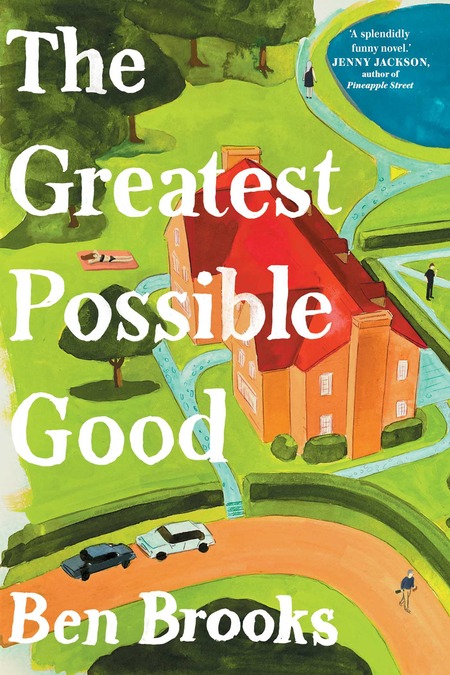
(courtesy Simon & Schuster Australia)
What does it mean to live a good life?
We all have airily vague ideas of what that might entail from doing good to others to treating people with kindness to not using plastic and prioritising people over digital obsession.
But it’s wide and open concept, big enough to drive a monster philosophical truck through, and it’s one that Somerset Maugham and British Book Award-winning author Ben Brooks has a lot of perceptive and thoughtfully dark fun with in The Greatest Possible Good.
While possessed of a sometimes whimsical and wryly observed spirit that can elicit more than a few laughs, The Greatest Possible Good is also earnestly intense, taking us to places that we’ve all journey to at one point or another in the service of exploring the great void that exists between worthy intentions and flawed execution.
Of course, when you embark on living on a good life, whatever the hell that means exactly, like family patriarch Arthur Candlewick who, after falling down a disused mineshaft for three days had a come-to-Jesus moment (metaphorically, not literally), decides to give away his wealth to global charitable endeavours, you don’t think anything about it will go awry.
After all, when you’ve had three days to ingest a book on “effective altruism” during your mineshaft entombment and had an epiphany about what it means to be a good man, you don’t even begin to conceive of this zealous approach to life, and yes, Arthur becomes as insufferable as a new religious convert or vegan, becoming anything other than a boon to everyone you do and don’t know.
As a teenager, Yara had always imagined that her family, when she had one, would be an inseparable band of bantering adventurers, going forth into the world together … She had never expected that they would be four people conducting four entirely separate lives out of the same building, like businesses sharing space in a shopping arcade …
But here’s the wild variable in all this – we’re all gloriously flawed as human beings and so it’s a rare person indeed – do they even exist? Unlikely – who manages to convert laudable ideas and goals into something that endures without flaw or failure.
Sure, Arthur does good with his millions of dollars but while he feels a warm inner glow, his talented, STEM wife Yara, who meticulously charts and organises everything about her life, is appalled that he would take such a radical step without checking with her first.
For reasons that The Greatest Possible Good goes into quite poetically and with incisively understandable insight, Yara fears being without money; she’s not greedy necessarily and certainly wants to do some good in the world, whatever that may look like, but she wants to live in a nice house in a cute village with all the luxuries of a hard-won uppercrust life at her fingertips.
She think Arthur has completely lost it, and as she tries to grapple with what Arthur has done in his radical new way of living, it becomes clear that a huge and unbridgeable schism is forming between the once-close(ish) husband and wife who find themselves on either side of a fairly fearsome divide.
Quite where that all leads must be left to the reading of The Greatest Possible Good but suffice to say, while Arthur feels virtuously good about his life and Yara believes herself to be a good person, it’s increasingly hard to see them remaining on the same page.

(courtesy The Curtis Brown Group)
Thrown into uncertainty are Arthur and Yara’s two teenage children, Evangeline and Emil, older sister and younger brother, who has vividly different approaches to life.
While both are private school educated at one of the UK’s most prestigious centres of learning, Evangeline takes an unyielding path to living a good life, holding hard to ideals like the evils of the capitalistic system (rather ironically while she benefits mightily from it) while becoming furious at her father when he actually dares to live out the very ideas she rather aggressively espouses.
She has no real friends, take refuge in her graphically prosecuted beliefs and thinks she alone is the bastion of all that is good and laudable; Emil, meanwhile, prefers to seek sanctuary in drugs and alcohol and numbing himself to the unending pains of the world, both his familial one, wider society and the earth as a whole.
His is a path of evasion and numbness, and he responds to the slow decay of his family at the hands of ill-considered if worthy good intentions by retreating from everyone and everything, although eventually the world catches up with him and he discovers that maybe in the midst of all his evasive activity that he might have a good and interested heart after all and that he might want to do some real good after all.
‘I don’t think “happy” is the word, but I’m glad I did what I did. I think it was right.’ [Arthur]
‘Then there we go.’ [Yara]
‘What’s wrong, poppet?’
‘It just wasn’t the deal, Arthur.’
‘Well,’ said Arthur. ‘No, perhaps not. But I think what I really felt was that we had so much, but we weren’t really happy, so what was the point?’
What makes The Greatest Possible Good really sing in the middle of its hilariously but sombre musings on what it means to be a good person is the way in which Brooks never really damns any of the Candlewicks, letting them rest in their attempts to be good people and simply documenting how they rise and fall on the strength of good intentions battling it out with their fallible humanity.
This is not a novel that aggressively prosecutes its argument; rather it lets its characters elevate or damn themselves depending on where they are in their long and vividly told story, all too aware that simply because we fail at something or don’t live up to laudably unforgiving ideals doesn’t mean that we are inherently evil or wrong.
In fact, the very nature of being human is that we will reach for the stars even as we find ourselves falling into trenches full of mud, shit and broken things.
It’s the way of life, and as noted, Brooks has a huge amount of fun with it, serving up a brilliantly flawed family that you will readily identify with and love even as they frustrate the hell out of you who attempt to live good lives and in many ways manifestly fail, leaving The Greatest Possible Good as not so much a cautionary tale as simply a story of good(ish) people trying to lead good lives and sort of failing, sort of not, which is what we all do to varying degrees of failure and success.