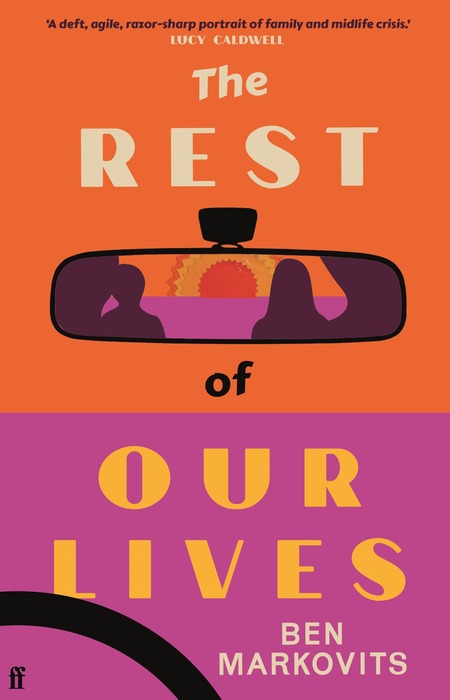
(courtesy Allen & Unwin Book Publishers)
Laments about middle age are often viewed as a tired old cliché.
But what is often forgotten in the midst of all the eyerolling and lowkey dismissals is that the cliché exists for a reason; middle age is a time when youth is walking out the door – let’s be fair, it’s long gone but people like to pretend they are still youth adjacent – and older age is perilously close to manifesting itself with its own set of, we assume, highly unattractive clichés.
It’s a major inflection point in our lives, a time when almost everyone begins to wonder whether the promise of youth has, in fact, been realised and whether the all-but-inevitable stagnation of the present day can be remedied in any way or whether this is it.
This oft-trodden ground literarily is given a vibrantly fresh and nuanced treatment by Booker Prize shortlisted author Ben Markovits in The Rest of Our Lives, a novel which sees a dad well and truly entangled in the uninspiring weeds of middle age impulsively drive across the country after dropping his daughter off at university (or college as its often referred to in the American context).
To grant some context to what looks like a wildly impulsive act, Tom is on hiatus from his job as a professor in law, and with time on his hands, the real world, which includes his wife Amy, is as pressing an issue time-wise as it might normally be.
Amy asked me, ‘When will I see you again?’
‘Tomorrow late, unless I stay another night. I’ll call you from the road.’
Then I reversed out of the drive, and they [Michael and Amy] stood there until we [Tom and Miriam] couldn’t see them anymore.
Tom is also 12 years on from his wife’s affair, which she claims meant nothing, and while their tired and stale marriage didn’t implode at the time, Tom vowed to himself that when their youngest child Miriam went to college that he would leave Amy and see what else life offered.
That’s not necessarily uppermost on his mind when he sets off for Pittsburgh from his home in New York but after he settles Miriam into Carnegie Mellon University, he remembers the pact he made with himself and keeps heading west to to see old friends with whom he’s lost touch, his son Michael who lives in L.A. and with whom he has a not especially close relationship and an old girlfriend.
It’s like a greatest hits of the past and present road trip, the kind of mix radio stations of a certain demographic tilt love, and which might just shake things up a little bit.
Not that Tom sets off with that expectation actively front of mind.
In fact, The Rest of Our Lives rests on the idea that much of life is what we make as we go along, and as a fairly laid back kind of guy who hates conflict or expressing an opinion to a degree that infuriates or bemuses friends and family, most particularly Amy, who can’t understand how you can be so actively hands off about life.
No, Tom just reacts instinctively and what follows is less of a planned series of events than a rolling with the punches kind of deal, especially in the transformative (but not for the reason you think) final act.
Told as a travelogue of sorts, though without wondrous whimsicality and with a lot of introspection – from others, not so much Tom who does feel things, and who is in nagging ill-health which he chooses to ignore, but whose words indicate a man happy to let the world roll over him to a surprising degree (even though things do affect him and that becomes clear throughout The Rest of Our Lives) – the novel operates as a slow unfurling of Tom’s life, one told with commentary, much of it not sought out by Tom, about what might have gone wrong, and rarely right.
The Rest of Our Lives thrives on not coming with absolute declarations about anything.
That might seem frustrating but the the truth is life often exists in a limbo of bruised and bloodied loose ends and while the sort of declarative statements and absolutist conversations that pepper TV and movies would be delicious to have in real life, it’s very rare that life is ever that definitive.
So, Markovits invests Tom, and by extension infuses The Rest of Our Lives with a sense of half-realised epiphanies, the kind that suggest something is amiss or went wrong a while ago but which don’t offer easy, fast solutions because often they are simply not there.
At least, not right away.
By observing and honouring that, The Rest of Our Lives takes a slightly out-there premise and gives it the substance and sheen of the real world where the definitive often comes second to we’re just not sure.
We took his car. It’s a funny thing to be driven around by your son, you feel the power dynamic shifting.
And that’s what’s so powerful about this slim but fulsomely told story.
It knows life comes with reckonings and forks in the road, and that we have to react to them in some sort of fashion, but it’s also deeply and affectingly cognisant that we often don’t have the answers or the right, timely responses and that is a perfectly normal part of being human.
Sure, some deep-seated part of us wants things to be nailed into place with authority and a strong and unassailable sense of an acutely detailed resolution being arrived at, but life rarely gives us that and the real gift of The Rest of Our Lives is that it honours that in ways that consistently ring true.
Reading the story of Tom and his extraordinary life-changing journey across the United States is to bear witness to the messiness and knowability of life and ourselves.
Even when the final act introduces a lightning rod moment which galvanises minds and emotions, The Rest of Our Lives remains true to the idea that even the starkest punctuations in life rarely come with ready answers and certainty of insight and that the best we can often do is what Tom ends up doing and patch things up where we can, make changes where possible and try to figure out the rest as we go along for however long our lives last, and wherever they take us.