(courtesy Pan Macmillan Australia)
How do you get over a broken heart? Especially one ten years in the making?
It’s a question with a huge and open-ended answer, an unwelcome one that Elly has to grapple with when her boyfriend of ten years and husband of less than a year walks out during an argument and never returns nor makes any form of contact.
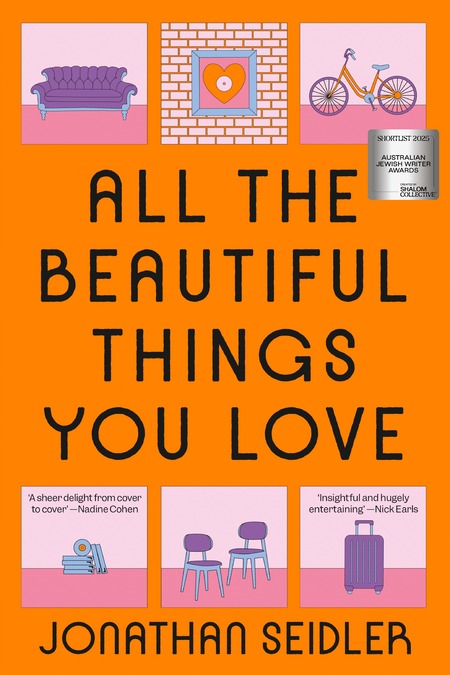
The central figure in Jonathan Seidler’s emotionally arresting novel, All the Beautiful Things You Love, Elly is confronted with a huge dilemma – how does she move forward in any sort of meaningful way when she is surrounded with the all the things that she and Enzo accumulated over a decade of what she assumed would be a forever state of togetherness?
In a story which is funny and poignant, sad and hopeful, Elly decides that her only meaningful option is to start selling off all the things that remind her of Enzo, of their relationship and of the unique special moments that meant the world to them at the time but which simply remind her that it’s all over.
She jumps onto Facebook Marketplace, traditionally not the sort of place where you want to spend much time given how weird so many people seem to be on the platform, and she finds that not only is there a market for her tarnished memories but that she’s able to meet some truly genuine and wonderful people, some of whom go on to define her new life without Enzo.
Love songs can be penned with an audience in mind, but ultimately, it’s the lovers that give them meaning. As Elly and Enzo scrub back through the digital stream to listen to the song over and over again, tea turning Siberian in the chipped Anthropolgie mugs with the gold handles that Elly refuses to throw out, this song becomes theirs. Without a single word being spoken, it locks into their hearts like a rare amulet.
As she sells off the very rare red heart-shaped single of “Valentine”, a 2011 release by Jessie Ware & Sampha, which Enzo had to hunt through multiple record stores across London to find, and the silver chrome bike that Enzo got her in a bid to convince her she could ride a two-wheeled mode of transport after some early accidents in her first year in London convinced her otherwise, she begins to heal in some surprising and heartfelt ways.
She builds connections and friendships with a number of the buyers including Himesh, who buys the enormous, thickset, heavy wooden table Enzo and Elly got in Italy on a whim, and Xenia, a part-time DJ who’s passionate about music and buys the aforementioned “Valentine” single, and in so doing, unwittingly embarks on a strange form of therapy which helps her to talk through and reconcile what’s happened to her.
Though she still loves Enzo, and can’t understand why he won’t contact her or come and retrieve any of his stuff, she also knows the relationship is over, and it’s the unexpectedly involved conversations with the people picking up the detritus of her onetime life which help her to work through some fairly significant emotions.
She doesn’t necessarily want these conversations, and is flummoxed at first that people who were supposed to just pay, pick up and go stick around to talk and talk and talk, an act she sees an invasive at first but which she eventually comes to welcome.
While the objects at the centre of All the Beautiful Things You Love are the framework for a beautifully involving story, it’s the people who buy them who come to figure heavily, in both temporary and lasting ways, in the way Elly life reforms in the wake of a truly terrible moment in her life.
What makes the connections that Elly forms so meaningful is that they happen when she isn’t expecting them and delivered a sense of confessional closure she wasn’t even aware she needed.
It’s the humanity at the heart of All the Beautiful Things You Love that really makes it come alive and which draws you into a story which, while it may have a fairly impressive amount of humourous insights and nuanced interactive moments, is ultimately about how you navigate your way through pain and loss and the tearing apart of something you thought would absolutely last the distance.
Having your confidence shaken like that is hard to move on from, and while Elly does display a certain bravura in the face of adversity, Seidler writes her as a character so beautifully that you know she is hurting and lost and alone and that while these new friendships aren’t something she wanted, they do become something she needs.
It’s that subverting of expectations which really makes All the Beautiful Things You Love such a true delight because it reminds us in the very best and insightfully thoughtful of ways that life really forms itself into the shape we think it will.
She does not know how long she cries for, in the office of the boss who has offered her his friendship, but she does know that when it ends, the dust will have been banished, Elly will rejoin the ranks of the clear-eyed and the real work will begin.
We set off in life at many points, and certainly this is true of Enzo and Elly, and think we will arrive at points A, B and C and that X, Y and Z events and emotions will accompany us on this all but certain path.
Human beings are gloriously optimistic even in the face of harsh reality and that’s certainly true of Elly and Enzo who think that the one big issue on which they don’t agree won’t rip their relationship asunder; I mean, who expects the worst to happen when the very best seems so palpable and immovably strong?
But as All the Beautiful Things You Love demonstrates in the sale of once-precious relational goods, new friendships and found family, and the way life reshapes itself in ways that happily confound Elly, life goes on anyway, despite our expectations, and we often end up with something that may not fit our expectations but which is nevertheless welcome and wonderful anyway.
It’s not easy getting top that point and certainly as All the Beautiful Things You Love recounts how the relationships came to be in Elly’s possession even as they leave it, you come to understand that the path Elly has to tread once Enzo leaves is not an easy one.
But it happens anyway, and this beautifully wrought and seamlessly judged story of a life lost and a new one gained by degrees and through the unlikely mode of a community sales platform, reminds us that while we might lose a lot, we can gain it back too in ways that will come to mean something new and different and like Elly at the end of All the Beautiful Things You Love, transform us in ways that we don’t expect when all we put up is a simple series of items for sale.