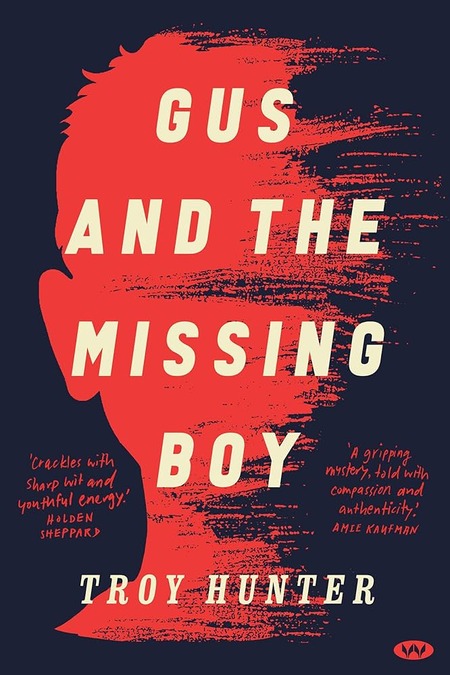
(courtesy Wakefield Press)
Growing up, it’s often well nigh impossible to feel comfortable in your own skin.
Things are changing fast, and figuring which way is up or down emotionally, socially and in a thousand other hugely challenging ways, becomes the stuff of exhausting everyday coming-of-age parkour-ing.
It’s not as easy time at all and one person who would emphatically agree is 16-year-old Gus Green, described on the back cover blurb of Tory Hunter’s Gus and the Missing Boy as “overweight, gay, his injured mum’s primary carer [with] onl two real friends: sporty Kane and feisty Shell”.
He doesn’t feel like he’s part of the world he inhabits, and while that is something that pretty much anyone his age would identify with, it become an even more pronounced a sensation when he discovers that an AI-aged up teenager on a missing persons website looks like him.
Exactly like him.
Is he a kidnap victim? Is he simply reading far too much into what is, after all, just a digital guess about what the kidnapped three-year-old (from 13 years previously) might look like now? And could this simply be the escapist whims of a kid desperate to find a reality in which he feel quite so sh*t?
Whatever is in play, Gus is game to investigate further with the true crime buff, who wants to be a policeperson one day, figuring it’s a good chance to sharpen his skills while getting to the bottom of a mystery that might have a very personal meaning for him.
My T-shirt has ridden up over my flabby gut. Shit. I quickly pull it back down. Did she see the new cut? I look back to see her reaction, but her mind is clearly on other things. She’s stretching out her legs, rotating her ankles in circles. Round and round and back again. Totally like my life lately. Ever since Dad died, she’s treated me like I’m ten again, like we’ve gone back in time.
So Gus plunges into an investigation, online and in person, with the Melbourne-based teenager even going so far as to journey up to the NSW town of Bellanta (fictional but think Tarcutta adjacent) to dig through newspaper archives, speak to onetime suspects and interested parties and even play amateur police investigator with the original detective who worked the case.
Funny and thoughtful and full of characters who really grab your heart, Gus and the Missing Boy is a brilliantly conceived and executed coming-of-age story which really gets to the heart of what it’s like to navigate the incredibly changeable teenage years, and how it becomes even more challenging when you’re dealing with a potential blow-your-world-apart moment.
Gus has no idea if he’s barking up the right tree or simply hopefully delusional, but one thing he’s sure of is that he can’t simply pretend like there aren’t some huge question marks over his childhood and lingering unanswered questions about who he is, why he has no photos before age three and why his mother seems to be cagey about answering any and all questions he might have.
Hunter does a masterfully involving, empathetic job of sustaining the mystery just enough to keep Gus, Kane and Shell’s possibly ill-advised sleuthing ticking along, while giving out some answers, or at least partial answers, so both we, and of course Gus, feel like the mystery is one worth solving.

(courtesy Wakefield Press)
Ostensibly a whodunnit novel, Gus and the Missing Boy seamlessly meshes this part of genre-straddling make-up with a highly relatable sense of what it means to really know yourself.
When you’re adult, it’s far less of an issue than it is when you’re a teenager and when knowing who you are, what matters to you and what you want from life feels like it matters more than life itself.
The feelings are intense at that age, and the judgement calls not as wise as they could be, and Hunter captures all of that so affectingly and evocatively that you are there every step of the way for Gus, willing him to either prove the kidnapping angle or disprove so he can go on to make some peace with his very messy, extremely unsatisfying current life.
To be fair, very few of us, even in all the messiness of being a teenager, have likely never found ourselves facing such such a huge existential mystery as Gus does; even so, so deftly does Hunter weave the story that anyone who has ever felt like their teenage world doesn’t fit them even a little bit will find a lot with which to identify in Gus and the Missing Boy.
He is like an Every Teenager writ large but with a decidedly queer angle which adds extra richness to a story already dealing beautifully with what it means to survey the landscape of a life and wonder where on earth you fit into any of it.
Shell looked worried. ‘This is huge, Gus, but I think you need to give your mum a chance to explain. It’s a lot for her too.’
I nod and lie back down, exhausted. Fighting with Mum, getting drunk, wanting to cut, trying to kiss Kate … I am such a mess.
Winningly, Gus and the Missing Boy doesn’t simply focus on Gus though he is, naturally enough, the main narrative game in town.
Bestie Shell, a fellow overweight teenager who isn’t sure if her assigned gender fits her anymore and is wrestling with what that means in a loving but reasonably conventional family, and kind-of older brother Kane (he’s three years old and has lived with his parents next to Gus and his mum since he and Gus were kids) also have some fairly big mountains to climb and it’s lovely to see this small found family draw closer (and sometimes pull apart) as they work to solve Gus’s big, potentially life-changing mystery.
Gus and the Missing Boy is in many ways a love letter to the way in which identity shapes and moulds us and how any challenge to the accepted norms of our life can feel a full frontal assault on everything we are as people.
Hunter gets the enormity of the true crime sleuthing Gus has taken on, and while the novel does have moments of quirkiness and playfully mischievous banter, it treats Gus’s quest not as some childish quixotic adventure but as something serious and worth of pursuit.
Gus and the Missing Boy is a novel that knows life is tough at the best of times and that it can get even tougher when something massively challenging like maybe being a kidnapped kid comes into play and it treats it all with the requisite empathy, seriousness and understanding of the temporary trauma involved, mixed in with just enough humour, heart, found family & friendship and definitive answers to fully round out the novel’s inherently thoughtful and compelling humanity, and to leave you eminently glad you get to come along for the ride and see where Gus’s grand existential adventure will end up.