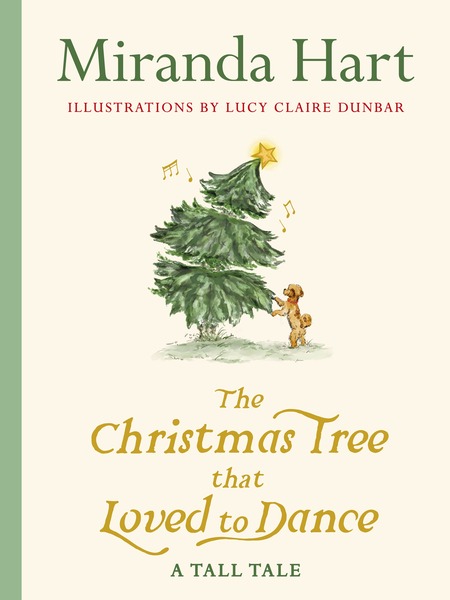
(courtesy Penguin Books Australia)
Ever since I discovered her breakthrough sitcom Miranda, I have loved the whimsy and old-fashioned chatty cheerfulness of comedian/writer/actor Miranda Hart with the sort of enthusiasm that people much younger than me reserve for zeitgeist-heavy K-Pop bands.
She embodies all of the fun and silliness of sitcom writers and performers of old while still feeling very relevant and 21st century-ish; it’s a perfect mix and it makes pretty much anything she does feel like a very funny, warm hug from a cool friend who seems to know how to summon up the best of the past without becoming trapped in rose-tinted nostalgia.
Everything I love about the creative person that is one Miranda Hart seems to have distilled itself, with delightfully charming festive trappings in The Christmas Tree that Loved to Dance (A Tall Tale) which dares to wonder about what happens to all the fresh Christmas trees when they have done their duty and, with lights and tinsel removed and decorations off their branches and back in their boxes, they are cast unceremoniously out onto the street.
For most people that is the natural seasonal order of things; you grab a tree from the lot, make it pretty and then when Boxing Day rolls around, you send it back to become part of the circle of life, or something.
No one really questions it until one day Joan and her lovely ginger poodle Jessie go for a walk around her English neighbourhood, expecting to do nothing more than add a few thousand steps to her to fitness app and then head for a nice warm bath.
The next day, Joan and Jessie decided to take their morning walk via the street where they had found their tree friend. Their usual routine was the opposite — park in the morning, street in the evening. And itw as this fateful decision that ultimately led to their Big Adventure.
But then something quite unexpected happens.
And by unexpected, we do mean unexpected because after tripping over a discarded tree, thrown haphazardly onto some black garbage bags, Joan hears said tree apologise to her.
Wait, wait, what did it do exactly?
It talks is what it does, saying “I am so, so sorry”, and after establishing some twisted neighbour isn’t getting their jollies giving voice to dead and thrown away trees, Joan, who apparently has a Doctor Dolittle ability to talk to living things like poodles, and it seems how, trees, finds out that she can indeed converse with Christmas trees including the rather sweetly named, Poodle Tree.
Whimsical much? Whimsical a lot, actually, but this moment of imaginative eccentricity is the first of many in The Christmas Tree that Loved to Dance (A Tall Tale) which rather wonderfully posits that even the most ordinary things in the world can be, if you look hard enough, quite extraordinary.
It’s theme that continues right through this exquisitely wrought hardcover novella which is filled with the wondrous notion that everything around us can be far more than ho-hum if we’re just willing to look for it.
That’s a common theme admittedly in books set at Christmas, which has been bestowed, as a season generally, with all kinds of redemptive, healing magicality, but The Christmas Tree that Loved to Dance (A Tall Tale) takes it even further, gifting us with a story that dares to ask us to not just think extraordinary thoughts but to live them out actively in all kinds of moments too.
Realising that all the thrown away Christmas trees on her street, and those surrounding it, are mourning their fate as future organic landfill, Joan, rather idiosyncratically, decides to save those she can, filling her house with over thirty trees that she is convinced with have the best of all lives safe from the garbage collecting service’s hands. (One thing she forgets is that they might just continue to decay and die no matter where they are but that’s a narrative twist for later in the story.)
Competing with Joan though are some mysterious men who are filling a truck, with a furtiveness worthy of the world’s best spies, with all the trees they can get their hands on and convinced they are up to no good, Joan decides to follow them and find out what kind of nefarious deeds they are committing.
It’s at this point that the spoilers must stop because what Joan discovers and what the men are doing is in the tradition of the very best stories of the season, and the lovely part is that Joan and the men who steal trees may not be that far apart in intention and deed at all.
But that is for the end of the story, one which ticks every warmhearted, goofy, funny, sweet box you could want it to and which leaves you feeling good about the world, even a post-Christmas one.
‘You need to find out what they have actually been doing. Where they have been taking the trees. If you can’t find a way to save your trees at home, perhaps next year you can make sure the January trees will be saved from these people. Now, hurry.’
They gave Sycamore a quick hug and rushed off.
Reading The Christmas Tree that Loved to Dance (A Tall Tale) is like being taken back to one of the stories of your youth if you are of a certain age; if you are younger and not as inclined to nostalgia, you’ll still find yourself stirred by the fact that the world is extraordinarily magical and that good people can accomplish the most wonderful things if they are simply brave enough to do it.
Joan is rather worried her neighbours will think her quite mad, both about the talking trees and creating a community of them in her home, and it seems that her sweet neighbour Daniel, who may quite like her, might be getting a completely wrong impression of what she’s up to, but come what may, Joan decides she has to follow her conscience and do what needs to be done in the service of a greater good.
With gorgeous illustrations by Lucy Claire Dunbar, which summon a delightful Paddington Bear vibe to proceedings, The Christmas Tree that Loved to Dance (A Tall Tale) is that story you need to read, not just at Christmas but whenever you feel like life is altogether too deadly, dark and dull.
It can often feel that way in the immediate aftermath of the colour and festive glories of Christmas, but Hart rather beautifully reminds us, with chummy turns of phrase and a lyrical storybook lilt that works perfectly for the story, that goodness and loveliness doesn’t stop just because we reach a particular date and that we can, if we point our minds to it, not simply think good things but do them too, making the world a far better, much more extraordinary place in the process.