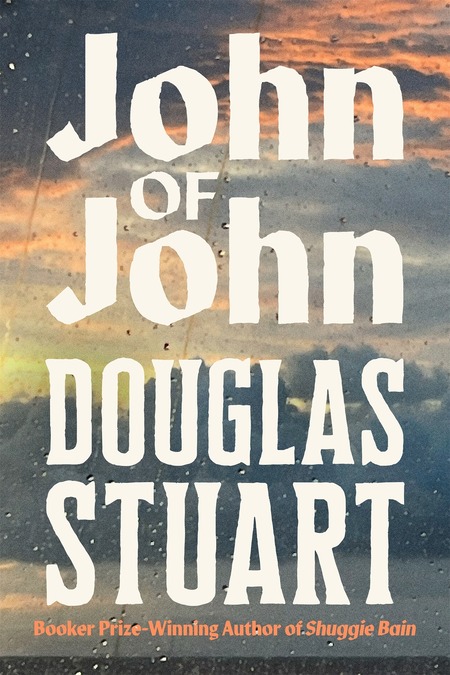
(courtesy Pan Macmillan Australia)
There’s a real joy to reading a novel by someone who wields their words not simply with artistry but with a sense of deeply affecting humanity.
It’s easy enough if you’re a masterful writer, to make sentences and paragraphs and chapters that sing with the sparkling beauty of the written word, but too often all that does is create a very pretty word blizzard devoid of heart & soul, and meaning.
In the case of Douglas Stuart’s new luminously moving novel, John of John, there is no risk of gloriously executed writing obscuring raw and unflinchingly gritty humanity, with the book finely and movingly balancing singing prose with a sense of expectation and truth coming fast to a messy reckoning.
The world described in John of John is one of Calvinistic grim austerity, where there is a stark demarcation between those who are Saved, and those who are not, and pretty little tolerance or love of the latter by a hugely judgmental, almost poisonously harsh former.
Life is tough out on the Outer Hebrides islands which sit facing the full force of an unforgiving Atlantic off the far northwest coast of Scotland where many people don’t own the land they farm, renting their crofts off landlords, often for many decades, if not centuries.
In the fictional settlement of Falabay, the soil is shallow, the buildings in increasing disrepair, save for those sold to mainlanders as holiday homes or the rare crofter who can make money from their farming, and Calum John has just arrived home at the request of his difficult father John.
If he [Reverend Rose] seemed more relaxed that their previous ministers it was simply because he understood that the congregation was captive, not just geographically, but by the expectations of their neighbours. They policed themselves through shame and slights and petty judgements much better than he could in his sermons.
Freshly graduated from textile school, Calum John is gay, a state of sexual being which it doesn’t take a genius to realise won’t go down well in the strict confines of hothouse Hebridean Calvinism.
This is a world of almost feudalistic religious devotion where a young woman falling pregnant out of wedlock is a thing of pitchforks and flaming torches vigilantism, and where the love of Christ takes a firm second seat to people toeing the line and acting a very restrictively narrow part.
God forbid you should veer from the one true way because you will sanctioned and punished and treated like an outsider worthy of hatred and judgement and precious little to none mercy or kindness.
Calum knows how it goes and so when he returns home with long hair and a pronounced unwillingness to fully play the suffocatingly confined role assigned to him and all other islanders, tensions erupt once again between him and his dad who, though he loves his son, is ill-adept at expressing it.
The only sanctuary for Calum is his grandmother, Ella, a Glaswegian who married into island life many decades earlier and who has never really become part of the community thanks to her lack of learning of a distinct form of Gaelic and her unwillingness to play the part of good religious woman.
She prefers to be herself and has paid the price; even so, somehow, she and her son-in-law John have existed in an uneasy detente for years, their ability to live in the same small rundown house even more remarkable when you consider that Calum’s mum Grace, who lives way over on the other side of the island, left his dad when Calum was just a boy.
What is most impressive about John of John is that though the world in which its compellingly immediate story is told presents in one way, the truth of those who inhabit is quite another.
If you have grown up in any kind of church, particularly a conservative one, you will be well acquainted with the way in which you must say and do all the right things outwardly while inwardly letting your very individual freak flag fly.
No one can see the inner person of course, and so, a religious ecosystem develops where people are seeing each other all the time, socialising, talking, worshipping and praying and yet, not even really knowing each other at all.
It’s a cruelly unforgiving type of world to grow up in, and it can do you damage, constantly keeping the inner and outer worlds apart and praying that the former does not accidentally erupt out into the latter.
What drives John of John is what happens when little by little the realness of life and the people living it can not no longer be contained by a viciously nasty cycle of expectations and punishment.
There’s only so much falsehood people can project before they crack in big and small ways and it’s fascinating to read as Calum, John, Ella and a host of others including John’s close friend Innes (who may be more than he appears) finally have to reckon with truth no longer willing to play second fiddle to hypocrisy.
‘He was so beautiful, John. I cannot tell you how beautiful he was.’
If he left now. If he got in the van and drove as fast as he could, then maybe Cal would still be asleep. Maybe he could lie down beside him and pretend he had never left.
‘But he was only a boy,’ he said, as he pips sounded for more money. ‘All the same. It was nice to be noticed.’
Packed with a quiet intensity of emotion that unfurls with an intense deliberateness and an incisive commitment to showing how hard it is to imprison wild humanity within the confines of fiercely unkind dogma and punishingly cruel theology, John of John is one of those books that makes you gasp with realisation at how much damage we do to ourselves and more when we let the outer lies hide away the inner truth.
There comes for everyone a grand and impossible to ignore reckoning, and what makes John of John so brilliantly special, is how Stuart brings that to the fore when everything would suggest the prevailing state of things will always come out on top.
The small cracks though that suggest the old order is weakening and cracking are everywhere in the first half of John of John if you’re paying attention and this is one book that demands a thorough and patient reading because so much happens in-between the big grand scenes and intimately epic interactions between various characters who don’t say what they mean at first glance but who are screaming the need to speak their truth in amongst the carefully measured words they say.
There is so much richness and raw humanity in John of John, all of it expressed in a way that rings true and which, though it is agonising to be exposed to at times as you almost will certain characters to break free and be themselves before something terrible happens (and it does), speaks to the need we all have to be our authentic selves, to let our hearts go where they will and to somehow find peace and accommodation with those we love in ways vital and truthful before the lies consumes it all and we are left with nothing but empty sadness and pain.