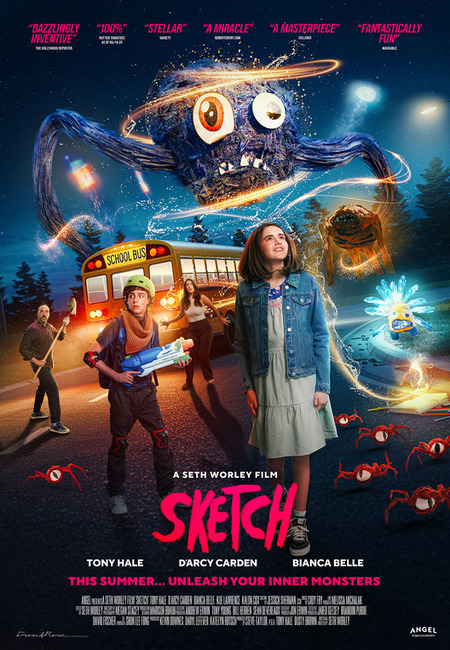
(courtesy IMP Awards)
One of the things that you never realise about grief, until you are mired irrevocably in its desperately sad and regretful depths, is how powerless it makes you feel.
On one level, of course, you know, especially when someone you love dies, that you can’t bring them back and that powerful though the technology of the third decade of the 21st century is, you can’t wind back the clock and restore things to the way they were.
But good lord we wish we could and we find ourselves mired in pain seemingly without end wishing and hoping that we could fix what ails us, but we can’t.
That’s something that Sketch, written and directed by Seth Worley, understands all too well, letting the three central characters of this surprisingly dark film – it’s not the darkness that’s the surprise; rather how rewardingly willing the film is to embrace it, knowing we must pass through it to reach the light – feel all the pain and loss and terror at the idea that life may never be good again.
What it also does masterfully well, and honestly this spoke to this reviewer so deeply, is acknowledge that we have two ways of responding to catastrophically great loss – we can either shove it down and pretend it’s not there, which is what father and son, Taylor Wyatt (Tony Hale) and Jack (Kue Lawrence) has chosen, the son following the example of the father, or we can, like Amber (Bianca Belle), the younger child of the family, channel our unrelenting pain into outward expression.
In her case, it’s pretty graphic art, in which her school bus bully and anyone else that causes her grief, is portrayed as being on the receiving end of some rather violent and bloody treatment by monsters which manage to be both extravagantly, imaginatively cute and terrifyingly homicidal.
Rather than being told what she’s doing is unhealthy, Amber is encouraged by the school’s counsellor to keep putting her feelings down on paper, because, as even Amber admits, once she has it out, all the anger and sadness doesn’t feel as bad.
But one thing Sketch does do quite beautifully is remind us that while it’s good and healthy to admit the darkness is there, because suppressing it, as Taylor and Jack learns doesn’t do anyone any good, you also need to remember that the good is there too.
In fact, there’s one arrestingly intimate scene where Taylor, desperate to reassure his daughter that he values her art and her beautiful, playfully creative heart incredibly highly, implores her, while he also holds a container of art she did before her mother and Taylor’s wife died, to let the bad out but also to let some of the good in too.
It’s a powerfully tender and nuanced scene that almost forms the central thesis of Sketch which, as you will know if you’ve watched the trailer, is all about how the monsters of Amber’s grief-stricken, therapeutic self expression, come alive in the real world, all of the young girl’s fury and pain given form in creatures that simply want to destroy and kill and maim because that’s what Amber was feeling when she drew them.
The titanic battle between Amber’s come eerily to life creations – and it is dark and eerie and downright scary at times but that makes sense; it is, after all, grief we’re talking about here and it’s not pretty – and the wider world largely comes down to Amber and Jack, and later Taylor and his sister Liz (D’Arcy Carden), and sweetly, Amber’s bully-turned-friend (ish) Bowman Lynch (Kalon Cox) who must stare their enemy but in the case of the Wyatt their deep, abiding grief if they are to emerge triumphant.
This is where Sketch also excels – while many of the scenes are fantastically and thrillingly imaginative, the monsters so visually striking, and yes, weirdly kind of cute, that you almost want to cuddle them except they’d eat you, Worley doesn’t let the blockbuster look of the second half of the film taken over.
It’s big and bold and colourful and brash yes, and it certainly sets up some pretty huge and impressive stakes, but it is also heartbreakingly intimate, emotionally vulnerable and brokenly human, giving what first appears to be a playfully combative film a real emotional depth and resonance.
There are many times in the final act, especially when the bleakest and most nihilistic of the monsters face their human opponents – ironically and tellingly the very people who gave them life – when your heart just breaks.
If you have ever lost anyone you love to death, you will be well acquainted with the seemingly bottomless depths of emotion that go along with their loss.
The feelings can be so deep and so endless that you feel almost suffocated by their immensity and capacity to dominate everything, and the beauty of Sketch is that it embraces the truism of that and doesn’t pretend, for the sake of entertainment, that battling the monsters of grief is anything other than a long dark voyage into the very saddest parts of your grief-soaked soul.
The film does end on a hopeful hope but it doesn’t pretend for a second that getting to that place is an easy road to travel; in fact, when Taylor and Jack are talking it out near the end of the film, the dad trying to talk the son out of a course of action that won’t yield the expected results, it embraces how hugely sad and dark being embroiled by the helplessness and powerlessness of grief can be.
It’s a dark and difficult ride in so many ways but by bringing it to life with vivid technicolour terror married with the kind of raw emotional honesty you might not expect from a film of this type, Sketch excels as an arresting journey into the very worst of times, and that scary though it is to go down that path, that it’s the only way to truly guarantee you will come out the other wise, if not healed, then at least on the way there.