(courtesy Russell Hobbs British Film Festival)
There is a rich authenticity to every one of British director Mike Leigh’s films, a sense that you are seeing real people living all-too-real lives in circumstances that don’t pretend life is anything other than a hard slog.
But for all the gritty honesty of the setting and the people who inhabit, there is a beautiful evocation of what it is like to find your small slice of the world, however flawed and difficult it might be at times, and to inhabit it with sincerity, joy and the comfort of those you love around you when the joy is absent.
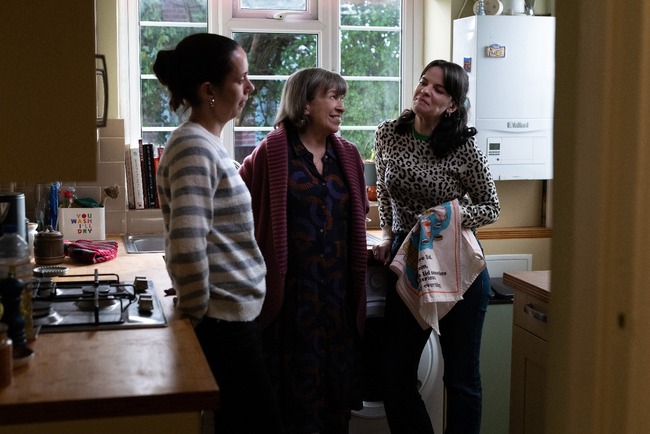
In what could well be Mike Leigh’s final film, Tender Loving Care, we meet two lifelong friends Amy (Kate O’Flynn) and Rosie (Alice Bailey Johnson) who are back living with each other again after Amy’s loser boyfriend Jamie decides to go to to Scotland to live with his ex.
She’s not really that devastated, or at least won’t really admit to it if she is, but she’s is distinctly nervous about telling her ageing parents Birdie and Geoff aka Pops (Marion Bailey and Paul Jesson who are alumni of a number of Leigh’s films) that her relationship has failed.
It’s not really clear why she’s nervous, save for the fact that her father is increasingly frail and forgetful and perhaps she simply doesn’t want to bother them, but when she does finally ‘fess up, it’s done with a hefty dose of awkward humour as she admits that she and Rosie are housemates again, a state of cohabitation that suggests she is no longer living with Jamie.
There is undeniable love between Amy and Rosie of the BFFs Forever kind, and between Amy and her parents and Rosie whom Birdie regards as a second daughter – Rosie admits at one point that her relationship with her mum and dad remains strained to the point of non-communicative estrangement, and that Amy and her folks are her real family now – but what is fascinating about Tender Loving Care is that for all this tender closeness, much of the dialogue remains comfortably superficial.
It exists in the realm of cliches and well-worn phrases, of songs sung and emotionally intense admissions delivered indirectly or with sing-song phrases, and while you might be tempted to think that this means no one is relating deeply, it becomes abundantly clear that there is an acknowledgement, even if it’s not said out loud, that they understand that what is said is purely a coping mechanism to handle some deeply uncomfortable life truths.
Amy has spilt with her partner, Rosie’s dating life is moribund, Pops likely has dementia and Birdie, for all her buoyant, tea-driven relating, seems to have no idea how to navigate a world which bears no resemblance to her glory days of meeting her husband at work and establishing what remains a close, cute, and very happy marriage for the most part.
These are people who are in crisis in a sense but who have no choice but to keep putting one foot in front of the other, secure in the unconditional love that unites and supports them.
Feeling more like a play with discrete scenes than a movie with an overarching narrative, Tender Loving Care is a touching gem of a film that celebrates, quietly and without fanfare, what it means to belong, to be loved and to be unquestioningly cared for.
There is no gloss to this story and no promise of happily-ever-after, and in fact, the penultimate scene serves to remind us that life will go on until it doesn’t and even then the tides of life keeps going in and out and all we can really do is try to keep up.
Split between Amy and Rosie’s lives as social workers of some decade and a half standing, Birdie and Pops’ uneventful domestic day-to-day moments where tea seems to be the comforting answer to everything, and some truly lovely scenes where all four characters are together – apart from the main four characters, Tender Loving Care tends to keep supporting plays limited to Rosie and Amy’s characters who despite their longevity in exhaustingly demanding roles, remain sincere and caring – the film doesn’t race for emphatic scenes or melodramatically intense dialogue.
Tender Loving Care prefers instead to let these characters do their East London thing, their lives carefully circumscribed by the demands we all face to tick a slew of boxes on a daily basis; if you’re tempted to think that their lives are too small and they are doing themselves a disservice by not thinking or living figure, the film reminds us that all of us are, to one extent or another, living inside fairly constrained parameters.
The issue then is not how big those lives may be but how they are lived.
It is heartwarmingly clear, even in the toughest moments of this luminously affecting film, that within their own small worlds, difficult though they may be at times, they have a found a richness of connection, belonging and loving support, and it’s this emotional vitality which sustains them and makes their small geographic worlds feel emotionally big.
In the end though what really moves you about Tender Loving Care, which begins and ends in what appear to be random if meaningful moments in the characters’ lives, is how much these people love and need each other.
We talk often about how much friends and family mean to us, and it’s in a range of quiet sad and happy, buoyant and reflective scenes, that Amy and Rosie mean the world to each other as close, enduring friends and that Pops and Birdie are each other’s absolute worlds and that they treasure the fact that Amy and Rosie still want to see them and hang out with them.
Their lives are rich and full, and while they aren’t without issues, especially when it comes to ageing and death and romantic disappointment, they are are sustained by each other, however imperfectly that is sometimes expressed, and that is what makes life worth living through times good and bad, and whatever lies in wait in an uncertain future.