(courtesy French Film Festival/Palace Cinemas)
The end of romantic love is generally portrayed as a piece of cataclysmic, antagonistic trauma with hopes sullied, joy vanquished and that cost sense of belonging messily ripped asunder.
In short, it is very much a Dickensian worst of times.
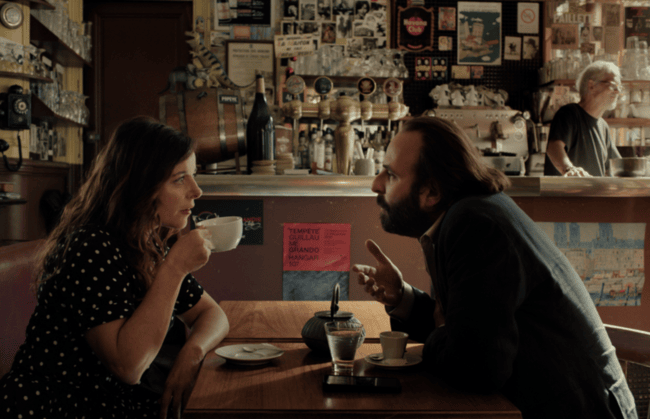
But in What is Love? (C’est quoi l’amour ?), written and directed by Fabien Gorgeart, whatever earlier dislocation may have occurred when Marguerite (Laura Calamy) and Fred (Vincent Macaigne) split up well over a decade ago has now settle into an amiable, if at a distance, friendship.
Marguerite is happily coupled up in a long-term relationship with Sofiane (Lyès Salem) and they share a teenage daughter, Raphaelle (Saul Benchetrit) who is in the throes of moody first love and prone to emotional outbursts when parameters are placed her amorous heart, and Fred is engaged to Chloé (Mélanie Thierry) who described him as the love of her life.
There’s no ill will, no lingering rancour, with even Fred and Marguerite’s twentysomething daughter, Léa (Céleste Brunnquell) embracing each of the new couplings; so, when Fred tells his ex wife that he wants her to help him prove to the Catholic Church, who married them, that their marriage was doomed from the start, a crucial step in obtaining the annulment that he and Chloé need to get married in a church, Marguerite agrees without hesitation.
Surely with that much generosity of spirit and bonhomie, the path to an annulment should be a relative walk in the park?
Ah, no think again, because as What is Love? (C’est quoi l’amour ?) kicks up a gear or two, charming and funny in equal measure, it becomes apparent that while Fred and Marguerite might have buried the hatchet, they aren’t prepared for how pedantic God and his church are going to be in getting them to prove their marriage was ill-fated from the get-go.
Pedantic doesn’t even begin to describe it, and as they jump through hoop after hoop after invasive hoop – at one point Marguerite is asked by a priest how many people she has slept with and let’s just say the fraught conversation does not end well – it becomes apparent that a good deal more of their past will be raked through than either of them expected.
Marguerite particularly find this very hard to deal with.
While Fred is wrapped up in the starry-eyed wonder of semi-new love, meaning much of the interrogative stuff from the church washes off his back like the proverbial, Marguerite, though she is happy withy Sofiane, finds it all confronting.
As she says to Sofiane at one point, who is supportive but who also begins to wonder of all this digging up of the past is reigniting old flames – thankfully What is Love? (C’est quoi l’amour ?) doesn’t go down this obvious route, its storyline far too clever and thoughtful to indulge itself in something so basic – all this need to trash what she and Fred had so the church will be convinced it was dead in the water to begin with is making her feel like she wasted her past.
Deep down she doesn’t think this; she has a warm friendship with Fred, more all the closer by the two finally sorting through issues that may not have seen the light of day when they first split, a sparklingly lovely daughter in Léa and memories that are more warm and fuzzy than anguished and sad.
But we all know that what might rationally be the truth can pale in the face of strident emotional reactions, and Marguerite, while still committed to Fred getting a church ceremony for his second marriage, begins to wonder if it’s worth being made to feel like her first great love was a lie and fiasco.
Not helping is the fact that after their first petition for an annulment fails, they are forced to go higher, as high as the Vatican as it turns out, which, while it involves a fun trip to Rome for everyone involved – it’s here that Fred and Marguerite, their partners and kids bond as a found family which proves the past doesn’t always have to sour the present – means that they have to go even harder on the whole “our marriage was a HUGE mistake” line.
Again, it’s all for show and not even remotely the truth and it’s all being hyped up because the more dire it is, the more chance they have of gaining the elusively precious annulment, but the toll grows on Fred and Marguerite and on their partners in ways big and small, and it looks like they may not even get what they want despite all the effort.
It all ends happily, of course – that’s flagged a mile off and is not even a spoiler – and while What is Love? (C’est quoi l’amour ?) does overdo the Rome segment and extend things past their use-by date, the net result is that the past is sorted, relationships reorient and everyone ends up happy and with exactly what they came for.
At the end of the film, we are invited guests to the wedding of Fred and Chloé, well, the reception anyway where the proof that the past being dragged up and raked over, while trying in the short-term, actually led to some healing and bonding in the present and that you can go back and sort things out without screwing up what you have now.
Charming and sweet, intense and moving in quietly nuanced but affecting ways, What is Love? (C’est quoi l’amour ?) does a beautiful job of showing that we don’t have to be victims or prisoners of the past and that though the transition to the present, and eventually future, may not be as smooth as we’d like and may challenge us emotionally in ways we don’t seeing coming, being brave enough to move on and do the deed can result in some very good things indeed and a healing you didn’t know you needed.