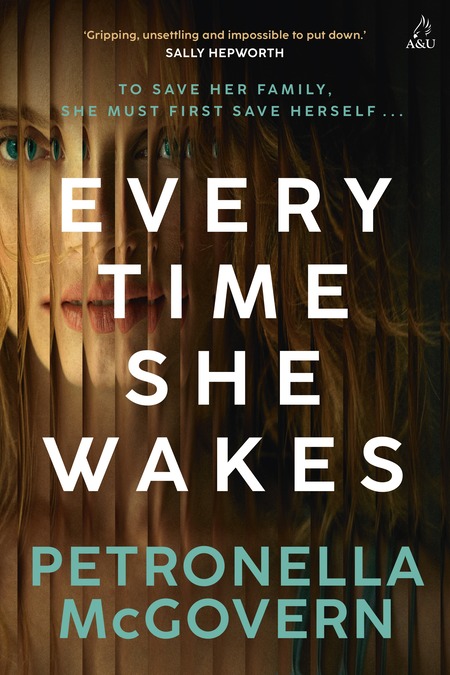
(courtesy Allen & Unwin – Australia)
If you ever have the opportunity to go to a book launch of any kind, even it features a genre that usually doesn’t trouble the heaving shelves off your overstacked TBR, then you must go.
Not only will, of course, have the great pleasure of being introduced to a newly-published book which, if you are sensible you will read and no doubt love because this is the way of these things, but you will get to hear from the author about why they wrote the book and what led them to do what they did character-wise, narratively and overall vibe, flow and theme.
It’s a real gift, one which provided triple the joy recently, when this reviewer was able to go to a crime fiction panel (also featuring Dinuka McKenzie’s She Lied First and Emma Babbibngton’s The Gardens) staged by Dymocks as part of their Books in Bars series, at which Petronella McGovern debuted her trippy, emotionally impactful and brilliantly clever new novel Every Time She Wakes.
I made the transition from kids’ books to adult reading material quite a few decades earlier with the books of Agatha Christie (a suggestion made by my much-missed Dad) and yet somewhere in the intervening period, I lost a love of crime novels for reasons I can’t fully articulate.
Thankfully, in recent years, a close friend of mine, and also a colleague, who are both into crime fiction, have inspired me to give the genre another crack and I’m glad they did because reading thrillingly good books like Every Time She Wakes are the result.
As Vince says, I’m mentally exhausted. In my dream, I’d already handed over my resignation letter. But in reality, I haven’t written it yet. And I haven’t met the journalist either.
The nightmare of being kidnapped is my intuition warning me.
I have to make smarter decisions today.
Touted as an unputdownable thriller with the mother (literally) of all good mysteries at its heart, Every Time She Wakes is the sort of book that defines the term “page-turner”, delivering a story of such highly-accessible complexity and edge-of-the-seat stakes that you wonder, on almost every page, where things will go next.
That is a brilliant state to be in when reading any book because how often are we truly surprised in this well-telegraphed digital world of ours anymore, but it’s even more of a pleasure when you’re reading the work of a writer who understands how to maintain the taut but necessary balance between tantalising possibility and a known state of being.
Set in the leafy suburbs of Sydney where dense bushy national park meets the bitumen and bricks of suburbia, Every Time She Wakes begins with a kidnapping, that of Suze and her family – husband Vince and teenagers, 19-year-old Frankie and 15-year-old Issy – and Frankie’s relatively recently installed BFF, Clio, by two people purporting to be firepeople evacuating residents threatened by a nearby bushfire.
With news reports buzzing constantly about the threat posed by the gum tree-fuelled conflagrations, and the need to get out of your home when instructed, Suze doesn’t question what they’re told to do; that is, until the van they are in races past likely evacuation centres and keeps on going until, triggered by events best left to the reading, it crashes, killing presumably everyone onboard.
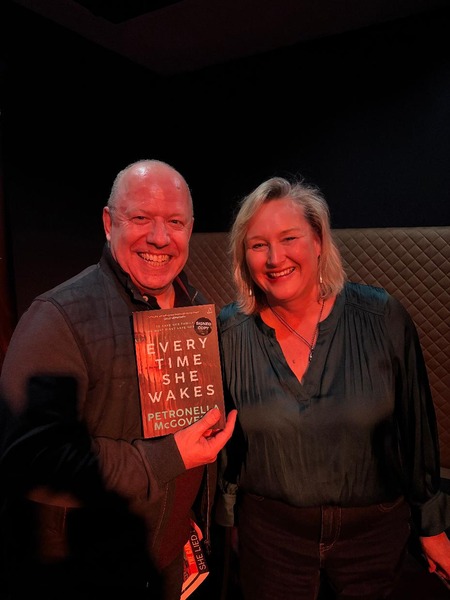
Reviewer pictured with author at Dymocks crime fiction panel Books in Bars on Thursday 13 August 2026)
Except that it doesn’t.
Suze wakes up the next morning, two weeks before the kidnapping even happened, safe in bed with Vince, with her two daughters and Clio fast asleep elsewhere in the house, forced to conclude, because what other option is there that makes any sense, that she dreamt the whole thing.
Only, in this fiendishly clever and richly human thriller where it’s not only the events that propels things but the deep abiding trauma of its characters, most particularly Suze, it all really happened, and as the Groundhog Day-ish cycles of awakening, discovery, terror and death play out again and again ever-increasing speed and frequency like some sort of demented rinse-and-repeat motion, Suze realises that she must work out who is kidnapping them and why if she, and her much-loved family, are ever to be free of this weirdly-entrapping temporal curse.
She is also under mounting pressure to stop the cycle because every time it does its trippy things, her world changes, usually for the worse; careers options narrow, people come and go and the entire fabric of her existence begins to diminish in size, depth and emotional richness.
What is most remarkable about Every Time She Wakes is that though there is a first-class mystery at its heart, one that will seize the imagination and clutch the heart tight with its seemingly impenetrable unknowability (thought masterfully explained bit-by-bit), the novel is at heart an exploration of how trauma can shape us and if there is a way, easy or otherwise, to escape the damage often done decades earlier.
Stretching up my arms, I tilt my head back and scream into the sky. The sound barely echoes around the valley; it’s muffled by the smoke and dies away amid the decaying tombstones.
I have to go back.
While Suze has no choice to work on the whys and hows of a confounding series of events that shouldn’t make sense in the world we know – although, increasingly, the idea of a multiverse of possibilities governing life on earth, is gaining currency – she also has to grapple with the fact that it’s her own trauma that might lie at the heart of the mystery.
Surrounded by people she loves, and some truly terrible human beings who you will love to hate throughout the story, Every Time She Wakes is, at its soundly-realised and emotionally resonant core a study of the way we go through trauma and either pretend it didn’t affect us or we do our best to disguise the lingering aftereffects, shoving secrets down left, right and centre in a futile bid to pretend it’s all gone away.
But trauma is rarely that accommodating, and its lack of a neat and tidy outcome is in full glare in the richly told surrounds of Every Time She Wakes which is a rip-roaring time slip thriller of the highest order, and one which could well threaten how much sleep you get as you understandably bargain with yourself to read “just one more chapter”, but which also knows that sometimes the most extraordinarily terrifying things in our lives have their roots in trauma past, and the decisions and accommodations we make in the light of it and that maybe the only way to break the cycle is to choose freedom, to place ourselves and what we want at the heart of the story, and to then somehow protect and nourish what matters most rather simply given into expedient, and ultimately damaging, immediacy.