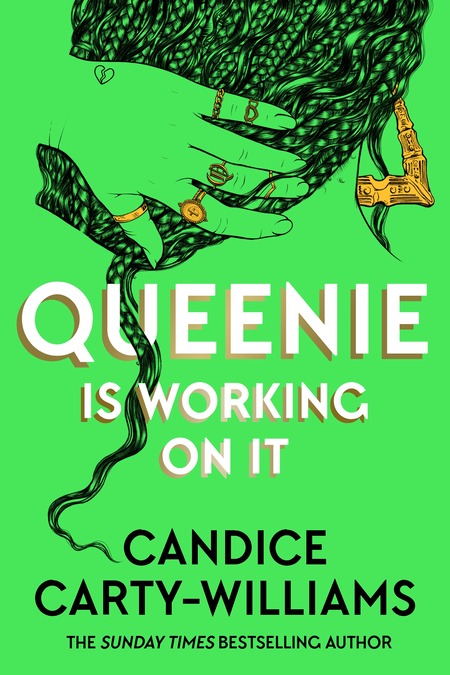
(courtesy Hachette Australia)
Some seven years ago when I had the great fortune to read Queenie by Candice Carty-Williams, it became quickly apparent that here was a protagonist I was going to really love … A LOT.
Queenie was everything you could want in a leading character, so much so that I gushed generously about what it was a joy it was to spend time with her:
She is, hands down, one of the most real, human and fully-formed characters you will ever meet in any book, a woman who is acutely aware not just of the personal demons she must face down but those that come with being a black woman in a society that still, even in the supposedly progressive 21st century, elevates all things white above any other cultural touchstones or concerns.
Picking up with Jamaican-British Queenie roughly eight years later in Queenie Is Working on It, you have an immediate sense of friendship renewed, of being reunited with someone you came to know and love and who continues to be every bit as real as she was before.
What really stands out this time is that Queenie is trying her best to make a go of things; she has a brilliant new job working as a writer and editorial director at a Black-owned and run online magazine which is doing its best to raise the profile of the many talented Black creatives working across the UK, the vast majority of whom, unless they are an in-demand rapper, are often overlooked by a very white-centric mainstream press.
‘Looks like we’re all growing up, innit?’ Kyazike sighed. ‘Listen, one of us has to get married in the next couple of years. We’re reaching middle age.’
As Kyazike turned on the TV and started flicking through channels, I felt the wound rip open. And I didn’t just remember the good stuff with Frank. I remembered the pain of being seen. I remembered the confusion that he was there despite knowing how much of a mess I was. I remembered not having answers to his questions. I remembered the end.
But while Queenie is kicking some impressive professional goals, though not without some significant headwinds and some serious impostor syndrome at times, her personal life continues to defy an easy fix.
She is slowly repairing her relationship with her once-hugely neglectful mother who is trying her hardest to make up for not being the mother she should have been, with much of Queenie’s mothering falling to her devoted Aunt Maggie and her grandmother and grandfather, she attends weekly family dinners without fail, trying though they might be at times – her family are lovely but they are a LOT – and she continues to talk in a group online chat with her bestie Kyazike, her cousin Diana and Cassandra who is slowly fixing the damage done to their friendship.
Goals getting kicked friendship-wise but not romantically, with her man of the moment Vin, all muscles and sex but no commitment a player with whom Queenie stays in contact long beyond their “relationship” use-by date because she can’t admit to herself that letting Kyazike’s cousin Frank, whom she has known since childhood and with whom she was in a brief but perfect relationship, was the biggest mistake of her life.
She is also trying to get pregnant, or at least work to making that a reality but some fertility issues and man troubles are cruelling any idea she has of being a mother which only start to become an issue for her because of an article she is writing.
If you were to look dispassionately, you might assume Queenie was a big old irredeemable hot mess but though she struggled to make headway in the first book, though growth was achieved and victories won, she is someone who is slowly but surely getting there in Queenie Is Working on It.
A consummately good writer who is able to bring forth characters who are flawed but not completely useless at being human, in other words, everyday people like just about every one of us, Carty-Williams does a superb job of making Queenie feel groundedly honest and real.
Does she make a hash of things far more than she and everyone who loves her (though she still thinks she’s unlovable) would like her to? Yes. Does she seem to be caught in the same PTSD-laced emotional trap of a childhood that continues to leach into and affect her adulthood? Also yes.
But here’s the thing, and why Queenie is such a beautifully honest and real character – she may make a mess of things but it’s not want of trying not to, and if you have ever struggled to best the painful trappings of a traumatic past, you will understand why even the best intentions in the world can fall afoul of entrenched and wholly unhealthy habits.
Queenie is brilliantly talented and clever and kind and thoughtful and a whole host of things that the better angels of our nature would love to have as their own, but she is often sabotaged by the fact that she doesn’t think, deep down anyway, that she deserves all the good things that should be coming her way.
She doesn’t believe in herself or in her lovability and much of Queenie Is Working on It centres on her trying to get ahead while trying to gain some leverage about her unconscious sabotaging efforts.
Why did this stuff happen to me? Was I magnet for disaster? Why couldn’t things with me just be normal? I know that my therapist always gave me a metaphorical smack on the wrist for using the term ‘normal’, but still. Whatever my life had been up to this point was far from it.
One significant thread running through Queenie Is Working on It is the power and strength of female friendship and how, while it matters for people of all racial backgrounds, it matters especially for Black women who continue to have to prove themselves over and over again in ways not even remotely demanded of their white counterparts.
Much of the professional life thread of Queenie Is Working on It centres on Queenie being patronised by people at her previous workplace who want to look diverse but don’t really want to put in the substantive work needed to really make a difference, with their hot and cold support for what Queenie does so well, and the Black talent she wants to lift up on a much bigger platform than her own, causing our beloved protagonist no end of grief and stress.
In certain key ways though, Queenie’s greatest enemy is her own lack of belief in herself and love for who she is, and it’s here that Carty-Williams writes her so beautifully with the character coming across as someone who stumbles and falls, yes, but who is hampered by the very real issues that come from a traumatised childhood.
There is real empathy and love for the lead character in Queenie Is Working on It from Carty-Williams, and every reader with a warm and open heart will feel it too as this funny, heartbreaking, hopeful and all too real novel comes alive with the adventures of an amazing woman who doesn’t have it all together, but who is most definitely, and beyond a shadow of a doubt, working on it.