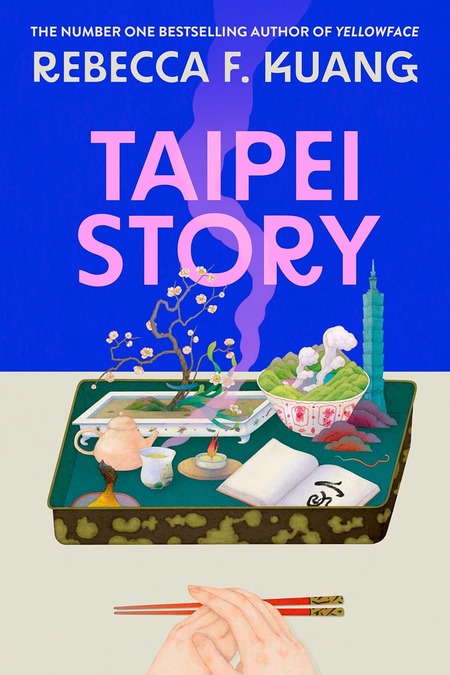
(courtesy The Borough Press)
Finding your place in the world is no easy thing.
It’s a seemingly impossible task made all the more complex and challenging when you are under a huge amount of pressure, external or self-imposed, or sometimes if you are truly unlucky, both, to be a particular type of person or follow a specific path or journey chosen for you, not because it suits you but because it has been decided you must.
Lily Chen, the protagonist of R. F. Kuang’s latest novel Taipei Story, knows exactly what kind of pressure situation feels like; or at least she thinks she does when she arrives in Tapiei from Boston in the U.S. for a summer of intensive Chinese language learning.
She arrives with the voices of her parents ringing in her head, voices which wish she would be more Chinese like her first generation immigrant Mainland Chinese parents are used to, that she would speak the language of their youth not out of a sense of obligation but because it is an intrinsic part of her identity.
It’s not that Lily doesn’t want this; she arrives in Taipei wanting to blend in, to be part of the crowd, to have her Chinese heritage be more than a part of her in passing but with more permanence, meaning and certainty.
And she’s signed up for what’s regarded as the most rigorous of the intensive courses so she clearly means business, or at least that’s what she tells hereself.
At the bakery, I hadn’t yet opened my mouth when the girl at the register reported my total in English. This also happened at the bubble tea stand, the post office, and the umbrella store.
‘That’s normal,’ said Skipper. ‘Young Taiwanese people like to practice their English.’
But socially awkward, caught between her parents and her sister’s endless feuds – her sister is far more outspoken about who she wants to be which causes friction with her mum and dad; Lily, by way of contrast, is far more compliant, eager to please and determined to be a good Chinese girl (even if she seems to be failing to be the perfect daughter her parents want).
It’s only when the idealistic excitement and breathless anticipation of her first few days wear off and she’s plunged into a grueling workload that leaves her reeling, exhausted and profoundly doubting herself that she begins to wonder, endlessly if she has what it takes to not only speak the language (spoiler alert: she does but she can’t see that much of the time) but to be as Chinese as she thinks she should be.
But where exactly is that level of perfect Chineseness and how will she know when she gets there?
Her classmates, who are either friendly, adversarial or indifferent in the hothouse environment of intensive language learning, don’t seem to be as bothered about this issue as she is and much of the story revolves around the friction she feels with her own and here parents’ expectations, but also with her temporary learning companions who don’t seem to be as fussed about how Chinese they are.
Learning the language matters, yes, and they want to success there but none of them brings as much overarching earnestness to the process as Lily does.
You do feel for Lily much of the time.
Even if you are not bicultural and have never had to sort out where you are on a spectrum of two often quite different cultures, you will readily identify with what it is like to be caught between two impossible sets of standards and expectations, wanting to be both and yet finding it hard to inhabit them equally.
Kuang does an affectingly clever job throughout Taipei Story of illustrating that while Lily, all social awkwardness and rampant overthinking, knows she is being borne down upon by pressures she could discard should she choose to, she finds herself unable to do so.
As the summer progresses, all homework, food discoveries and awful gossip that follows an ill-advised trip away to a spa resort with a guy she likes, Lily finds herself alternating between being ever more driven and switching off, escaping into orchestral concerts and arthouse cinema in a bid to give herself some sort of breathing space.
The pressure on her is immense, and while she can’t do much about the unrelenting workload of her language studies, she can do something about the familial and cultural expectations but instead of dialling the latter pressures down, she amps them up, wanting to know more about her family, where they come from, what happened to them and more.
Her drive to embrace her family heritage becomes so intense as this highly engaging novel progresses that even her mother is surprised at what she wants to know and why.
But now the apartment was silent, and there was nothing so frightening as the nights when sleep wouldn’t come and the dark was as vast as my imagination — when I had filled the void with everything I had done wrong.
There’s a good chance not everyone will agree with where Lily lands by the end of Taipei Story and how she sees herself as a Chinese-American woman.
But the fact of the matter is that Kuang never presents Lily’s time in Taipei as any sort of authoritative exploration of what it is like to be caught between two cultures and belatedly trying to embrace the side you have neglected for a whole raft of reasons, and in fact, the story comes across as a thoughtful study of the many ways you could see this kind of situation.
What emerges most strongly in Taipei Story is a picture of one young woman having her life placed under a spotlight-lit microscope for eight or so weeks during which so many questions and realisations are thrown up that she begins to wonder which way is up, a sense of discombobulation amplified even further by the death of her grandfather in China whom she knew but not as well as she thought she should have.
It’s a lot to deal with at any time but most emphatically when you are trying to keep with a course of study which comes with a ton of unyielding expectations and goals to meet, and when the language you are learning is not vocabulary and grammar rules but a pathway to a clearer sense of identity.
Maybe.
Funny and moving and never really letting up, Taipei Story is a story of one remarkable young woman grappling with intense thoughts and feelings about identity, culture and her place in the world, both the one we all live in and her smaller family-shaped one, and trying to figure out where home is when she’s never really at ease any place she goes and there’s no easy way to know what it will look like when she finds it.