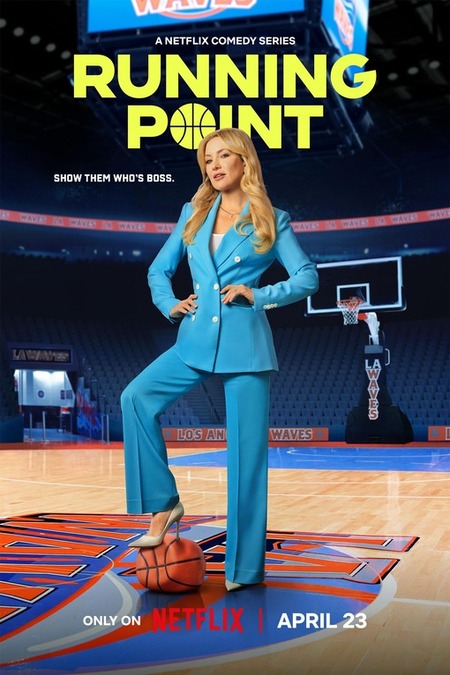
(courtesy IMP Awards)
Families, the kind that inhabit Christmas movies, heartwarming novels and feel-good streaming shows, are supposed to be all kinds of warm and fuzzy unconditionally loving and supportive, a calm port in the tossed and roiling seas of life.
The Gordons are NOT one of those families.
Oh, they love each other in their own weirdly sweetly and dysfunctionally touching way, and they even go out of their way to care for each other, well most of them do, but it’s hard to go all out on all that loving schmaltzy family stuff when you’re also running a business, and a BIG business at that.
Making that HUGE; in Running Point, the second season of which dropped recently on Netflix in all its highly bingeable glory, the Gordons run the biggest, most successful basketball franchise in the U.S. – the L.A. Waves.
The team is purely fiction, of course, but you suspect the mechanics of running a team like this, where salaries and egos compete for very limited space in the room and double-crossing is just another day in the office, are most certainly not.
In fact, if anything the show, which is funny and often touching in its delightfully quirky way, may even underplay the way things work in the service of some nice, sort of happy endings; in truth, as happens in one episode, you likely can’t switch from one sponsor to another, garnered to repair the team’s failing, much-neglected home court, without some serious legal repercussions.
But that’s surely half the fun of shows like this – you get some tension and drama but enough sitcom-y neat and happy endings that you feel cossetted and hugged just enough to feel good about the world, at least in part.
But Running Point which features Kate Hudson as Isla Gordon, President of the L.A. Waves after her successful but junkie older brother Cam (Justin Theroux) push one public boundary too far for the team’s PR people to stomach, is also happy to inject some real jeopardy into proceedings.
The cliffhanger ending to the season is a massive piece of WTS-f**kery but that must be left to the final episode where the lead-up gives you all the context you need to appreciate what a low blow act it is by one key character, but throughout the season, Isla has to dodge betrayal, end-runs, duplicitous bargaining and not a little concerted misogyny which assumes a woman can’t run such a high profile basketball team.
Guess what? She can and she succeeds, wildly and brilliantly, and while Cam, newly sprung from rehab by some typically underhanded maneuvering hates that, though he never says it out loud, her other brothers – General Manager Ness (Scott MacArthur), CFO Sandy (Drew Tarver) and Jackie Moreno (Fabrizio Guido), the product of their father’s many extramarital affairs – eventually swing in behind her and the family becomes as united as they’re ever likely to become.
After all, the Gordons are the Waves and the Waves are the Gordons and so even a wedding rehearsal dinner at Isla’s sprawling home can’t help but become an out-of-hours business meeting.
Running Point has a lot of fun exploiting the messy boundaries between family and business, and much of the tension that percolates through the series comes from how everyone navigates, or let’s be fair, doesn’t navigate it very well.
The messy blurring of personal and work lines bleeds into personal relationships too in season two.
Isla is on the verge of getting married to long time on-off boyfriend Lev Levenson (Max Greenfield) ———- SPOILER ALERT !!!!! ———- when she calls it off, realising she’ll be able to be off the clock enough for them to truly work as a couple.
Ness and Cam are supposedly happily married, the first far more emphatically and sincerely than the latter, and Jackie has a girlfriend for whom he is asked to sacrifice the opportunity of a career lifetime (but will he?) but Sandy too struggles to navigate being the kind of person who keep a relationship going strong.
And when he and Isla do get second (and in Isla’s case, third) bites at the romantic cherry, they come some fairly involved, entangling complications that make you wonder if they will find true love.
Well before the end of series, anyway. (With a third season confirmed, that’s a way off yet.)
But while all that might make the show, and indeed the second season seem hugely intense, and yeah, it can be at times, unafraid of big stakes and open, vulnerable hearts when required, it is all ridiculously, wonderfully funny.
It’s not as offbeat as say Loot, though there are some happily quirky moments, pretty much all character-based which endear the show to you, but it has that steady beat of gently comedic moments that keep you laughing, but which also allow enough time for you to take it all the drama sandwiched in between the quips, the hilarious snappy dialogue and the goofily silly moments.
Running Point doesn’t try for hilarious laugh out loud funny, though it is absolutely capable of it; its great strength lies in its ability to make the jokes and get serious and have them entirely natural occupying the one scene.
A lot of sitcoms shoot for that vibe but don’t land it; thankfully, the team behind the show which includes Mindy Kaling as one of the creators, know what they’re doing and have a masterful ability to make you giggle before wanting to hug whichever character has just been handed a shit sandwich.
It’s an art and one Running Point has down pat and the delightful part about the show’s second season is that they are able to effortlessly build on season one’s strengths – fully-formed characters, near-seamless world-building, snappy dialogue and narratives that never feel overstuffed or underdone – and grow them so that as the season ends, you know everyone better, marvel at how they grow as a family (well, mostly; shh, spoilers) and want the very best for them, imperfect though they are.
And as mentioned there’s one helluva cliffhanger which makes watching the third season absolutely non-negotiable.
Running Point streams on Netflix.