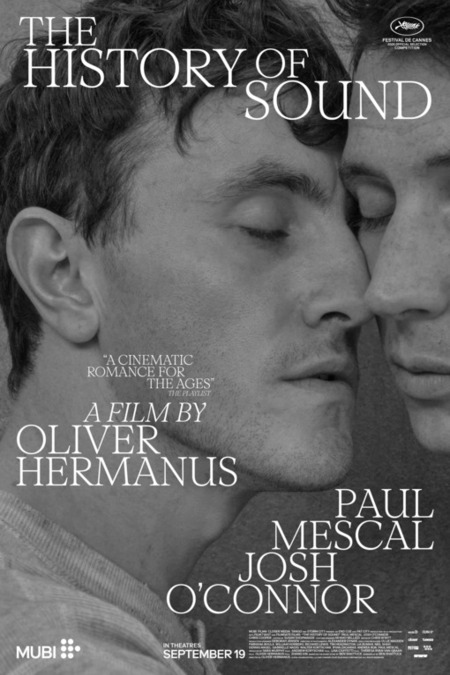
(courtesy IMP Awards)
Love in its purest form is supposed to elevate, enlarge, enthrall us, building and growing what was into something altogether bigger and better and different.
That’s the grandly idealistic promise that romantic love makes to us and much of the time, if allowed free and full expression, is exactly what’s delivered, even if, because we are human and we have a way of always muddying the waters, it’s not always perfectly realised.
The tragedy for those of us on the margins is that it not always given the chance to do what it does best, hemmed in by bigotry, suffocating societal norms and religious contrivance and its resulting orthodoxy, all of which is on heartbreakingly authentic display in the quietly arresting but emotionally powerful The History of Sound.
While the film was accused by a number of critics when it was first released of being too slow for its own good, it’s that very meditative quality which works movingly in the film’s favour, giving us a chance to digest in what feels like real time what it is like to find the purest love of all and to have it cruelled and marred by a world which simply doesn’t understand that love doesn’t simply come in heteronormative packaging.
Set largely in the years between 1917 and 1920, thought it ranges well beyond that at times, The History of Sound is the story primarily of a poor Kentucky farm boy, Lionel Worthing (Paul Mescal in soulfully perfect form once again) who is given a ticket of escape from his hardscrabble existence with his father and mother, played by Charles Sbarge and Molly Price, thanks to his beautiful singing voice and an observant teacher who saw the worldwide promise in his talent.
While singing was a way of life in many places prior to the arrival of recorded music, Lionel’s talent is far from run of the mill and it sees him get a scholarship to the New England Conservatory of Music where he meets the enigmatic David White (Josh O’Connor) who is an avid collector of folk songs and able to play and sing anything after just hearing it once.
The two men connect over their shared love of music in the pub where they meet, and then come together in an altogether different way later than night into the following morning when they sleep together and begin a clandestine love affair that, though pure in its expression, is up against a myriad of challenges from the get-go.
The most obvious of all is that being gay is illegal and men like Worthing and White are supposed to get married, have kids and say no more of a love that dare not speak its name.
But their strong attraction is undeniable and though they never really what you might regard as a conventional relationship, they pull apart and join back together again and again, most notably on a song collecting trip through rural America in 1920 which White says is funded by the college where he works and which is aimed at preserving fast-disappearing folk music which will be preserved on a box wax cylinders which the men lug around with them along with what is then state-of-the-art recording tech.
While the trip is a success, gathering up songs from a diverse range of settings including a unique community of escaped slaves and poor Irish immigrants on an island slated for development by that state’s governor, it’s real power and importances lies in bringing Lionel and David back together.
Suffering extreme PTSD after horrific experiences in the trenches of World War One, David is in need of an escape from a life of academia and it turns out later marriage (of the convenient kind) while Lionel, trapped on the farm he once left by an obligation to his ailing mother to keep it going needs a pressure valve release, and together they have months of time to walk and talk and sleep together in a way that their normal lives simply don’t permit.
It’s to be their significant amount of time together as the two men lose touch with David not answering any of the letters that Lionel sends him; heartbroken, Lionel takes a lover in Italy where he is singing in a prestigious choral group and attempts to go down the heterosexual marriage route until he realises with a crushing finality that his heart belongs to one person and one person only.
Any more than that and we are significantly into spoiler territory, but suffice to say that The History of Sound is a desperately sad and reflective tale of love expressed in its most pure and beautiful form only to be shoved back into a box and lost, on the surface at least, though it never of course, leaves Lionel’s wandering and querying heart.
He is a man broken by the love he found and lost, and in its quietly poetic way, The History of Sound takes us on an extraordinarily moving journey through one man’s attempts to live a life that is really shorn of all truly meaning and value when he lose the one person who truly made it something special.
Now, Lionel is too talented an individual to give up on life completely and the film shows him experiencing real moments of professional achievement and person joy, but we know as we watch his story, that these are really only interludes, fill-in things that, though good and impressive in their own way, don’t really ever make up for what he is lost.
In the final act, set in 1980, Lionel is a revered and much respected ethnomusicologist, impelled on that path partly by his love of music but likely also by his deep love for David and a need to keep his incipient legacy alive, and you could well argue his life has been a good one.
But the final scenes of The History of Sound makes it clear that whatever value and beauty his love now has and had, it is all tinged and compromised by the loss of David’s presence in his life and that love can never treated as something to be cut down and hemmed in and made to feel smaller than it is.
Love is everything and that is resonantly beautiful display through the lushly meditative expanse of wholly moving film which makes as powerful a case for love being love as I, a queer reviewer, have ever seen, and which sings, quite literally, about the power and beauty of connection and how it must be protected against all odds, though tragically, as The History of Sound makes heartbreakingly clear, that is not always possible.