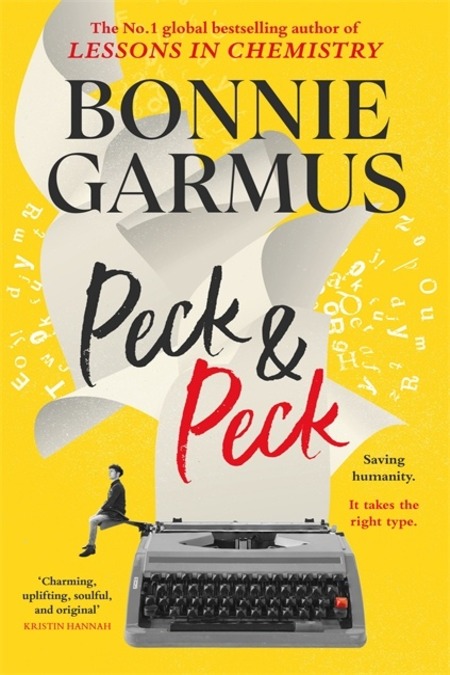
(courtesy Allen & Unwin – Australia)
It’s an interesting exercise diving into the sophomore follow-up to the debut effort of an author which was globally super popular and a phenomenon on all kinds of levels unto itself.
For a start, millions of people around the world have been waiting eagerly for the next novel to drop to see if literary magic can indeed strike twice, and once alerted that its in bookshops, have stampeded in expecting the new novel to be every bit as much the satisfying read and dopamine hit as the first super-successful, zeitgeist-shaping effort.
That’s got to be a lot of pressure for an author like Bonnie Garmus surely?
Whether it is or not isn’t obvious, of course, in the pages of Peck & Peck, the successor to the buzz-heavily successful Lessons in Chemistry (now also an adapted TV series), but it soon becomes clear that the new novel is not its predecessor and that it occupies a far less mass crowd-pleasing position in the literary firmanent.
That’s not necessarily a bad thing since the last thing many of Garmus’s fans want is a photocopy of Lessons in Chemistry and if she’s any kind of decent writer, and she very much remains one with her word play and eye for artful characterisation still pitch perfect, she will want to strike out for pastures new, preferably ones which have a whole new thematic sheen too.
The good news is that Peck & Peck, while having some of the feel of the global sensation that came before it, is very much its own highly readable, page-turning creation.
‘Because it was good, Pete.’
‘I know,’ he said, his voice dropping. He revered it as much as I did. ‘But we’ll still carry all the back issues; you can always reread. And look on the practical side: less time in the poetry section means more in the real world.’
I nodded in agreement. But we both knew poetry was the world. And part of it had just died.
For a start, it rests on a gleefully funny and clever premise which Garmus uses brilliantly well.
Peck & Peck is set in 1982’s New York City, all rough-and-tumble, garrulous crime-ridden chaos, in which the esteemed firm of the title have been publishing poetry for the masses (well, sort of masses) for the best part of a century from a grand, Srt Deco piece of building finery which gives off emphatic Willy Wonka and the Chocolate Factory meets Wes Anderson fantastical vibes.
In this architectural wonder, which has topiary cut into poetic letters outside and an “aviary” up top full of petrified espalliered pear trees and stuffed birds with grand staircases connecting all points in-between, operate 39 editors of various levels of skill and responsibility who must come up every quarter with daring and interesting poems which sing of the artistry and wonder of this most august and literarily evocative of written artforms.
The only trouble, as Peck & Peck makes clear again and again, is that publishing prestigious poetry volumes does not exactly resulting in mass market success and the kind of financial windfalls that come from publishing a super successful novel like, oh, I don’t know, Lessons in Chemistry maybe.
The firm is in trouble, a state of being that the protagonist of Peck & Peck ignores, one Batter Gray (he’s named after the family dog whose own name is an hilarious misinterpretation of a quite serious thing) when he accepts a position at the firm.
But rather than being hired as one of the firm’s legendary editors, who don’t move on too quickly or easily as you can well imagine, Batter, a 25-year-old poetry tragic from way back, finds himself in a far lower place on the company’s pecking order, which is not necessarily a bad thing when the two Editors in Chief, the wildly different fraternal twins, Salton and Declonius Peck, are at war with each other, their massively different outlooks on publishing poems, best summed up, rather crudely but accurately as art versus mammon, not gelling at all well.
Garmus has a great deal of fun playing around with the perceptions of what a firm which does nothing but publish poetry would be like.
While Peck & Peck has an august reputation, the kind that has made it a venerable if in-the-red bastion of the New York scene which somehow still rides high in the public consciousness, the internal machinations are as down and dirty as any sort of underground crime enterprise.
In a world where plagiarists are treated with a trip to the cultural and legal guillotine, and the purity of publishing poetry becomes a future-stealing end in and of itself which always runs the risk of being devoured by its own over-inflated sense of artistic self importance, tactics are dirty, near filthy and there’s nothing certain people won’t do to get ahead, no matter how much they might still sincerely in the nature of their God-given poetic mission.
He coughed again and closed his eyes. ‘Promise me something,’ he whispered.
“Of course. Anything.’
‘Keep following your gut. You’ve got a good one.’
These kinds of chaotic, messy background shenanigans should make for a fun and hugely playful novel and Peck & Peck certainly has a lot of fun channelling its inner Alice in Wonderland meets Wes Anderson vibe, and the twists and turns of the plot and the fortunes of the characters bring a considerable amount of enjoyment indeed.
But try as this reviewer night, the sense that Peck & Peck is not quite the book Lessons in Chemistry was can’t be avoided.
It’s not that the novel lacks in plot, characters or inventive storytelling, all star elements in the first book and very much still in evidence in its successor; what it doesn’t seem to have anywhere near as much of, which Lessons in Chemistry had in highly affecting spades, is emotional accessibility.
Batter Gray, while somewhat of a hero in the end, isn’t half the easy-to-identify-with protagonist that Lesson‘s Elizabeth Zott was she battled against the misogyny and male-oriented structural norms of mid-twentieth century USA; while he’s likably fallible and sweetly earnest, he doesn’t have the pull of Garmus’s easy to love and cheer on first protagionist.
It’s the very twisty-turny cleverness of Peck & Peck, which delights in its eccentricity, oddity and idiosyncrasy and which creates a hugely entertaining world in which bizarrely oddball narrative momentum and appealingly offbeat characters have a field day, that works against it; it’s a lot of fun to read and Garmus still has a gift for summoning up an immensely evocative sense of time and place in which highly memorable characters can do their thing but Peck & Peck, for all its love of the written word and the people who make it come alive, doesn’t pack the same emotional punch of its predecessor which ultimately makes it not quite the same read as Lessons was and which, and this is the unfair nature of literary sensations, it should never have had to try to be.