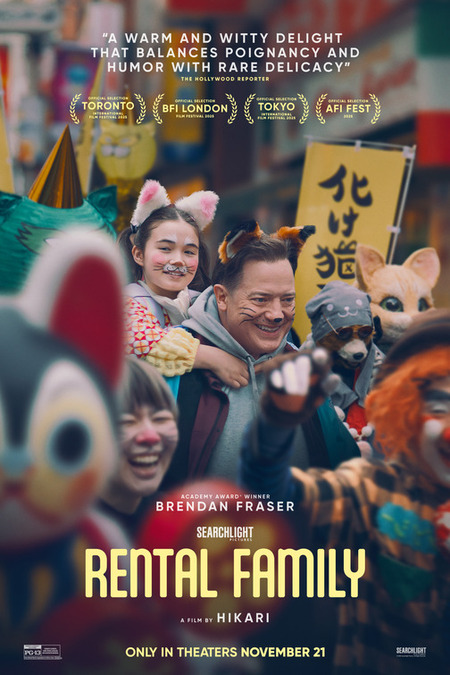
(courtesy IMP Awards)
People are not very good at bring authentic.
We talk a big name about laying your heart on the line or wearing it on your sleeve, and to be fair sizeable number of people do just that, but by and large, many of us play pretend about who we really are and what we’re feeling in order to keep the societal peace and smooth out the bumps and ripples of human interaction.
While these civilisational machinations are borne of good intention, they often come loaded with unintended consequences, something that Rental Family makes beautifully and heartrendingly clear throughout its nuanced and carefully thought out runtime of just under two hours.
Set in Japan, Rental Family introduces us to careworn American actor, Phillip Vanderploeg (Brendan Fraser in vulnerably affecting form) who has lived in Japan for seven years after coming to the country to star in a series of viral-worthy toothpaste commercials.
While the ads might have cult appeal, and prompt recognition of Phillip when he mentions he portrayed the central toothpaste superhero character, his career stumbles from one small job to another, and while Phillip has learnt the language and regards Japan as home, he is very much on the margins of Japanese society and feels quite alone.
How alone is movingly explored in a number of scenes where Phillip sits markedly alone in his studio apartment, looking out ruminatively at people in surrounding apartments, many of whom have someone to share their lives with; not everyone, of course, but there are enough people with connection that it underscores just how isolated Phillip really is.
This simple but effective approach to portraying how alone the central character is in a society surging with people is emblematic of a movie that has been written with empathy, heart and insight by the director Hikari (the mononym for Mitsuyo Miyazaki) who co-wrote this arrestingly gentle but emotionally powerful story with Stephen Blahut.
Things change, and quote remarkably too, when Phillip is booked for what he thinks is an acting job – it’s last-minute and his agent doesn’t explain the full details of the job as he dashes across Tokyo to get there in time – which introduces him to a company, which along with many others, which rents out actors to play the parts of fake fiancés, apologetic mistresses and even journalists pretending to write pieces about actors long out of the spolight.
Phillip initial reaction is that it’s all too absurd for words but needing the work, he takes up a number of jobs as the “token white guy” which introduces him to a number of people in desperate needs of connection such as an ageing but legendary actor with dementia, Kikuo Hasegawa (Akira Emoto), a woman in need of a romantic cover to escape parental expectations (Yoshie, played by Misato Morita) and most transformatively, Mia and her mother Hitomi (Shannon Mahina Gorman and Shino Shinozaki respectively) who need someone to play Mia’s absent white father so she can get into an ultra-competitive, prestigious school.
Quite where all these relationships lead – Phillip isn’t supposed to get personally attached but he has such a big heart and such a fundamental need for meaningful connection that he can’t observe that demarcation – must be lead to the viewing of Rental Family which takes audience members on a quite intense but nuanced journey through the need we all have to really connect with other people.
It’s the Mia story that takes central stage, though the Kikuo thread also packs a hefty emotional wallop and a sizable slice of the narrative territory, with Phillip becoming increasingly convinced that what is effectively professional lying to other people can’t have a good outcome in the long-term, even if it successfully fulfills an important short-term need.
For much of Rental Family Phillip plays his part, ticking the boxes that clients like Hitomi and Kikuo’s daughter Masami (Sei Matobu) have laid out as clients and which are understandably rigidly enforced by the company’s owner Shinji (Takehiro Hira), who have some secrets of his own, and Phillip’s colleague, Aiko (Mari Yamamoto).
But as Rental Family progresses, and the lines blur before unorthodox professional acting gig and the real world impacts on clients, Phillip begins to wonder about the ethics and morality of a system that allows people to hide their authentic selves and needs behind a veneer of thespian fakery.
While Rental Family does have some big “E” emotional moments, particularly in its raw and moving final act where a whole host of fabricated relational pigeons come home to roost, it mostly sticks to laying out some pretty big lessons about life in quiet, intimate scenes which underscore how what looks to be a laudable way to handle a situation might end up have some hurtful longer-term consequences.
A critique of a society where many things are still taboo and authenticity is sparsely used and often avoided in favour of artifice and politeness, Rental Family lays bare how much people as a species need to not only connect but to connect with a groundedness and honesty that many societal norms simply don’t allow for, especially in countries like Japan.
Knocking a considerable emotional punch and some moments of graphic realisation about how hard it can be to be authentic but how necessary is ultimately is, Rental Family is a sublimely beautiful and immensely journey into the often hidden and unexpressed heart of the human condition.
Fraser is in fine form as Phillip, much of the agony and sadness and quiet joy of his conflicted new job written large upon a face that conveys so much with the most subtle of gestures and expressions.
While it covers some intensely affecting emotional ground, the film is ultimately a joy, reaffirming again and again in a host of small but significant ways that we need to be honest and real, that we need our relationships to reflect that authenticity and that even though it be a wrench and all kinds of uncomfortable to transition from artifice to truthfulness that the end result is a powerful one and can transform lives for the better in ways no one expects.