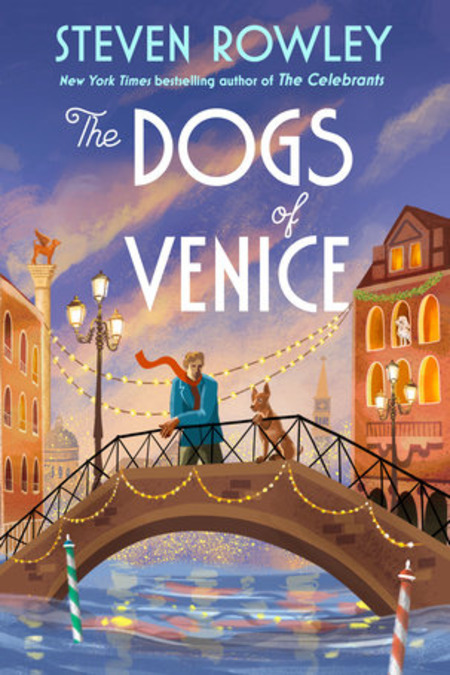
(courtesy Penguin Random House)
Can you ever get away from yourself?
Not really, but and this is crucial in the context of Steven Rowley’s delightful novella, The Dogs of Venice, you can get away from the place where you experienced trauma and that can make the world of difference,
So, same person, same pain but a different place and maybe, like the protagonist Paul in this delightfully meaningful tale, some much-needed insight and healing.
Set at Christmas in what is possibly one of the most romanic cities in the world, minus the flooding, of course, The Dogs of Venice is the story of one man who thought he’d found his forever love and happy home in the person of husband Darren only to discover that it wasn’t so permanent or joyful as he’d thought.
Broadsided by the sudden request for a divorce, which comes out of nowhere not long before the dream trip to Venice they’d jointly planned, Paul decides to go by myself anyway, answering the landlady’s query about their being two guests with a mournful “uno”.
It seems like the end of the road, and the trip a some of epitaph and wake in one, but as he settles into romance and experiences its food and atmosphere, and yes perhaps a sexually adventurous local, Paul begins to realise, little by little, that maybe there is life after huge personal loss.
And perhaps the one to teach him that is a small plucky stray dog that wanders the byways of Venice like he owns the place.
It [the dog] was so comfortable in its own skin and possessed such command; he could easily picture the dog waiting nightly in an alley behind a sleepy bistro for the chef to reveal from under a cloche a leftover bone from the kitchen’s special osso buco. Before the dog was a distant memory, Paul thought, That’s who I want to be.
If that makes The Dogs of Venice sound a little twee and a tad too cute, then banish those thoughts immediately.
Rowley, with his trademark wit and warmth, invests this small but emotionally powerful book with some incisive explorations of what it means to be human, both the bad (at first) and the good (eventually) and how when we’re in the depths of grief for anything that it’s hard to see how you won’t ever be lost in all the loss and pain.
The one thing, well, among many really, that ails Paul is his loss of confidence – he thought Darren was The One only to find out he’d made a grave error of judgement; so, how on earth can he possibly trust his instincts again?
He’s not sure he can ever approach life with any gusto or confidence, and The Dogs of Venice is, in part, a story about what happens when a once bravado-filled approach to life is drained of all its vitality and zest.
Sure, you can emotionally recover but can you ever be that confident again?
Or maybe, as Paul finds and then obsessively tracks a dog who seems to be unfazed by anything life on the streets throws at him, it’s a different kind of confidence that replaces the one you lost, one that knows how bad life can get and how wrong things can go and yet sallies forth and soldiers on anyway?

(courtesy stevenrowley.com)
Paul doesn’t know it yet but that’s the kind of confidence he needs.
With the wind well and truly knocked out of his sails, he could be forgiven for simply not trying again but this plucky little dog who, it turns out, may not lead quite the charmed life Paul first assumes he does but carries on anyway, slowly but surely inspires him to try again.
The key difference this time is that Paul appreciates that life can be terrible and messy and utterly undealable, and yet somehow, with the right mindset, you can move through it regardless.
What Paul learns is that he is enough, that he doesn’t need to pin all his hopes and dreams on someone else – “He would never need anyone again, unless they were open to needing him, too.” – and that, renewed and reinvigorated, he can approach life with confidence.
Just not the variety of it he once had, and honestly that’s a good thing because now he’s healthier in his outlook, more balanced in what he wants from himself and others and ready to deal with life in a way that’s far more grounded and honest.
It’s a wonderful place to get to and one of the beautiful things about The Dogs of Venice is how Rowley slowly but surely takes Paul on a journey to his sense of self, one that feels authentic and possible and not simply the product of narrative necessity.
He [Paul] sat up to listen. He’d imagined Christmas this year would land with a thud, but here it was being heralded with such beauty, and he was reminded of the miracles and renewals the holidays can bring.
So authentic is Paul’s journey that for all the wonder and magic that suffuses the novel – it takes place in the lead up to Christmas with all the attendant possibility and hopefulness that comes with the season – The Dogs of Venice always feels like something that could happen to any one of us.
That is likely the most magical thing of all.
When we read a book like The Dogs of Venice we want all the hope and newness and healing that it’s possible to put in a book and we want to feel that even though the world can be nasty and life can be brutal, and good lord Paul knows a thing or two about that, that change is possible, that we can face the pain and loss and look ahead to something better.
Many books offer that, and it’s good for the heart and soul no doubt, but it can sometimes venture too much into an escapist, fairytale vibe which, while happily diverting, can leave us feeling buoyed but rudderless when it comes to our life beyond the book.
The Dogs of Venice certainly offers healing, hope and possibility but it feels happily grounded as it does so, with Paul not having some sort of sudden, blockbuster-worthy epiphany but rather a quiet and very real sense that what’s learned while in the city can become part of his life once he leaves.
So, we get an authentic sense of hope from The Dogs of Venice which leaves you feeling like there is a way back from heartache and loss, one that makes sense in the real world and which will endure long after you depart where all the learning took place.