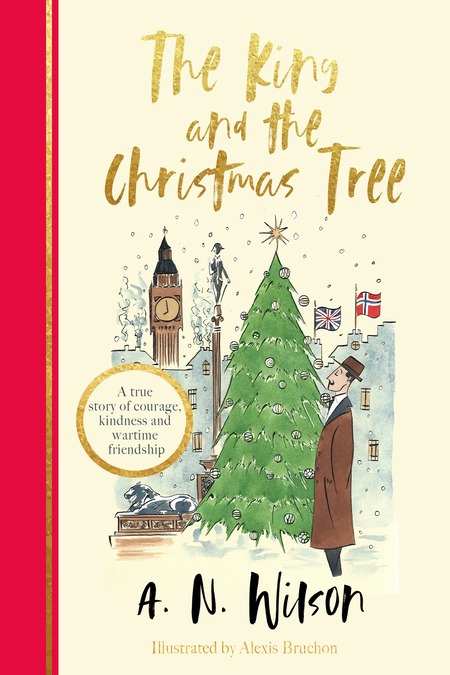
(courtesy Allen & Unwin Australia)
Since 1942, with a break between 1943-1946 and beginning again in 1947, Oslo has sent a minimum twenty-metre tall, eighty-year-old tree to Trafalgar Square in London as a symbol of the enduring bonds between the two countries, established most profoundly during the dark days of 1940-45.
“At the base of the tree,” notes A. N. Wilson, the celebrated author of The King and the Christmas Tree, “stands a plaque, bearing the words:
This tree is given by the city of Oslo as a token of Norwegian gratitude to the people of London for their assistance during the years 1940-45“
While for many people in Britain’s capital, the erection of the tree is simply the start of the festive season, the sparkling LED lights precipitating a glow of decorations right throughout the city, its presence is a symbol of how hard the people of two countries had to fight to stop civilisation falling into the abhorrent hell of the Nazi Death Cult.
In-between explaining how the tree is selected, transported and arrives in the UK, Wilson details in compelling, lyrical detail, why Norwegians have such a profound love for the support Britain gave them in the darkest days of their country’s relatively nascent independence.
But the remarkable part of the story is really that of King Haakon VII of Norway who decided, in direct contravention of many other monarchies and governments in Europe, that he and his government would not willingly submit to Nazi tyranny.
[When the tree is erected, the people of London and the people of Norway] are celebrating Christmas, yes, but perhaps unbeknownest to them, they are also celebrating their civic freedoms, their right to vote, their freedom of thought and expression; all the political beliefs for which their forebears fought so bravely in the Second World War.
His decision not to simply acquiesce to German might and fury, and the barbaric cruelty that always followed in its wake, energised the people of Norway, and indeed the Allies themselves, simply because they didn’t do the sensible thing as so many others had and they chose to resist.
As Wilson beautifully observes, being sensible in war, especially in the Second World War, rarely led anywhere good, and it was the countries like the UK and Norway which resisted, in direct contravention of all rational thought, that were the ones who stood the test of time and ultimately saved the world as we know it.
In fact, it was King Haakon’s down-to-earth bravery and liberal values which ensured that those beliefs prevailed; his cool head, and that of the government who followed him into exile in London, ensured that, unlike many other countries in Europe, their gold reserves weren’t looted and were able to fund Norway’s resistance activities, and that their merchant fleet was able to play a vital role in feeding and fueling Britain.
In many ways, the bravery and calm thinking of King Haakon and his unwillingness to give the wartime traitor government of Quisling any legitimacy – the internationally recognised government of Norway was always seen to be the one in exile – meant that Norway emerged from the war relatively unscathed and with much of its soul as a nation intact.
While ostensibly a book, and a hugely engaging one at that, about a beautiful and meaningful Christmas tradition, The King and the Christmas Tree is also a love letter to freedom, democracy, to the very best of humanity and to the idea when things are darkest, the light needs to shine all the brighter and it is up to good people everywhere to ensure the fire is stoked and never goes out.

(courtesy Bloomsbury Publishing)