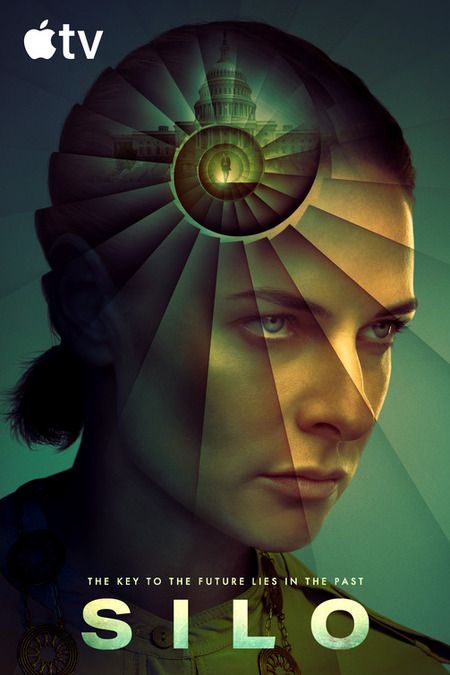
(courtesy IMP Awards)
Unless you live under a rock, and honestly as living strategies go it’s not a completely unreasonable one at the moment, it won’t have escaped your notice that humanity is potentially screwed in any number of emphatically species-ending ways.
As one character in the third gripping season of Silo observes, less, it must be said with sorrow that an chilling matter-of-factness, we are facing threats from viral pandemics, AI, asteroids, and climate crisis to name just four, and harrowingly, the list is hauntingly long, with the clock ticking on whether humanity will see out the current century as a going concern.
We have known since the series began, and longer if you have read the books by Hugh Howey on which the show is based, even longer, that the silos, all fifty of them, were constructed some 400 years earlier in our century by forces unknown who saw them as a viable way to keep Homo Sapiens around beyond whatever threat won the race to annihilate us.
What was seen as a way to keep the species alive until it could repopulate a nuclear war ravaged world has worked; well, as long as you don’t count the loss of democracy, freedom, self determination, a viable environment and sunshine and anything resembling the loss of civilisation as we know it.
The continuing stability of the world of the silos rests on people either not knowing about the way things were before everyone came to live underground, and remember no silo is allowed to know any other exists, much less contact them, or being made to forget through drugs which, if taken for long enough, rob a person of all their memories and any sense of self.
So, even if self determination was a thing, and as it stands, it’s limited in silos which feel more authoritarianly feudalistic than anything else, it can be taken away by medication which is administered to anyone, like Juliette Nicholls (Rebecca Ferguson) the protagonist of Silo, who dares to breach the Pact which controls all life in these mile-deep bunkers and question why it is they are there at all, and whether life couldn’t be better.
As season three opens, Juliette is being fed these memory-erasing drugs to keep her nice and meekly compliant, courtesy of the new head of I.T. Camille Sims (Alexandria Riley) whose husband, Robert (Common) remain the head of the Judiciary; he was the Big Bad of previous seasons, along with the presumed dead ex-head of I.T. (really the secret police of the silo system) but season three sees him switching allegiance in ways that will surprise and thrill watchers of the show.
Juliette is the only person to have left the silo and come back – see season two where she journeys to Silo 17 from Silo 18 where the series is set – and while that means she is a potential threat to the collective amnesia which is employed with oppressive insistency by a ruling elite who commune with what is assumed to be an AI entity (or is it?) in the Vault, the impromptu declaraton of Juliette as the new Mayor means neither Camille nor anyone else can do away her.
Hence, the compliance-enhancing drugs which render Juliette as a malleable vessel for those who need the narrative to track to a certain path and never, ever deviate from it.
But as is the way of systems that are tightly locked down with a fascistic fervour which brooks no challenges or opposition, eventually something has to give, beyond the rebellion which erupted at the end of the second season and which dies away to nothing with Juliette’s unexpected return, and that something is Juliette and patient friends and found family like mum-in-all-but-name Martha Walker (Harriet Walter), best friend Shirley Campbell (Remmie Milner), her partner and the Head of Mechanical Deagan Knox (Shane McRae) and a host of others who have, in their own highly effective ways, opposed a system which is clearly nearing the end of its useful life.
Season three sees the powers that control season three, with increasing doubt about why they’re doing it, and the thinking opponents clashing and then coming together in ways that will rewrite what we know of the silos and it’s fascinating to watch how the power shifts from episode to episode as understanding of the wider world grows and an appreciation that another way forward must be found comes to the fore.
Where season three is really interesting is the way in which it seamlessly weaves in how the silos came to be in the first place.
Much of how these seamlessly inserted flashbacks, which function as useful, narrative-enhancing exposition rather than current narrative-sapping devices which slow the plot down, must be left to the watching of this taut, exemplary season but suffice to say you will see a great deal to recognise about the way in which tech bros, geopolitical manoeuvring and runaway technology with no oversight (never has the phrase “Just because we can doesn’t mean we should”, popularised by 1993’s Jurassic Park but predating it, ever felt so resonant) all collide to doom, save and not-save humanity all at once.
As exposition goes, it’s masterful filling in of the blanks, and it makes much of what takes place in this status quo-busting season feel so much muscular, portentous and meaningful.
Quite what ends up happening to Juliette and everyone in Silo 18 must be left to what will now be a binge of all ten episodes, with the last episode dropping on 4 September, but it is a helluva of a game-changing ride which sees action, humanity and emotionally intimate moments come together in a story which is never less than thrilling, always groundedly and shockingly human, and which remakes Silo as we know it.
It sets the scene for the fourth and final season, which drops on 9 July 2027 and which will see the world change all over again, this time, you can only hope, for the better, though that, as with everything people touch, yet to be seen.
Silo streams on AppleTV
Is there more to the story? There is! The fourth and final season premieres next year …
A clip! A clip!