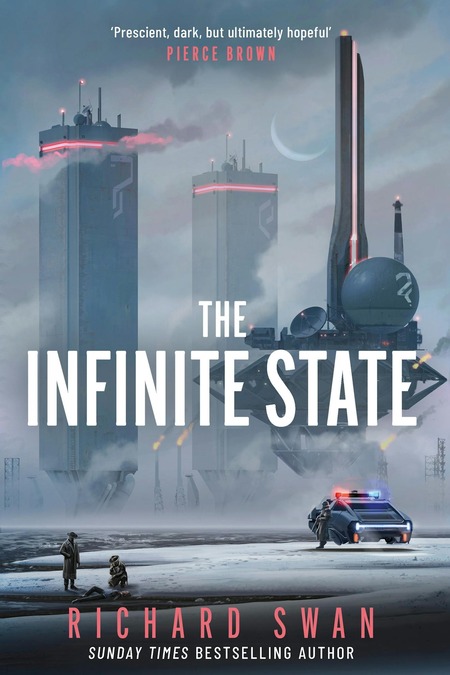
(courtesy Hachette Australia)
Watching the stop-start march of fascism across the globe in recent years, and the resistance of many people to its horrific progress, people who have noted history and are well aware of the sage lessons it teaches, has been unnerving and alarming but also somewhat removed for those of us who are still in functioning Western liberal democracies (though all are under assault to some degree or another).
What really sends the message home for those of us with no direct experience of fascistic government is reading a novel like The Infinite State by Richard Swan, a British writer now resident in Sydney, Australia, which pulls no punches whatsoever when it comes to describing what life is like under the unrelenting cruelly punitive hand of an authoritarian government.
Swan does no spare us any of the gruesome details, explaining in a story which is full of humanity and hope even as it delves into the darkest recesses of a society which has sold its collective soul to fascism, what it is like to exist in a world, in this case the 500-world strong Decurion Empire, where every movement is watched and scrutinised and punished should the action be found to be politically lacking.
The Empire, which exists alongside the Union of Free Nations (UFN), where democracy and high tech everything is the norm – one of the peculiarities of a society which Swan brilliantly describes toward the end of The Infinite State as “not a functioning government [but] a vast aggregation of information silos held together by a cult of personality” is how analogue it is in many respects and how ill-kempt it is – oversees everything from what can be said, what can be eaten, what you should do when and how, most importantly, how it should be done.
But she [Katherine] would do it. She would do it for Gabriel. She would do it for Eskil, and Yesper. She would do it for everyone who found themselves dead because they were randomly, politically expedient.
It is exhaustingly relentless, and should you fail to observe the correct obsequious behaviour, such as performing the “Salutations” to the Emporor or Pater Aeternus as he is known – Who gives you life? Pater Aeternus; Who gives you purpose? Pater Aeternus; Who gives you joy? Pater Aeternus – or dare to have an original or daring thought, you are punished, often up to and including death.
The Empire is a vile cruel and surprisingly fragile construct – it projects strength, and to some extent that strength is very real; but it is also frail and easily broken in other respects because there is no unity or community or joint strength with everyone out for themselves – and it is not to be trifled with as Katherine Fuller, the wife of a hugely wealthy senior Party functionary finds out when her husband dies in what to us would be a mysterious car accident but which is simply BAU in a society where disappearances are common.
Inheriting his immense wealth means Katherine has options, many, many options, but she also knows those options are heavily constrained and that life under Pater Aeternus aka Eternal father is “stratified, surveilled, and controlled” and that if she to truly live rather than merely limp along and survive like everyone else, she needs to do something daring and different.
That something is buying an undeveloped planet out in the orbit of the UFN and create a society where leaders are chosen, not imposed, where free choice is a right, not a sin, and where people can forge a life which is meaningful and substantial and not simply a collection of smoke and mirrors behind which unspoken seditious thoughts are expressed (if they are at all which, let’s face it, is hideously dangerous).
What The Infinite State makes scarily clear is how hard the state will fight back and how it will stop at nothing to stop anyone from living a life that is controlled to within an inch of its eviscerated life.
For all of the malignant cruelty and oppressive machinations around against them, what marks The Infinite State as something truly special is how much hope and possibility fill its pages.
Swan doesn’t pretend for one minute that sticking your neck out and creating a democracy on the doorstep of a cruelly despotic empire is ever going to be easy, and in many intensely frightening ways it is most manifestly not, but he does present hope as something strong and enduring and able to move mountains if those holding fast to it do not waver.
And therein lies one of the chief lessons of this impressively compelling novel.
He [Julian] launched to his feet automatically and joined in with the applause, each clap of his hands a betrayal. But what choice did he have? What choice did any of them have?
And so he clapped, and the crowd clapped, and they all cheered and brayed and looked forward to another year of horror.
While the Eternal Father and his viciously cruel rule appear omnipresent and omniscient and possessed of unassailable strength, and let’s not forget much of that is not fabrication but cold, hard brutal truth, the Empire he treats like a calcifying plaything can never be as strong and enduring as people united by ideals which speak of freedom, community, and mutual support.
Certainly Katherine and the disparately fascinating souls who end up her gloriously hopeful or doomed and quixotic experiment (depending on where you stand) wonder, particularly in the final third of the book, just how strong they really are or can be, but what emerges time and again in The Infinite State is how muscularly powerful hope and commitment to shared ideals can be.
When people are free to be themselves and to chart their own destiny, something quite powerfully magical happens, and yes, that doesn’t mean the threat of obliterative violence doesn’t vanish sadly, and they can overcome the kind of menace that the Decurion Empire represents.
Does that mean that The Infinite State is full of rapturously happy endings?
Not even close, though we can say that the hope evinced by Katherine and her team does pay some supremely exciting dividends that more than justifies their grand experiment in democracy, but sometimes the trying is the thing and that emerges quite strongly in Swan’s immersively brilliant, page-turning triumph of a novel.
Full of grandly thrilling ideas and the darkness which seeks to render them to nothing for all time, The Infinite State is a sci-fi novel that acknowledges how fascistically dark the world can be and how brutally nasty it often is but which dares to strike a flame and nurture it, a flame which may not change the galaxy at first, even if its changes many peoples’ lives, but which eventually makes remake everything, if only because finally people are asking “what if” and daring to see where that answer goes.