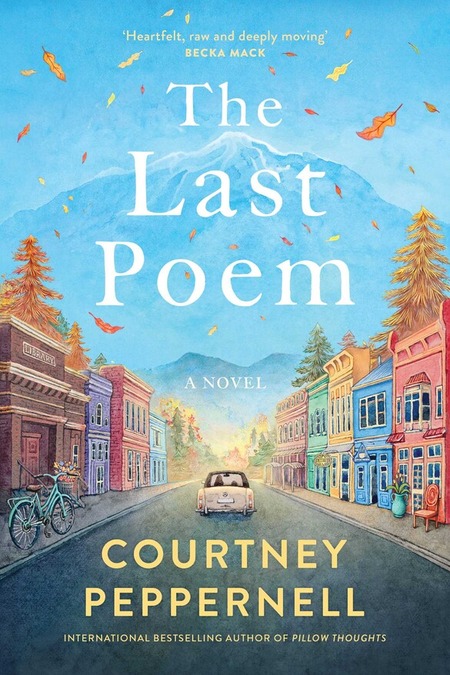
(courtesy Simon & Schuster Australia)
When my parents died less than four years apart in the mid-to-late 2010s, I was plunged into the kind of grief I had never really known before.
And honestly, I wasn’t sure what to do with it; I expected it to be intense then ebb away and then settle into something I could maybe live with but it kept rollercoasting along, taking me, taking me down, and never following any kind of chronological pattern or adhering to any sense of certainty.
I now know that grief doesn’t operate to a schedule but it took a lot of deep sadness and living with loss day-to-day to understand that and so, it’s wonderful to see the truth of that, and how grief manifests differently for each person caught in it, reflected in the heartfelt, poetically rich pages of Courtney Peppernell’s novel, The Last Poem.
From the first pages when we meet Brooklyn Wren Paisley, lost in the grief of tragically losing her fiancée Lucy in a car accident, this movingly evocative, emotionally intimate and nuanced novel treats grief the way it should be treated – as something that completely devastates a person’s life and which manifests in ways as different as the person themselves.
It may sound weird to say but it is such a joy and a relief to see this reflected so incisively and thoughtfully in a knowledge and to have your experience of grief validated in some way.
The thing about grief is that it doesn’t care who it targets. It will visit anyone’s doorstep, and when you open the door, you never know who will walk in, and who might walk out.
That’s why our group wasn’t just for those who had lost someone to death; it was for anyone carrying the weight of loss in all its forms. Sorrow has many faces, and each one of us had been forced to confront one of them.
The Last Poem is so empathetic in every fibre of its narrative being that you gasp in recognition just as much as you sigh with happiness at the way all the characters in the book, members of a grief group that meet in the local library of the caring and watchful idea of young thirties librarian Henry, become members of a the most beautifully mutually supportive found family.
The existence of the group is not something Wren, as she now calls herself in an attempt to distance herself from her old celebrity-status life as a famous poet and novelist in New York City, knows about when she arrives in the small, cosy mountain town of Everston, Colorado, marked by mom-and-pop stores, vibrantly, colour-diverse frontages and a sense of community that permeates every aspect of everyday life.
Wren really isn’t thinking of much beyond constant memories of Lucy and trying to find her again by visiting all the towns that the onetime art dealer would visit on her work trips, where she’d pick up at coasters from the bars she drank at to bring back to her beloved Wren (wrens were also Lucy’s favourite bird so the name has extra resonance there).
Everston is where the last coaster came from, and it’s here that Wren settles, unable to write thanks to grief’s heavy pall, with the semi-recluse spending her time renovating the long neglected home of senior citizen Gill, who is a member of the grief support group and eventually Wren’s pancake buddy at Sam’s Diner.
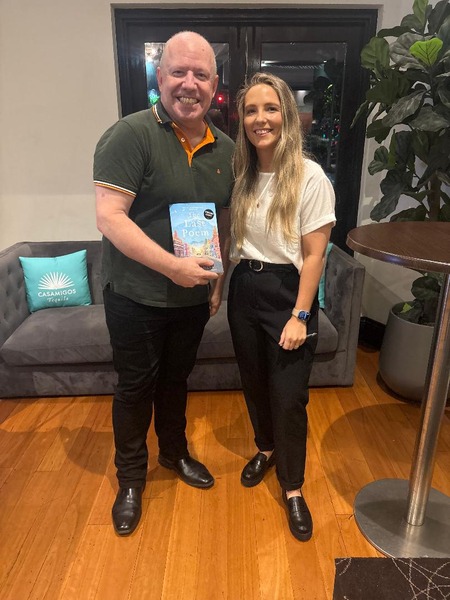
(the author (right) and the reviewer (left) at Dymocks’ Books in Bars event, Thursday 19 march 2026)
Wren isn’t planning on connecting herself with anyone, least of all the members of a grief support group but as she gets to know Gill and Henry, she finds herself drawn to the group, initially by virtue of the simple fact that she’s drinking one Tuesday night at the bar where an issue with the library’s plumbing has forced the group to relocate.
There she meets the rest of the group – Rita, Emmy, Bobby, Winnie and Julian, and most importantly, Olivia, a hard-bitten journalist grieving the death of a mother who never really loved her properly – and ends up becoming friends with them all and discovering that maybe her grief can become something else entirely, hard though that it to imagine.
The brilliance of The Last Poem is that it cracks open each and every mistaken idea we may have about grief and challenges them in the most loving and poetically caring ways possible.
Much of this is due to the fact that Peppernell is also a celebrated, internationally bestselling poet whose books have entered the homes and hearts of people the world over, and it makes sense then that poems feature heavily in the plot as each member of the group is asked to write a poem that reflects what grief and loss has been like for them and maybe what a future beyond its initial intensity might look like.
She [Wren] moved into my arms, holding me close to her. ‘This is what’s best, Liv,’ she whispered against my neck. ‘A new life. Here, in Everston, with you where nothing can hurt us.’
I [Olivia] held her tighter, knowing she needed this moment. Knowing, perhaps, that I needed it too.
These poems are sprinkled artfully and with great meaning through a novel that wears its heart very much on its sleeve, in ways that feel both devastatingly honest but also hopefully uplifting, and which stares grief right in the eye, admits how awful it can be but how by admitting to that truth, there can be healing and life beyond it.
The Last Poem sings with pain and joy in equal measure, and this is in part to its willingness to explore grief as it actually is.
People don’t mean to do this, of course, but when they are comforting a friend or family members lost in grief – which, by the way, takes many forms for many reasons and isn’t simply the result of the death of someone you love – they inadvertently try to minimise how grief feels and how quickly you should recover from it.
The real gift of The Last Poem of this raw, deeply emotional novel is that is simply says grief IS and by not putting labels on it or defining expectations, allows those caught in its grasp to breathe a sigh of relief, as all the characters do, that what they are experiencing, even though it might differ wildly from those around them, is completely valid.
Filled with honest reflections on the pain of grief and its slow, long passage through our lives, The Last Poem also celebrates loving again, in whatever form that may take, offering the promise of healing and renewal in the most glorious of ways at a time when people think life has ended.
It hasn’t, sings The Last Poem quickly and beautifully, it’s just different, and that is okay.