Figuring out who you are is one of the most monumental, and yes, challenging parts of growing up.
It’s messy, it’s three steps back to one step forward, or at least it feels that way, and it rarely makes as much sense as we want it to; but if that’s not enough to do your still-growing head in, then factor in realising you’re gay in a world, that for all its outward acceptance, still expects the world to fit into a clean and tidy, and extremely heterosexual mold.
As someone who realised they were gay the moment puberty hit, and who hd wrestle with what this meant as the member of a Christian denomination that saw being gay as a great, big “Shame! Shame! Shame!” (think Game of Thrones) sin, it made the normal coming of age chaos of being a teenager, already complicated enough by incessant bullying (because everyone decided, rightly as it turned out, that I was a poof), into a diabolical obstacle I felt ill-equipped to go around or through.
When I did finally come out, and it was ironically thanks to the patient counselling of a Christian therapist – he accepted me to choose Jesus but I chose something far more carnal instead – I was faced with an altogether, though intimately related conundrum – what does it mean to be a gay man when all I’ve told is how dark, terrible and morally bankrupt it is.
I honestly had no idea how to express being a man and being gay that wasn’t some collection of very tired and not authentic to me tropes.
The public Zeke Calogero is an award-winning academic; a diligent employee; a responsible roommate; a good, honest son, brother and uncle; and, most importantly, a massive fucking lie.
The private Zeke Calogero is the burnout, the hedonist, the Aussie Jack Kerouac, the free-spirited man currently spreading his hole for a daddy to eat in a bathhouse.
Every day for seven years, the two Zekes have gotten further apart, to the point where I don’t think I’ll ever be able to put myself back together. I honestly don’t know which one is really me anymore; which one to keep and which one to kill.
Turns out I wasn’t alone (and yes, it took a while to get to the actual review but trust me, the above is important and germane to what follows).
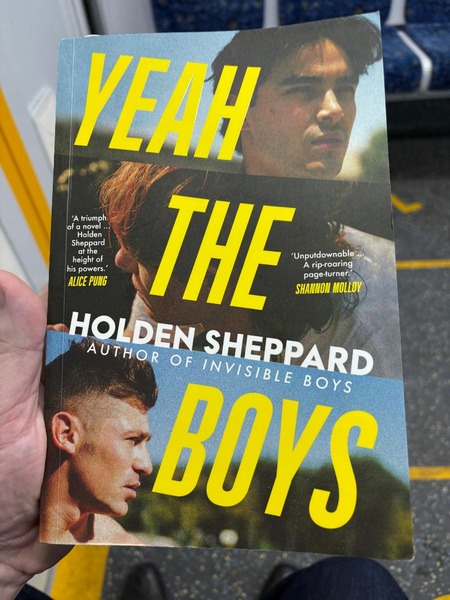
In Holden Sheppard’s engrossingly illuminating new novel, Yeah the Boys, each of the three main characters, all schoolmates from Geraldton W.A. (where the author himself is from) from one of his previous novels, the YA-situated Invisible Boys, has to come to grips with what being gay means for them beyond the host of stereotypes and deep-seated personal issues that have sent them all more than a little off course (although again, what does “off course” even mean when you’re really sure when you’re on it? All they know is, life feels empty and lonely and there must be a better way).
Charlie, the one who’s been out the longest, though not by choice after an involuntary outing when he was still in school, is the one you would’ve thought would have made the greatest mark of the lot of them, well and truly unwilling to dance to anyone’s tune but his own.
As a failed punk musician who has failed to crack any kind of big time despite his best efforts, Charlie feels like he hasn’t lived up to his envisaged potential, and it’s not until he’s taken under the wing of sixty-year-old Black American expat named Curtis, and his younger husband Ahmed, and becomes a founding team member of their bar, that he begins to see a way forward that might be worth something.
Feeling similarly unfulfilled though for wholly different reasons is Zeke who, if you’ve read Invisible Boys, you will recall had a rocky time coming out as his very controlling, Italian-Australian Catholic parents made it very clear they would never consider to a son of theirs being gay.
After he and Charlie escaped to Perth on a whim, he returned home to Gero, as the author describes it, to finish high school, only returning to the “big smoke” to do a uni degree which he financed by working in a call centre.
Filling the void of grinding unfulfillment with endless anonymous s*x, Zeke feels like he is heading nowhere fast, living with his ex-girlfriend in a Will and Grace-ish domestic setting, uncertain of how to reconcile his vigorously testosterone-filled sexuality with his masculinity which has always landed on the softer, nerdier side of things.
That is, until he join a local gay AFL team on a whim and discovers that being gay and a footy player may not be the almighty clashing of worlds that he, and wider society, thinks it is.
Finally, we have Hammer, a star professional AFL player for the West Coast Eagles who is so firmly in the closet that when it’s announced the club will take part in a Pride Round, becomes the most anti-gay spokesperson out there, turning social media on fire with his ill-judged, pain-fuelled comments.
Maybe two traumatised guys together is a recipe for disaster. Or maybe it’s good, cos we will both understand each other’s quirks. Either way, I [Charlie] don’t want to be lonely anymore. I have to believe that if I keep waking up each day, something good might happen. Maybe this beautiful trucker boy is that good thing. I won’t know until I try.
None of three guys has ever successfully and fully integrated their sexuality into their masculinity and the central thrust (ahem) of Yeah the Boys, which rather happily for this gay man gives full, graphically descriptive bent to the full-bore s*x each of the men enjoy with gleeful abandon (Zeke most expecially who has yet to meet a hot man he didn’t want to f*ck), is what does this look like and what does it mean?
Each of the boys, and many of the gay men who have faced the same dilemma, is hamstrung by old-fashioned attitudes baked in by heteronormative childhoods, but also by the gay community itself which has firm ideas about what it gay or not.
Vulnerable and ballsy honest in equal measure, Yeah the Boys dares to ask what life is like if you’re simply true to yourself and if the concept of masculinity, which is perilously narrow and suffocatingly small in idea and execution, is widened to whoever the hell it is you are.
A story about three childhood friends making their way back to each other as much as it about each of them making peace with what being gay means for them, Yeah the Boys is a vigorously thoughtful novel full of heartache and pain, joy and freedom but most of all, a wholly liberating idea that being gay is what we make it and that we should never be imprisoned by narrow ideas about what it means to be masculine and gay, and that maybe the two can exist together in ways that will set us free and change the course of our existence in ways that truly set us free and give us meaning where there was none.