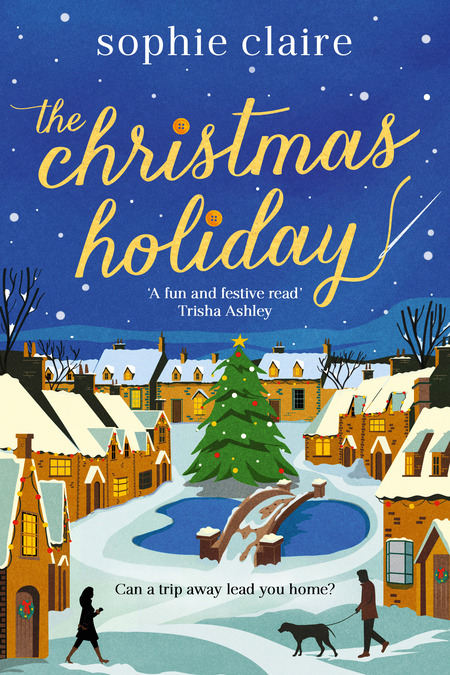
(courtesy Hachette Australia)
Life, for all its glorious moments, rich opportunities and heartwarming interludes, can also be a cold and brutal place.
We all know that; we’ve been there, seen it doing its dark and uncaring thing and wondered how something that can be so good, so uplifting and wondrous can break so consequentially and completely.
And so, instead of racing through the fields and skipping across brooks and up and down dale – metaphorically for the most part, to be fair – we find ourselves broken and beaten, lost and alone, even if surrounded by people and activity and, ironically, life.
The Christmas Holiday by Sophie Claire meets two people who are in such a place, who have experience trauma and great loss and barely lived to tell the tale, and while one is taking steps to rectify that and live her dream, the other, though physically moving on, remains lost in grief so overpowering he wonders if he will ever escape it.
The first person in this conclave of broken souls is Evie Miller, relatively fresh from a terrible, lingering break-up from a man she thought was all the good things in the worlds but who turned out to be, once the charm faded, to be a coercive controller whose only driver was to shrink her down and make her someone he could manipulate as it served him.
Fleeing him, Evie came to the small English of Willowbrook, a place of narrow streets, old stone buildings out of a fairytale and, she hopes, new beginnings.
‘I take it you like Christmas, then?’ Jake asked drily.
‘Winter,’ she corrected him. ‘I love winter.’ Her smile faded. She didn’t look forward to Christmas any more. Not since Zara had gone. Now it was a time when pain was felt more acutely, when empty chairs at the dining table highlighted those who were absent, and her parents’ voices had a false edge as they tried to fake a cheerfulness they didn’t feel.
‘And the run-up to Christmas,’ she said, choosing her words carefully, ‘the anticipation. But …’
Opening a craft shop to fulfill her lifelong dream of working in the creative arts, Evie feels like she is finally free to chart her own fate and do what her heart desires.
The only downside is that the shop isn’t making money, and though her work making quilts and curtains pays well, there’s simply not enough of it.
One paying job she does land is making sumptuous curtains for the old grand house on the hill, which brings her into contact, though she wishes it hadn’t, with the new owner, Jake Hartwood, a nasty, growly wine importer whom she meets for the first time late one night when she has gone to hung curtains.
He is drunk on whiskey, curt to a blisteringly cruel degree and disinclined to thank her or be kind to her; his only concession to any kind of humanity is offering her a place to stay when her car gets stuck in a snowbank on the estate when she tries to get home and she can’t go back to the miles, just a few miles away, that night.
It’s not the best of meetings, and it kicks off the enemies-to-friends dynamic of The Christmas Holiday which takes as its starting position that some people can be so lost in sadness and pain that they can’t see a way out and are nothing like their usual selves.
This is certainly true of Jake who, according to Evie’s best friend Natasha, was once the life and soul of the party, a man who joked easily and made the world a brighter place until his beloved wife Maria died and with it, any enjoyment of life or vivacity of spirit.

(courtesy official author site)
You know, of course, that these two lost people will find a home with each other, but as The Christmas Holiday kicks off, you share Evie’s initial impression that Jake is someone best avoided.
He’s determined to keep the world at bay, doesn’t want to celebrate Christmas with his two sisters or their families and can’t see any point becoming closer to bright, ever-optimistic and pretty Evie who has a passion for her craft, a need to make her business work and a growing need to stand up to her ex, Tim, who is stalking her and her cold, cruel parents who don’t care that Tim cheated on her or treated her terribly and only see a man of means who can give her money and standing.
Honestly, in the scenes where we meet Tim or her parents, you can well understand why Evie fled to Willowbrook and why her new life running a shop, no matter how badly it is doing, is far preferable to staying in London where she miserable in just about every possible way.
It’s also understandable why she would label Jake “Mr. Arctic” and seek to avoid him except when it comes to the supply of curtains and quilts for his new home.
‘Oh, Jake …’ Her voice broke, but it didn’t matter because he dipped his head and stole the words from her lips with a lingering kiss, loaded with the need to avoid confronting his emotions or thoughts, and just feel.
Because being with Evie felt so right, so good. And he wasn’t ready to think about anything beyond that.
Slowly and surely, however, Jake begins to see a spark of life in Evie that he needs and Evie sees a man broken by loss who has a good heart and a caring nature, and after forming a nascent friendship which comes to matter a great deal to both of them, they decide to spend Christmas in Provence together, simply as friends.
Yep, it’s a clear case in The Christmas Holiday of people telling themselves stories to escape the truth of their hearts, and as they spend more and more time together over a Christmas of simple but hearty meals, quiet drives along the coast and through villages and long-delayed passion, it becomes obvious that these two people need each other more than either can commit.
But will Christmas work its magic on them?
Of course it will, but what’s lovely about The Christmas Holiday is the way in which Claire does it, giving ample space and time for the truth of their loss and trauma to be expressed and understood, a patient and meaningful approach that means that when they do get together, and this being a festive romcom, that is all but inevitable, is feel like the most wonderful and true thing in the world.
The Christmas Holiday is all about very Christmas themes of hope, love and second chances but it celebrates those beautiful things by acquainting us with how terrible their counterpoints are and how, if we can open our hearts to possibility and a future free from pain, and if that openness is not there at Christmas then when is it, a new life awaits, one where we can begin again and find the home, the real home, we have always been looking for,