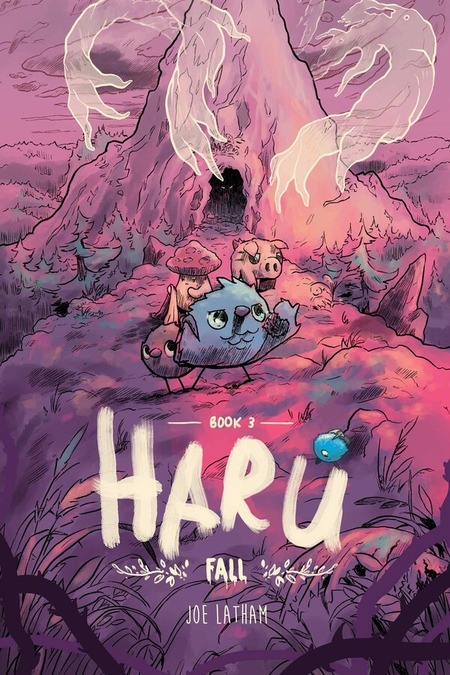
(courtesy Simon & Schuster)
It’s easy to think that war and hatred, bigotry and violence are far more powerful than love and peace, joy and community.
After all, the former are emphatically bombastic and loud; they look powerful, they appear menacing, bristling muscular energy of the worst, most destructive kind – surely greeting card sentiments like love, hope and pace haven’t got a hope of standing against them?
But in Haru: Fall, the third in the beautifully resonant series by Joe Latham which has art and writing in perfect lockstep, the characters, and by extension those who read these graphic novels – happily, the series is targeted as a very young demo who do tell to heed the lessons in the books, even at a young age – learnt a sage lesson, one that sets to one side for all time the idea that might is right and love is just a cutesy emotion with no real gravity, impact or substance.
As the Blight grows ever stronger, summoning golems and terrifying creatures from the gaping chasm of his own pain, Haru, who is in a realm called the In-Between, and Yama, Herb and Frei, and Goose, Haru’s brother, who are fighting their own battles out in a real world ravaged by darkness and pain, must band together and rely on each other to win their titanic battle against the Blight’s malevolence.
It looks like an unwinnable battle but none of these plucky kids, for that’s what they are, barely out of childhood and only discovering who they might be as adolescence holds them close, are willing to give up and they immense power and support in each other, something that eludes the Blight who has numbers and venom but no one standing in his evilly broken and red-stained corner.
(courtesy Simon & Schuster)
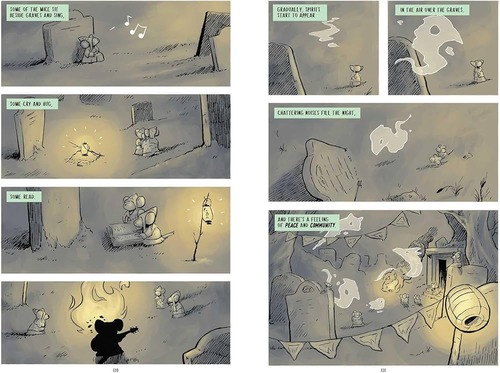
What truly strikes you about Haru: Fall, and indeed the local series, is how Latham never backs down from the idea that love and peace and hope and community have a strength that defies the most virulently hateful of opponents.
On Haru’s side are friends and family, on this plane and the next, who will do whatever they have to to look after each other and to defeat the great evil arrayed against them.
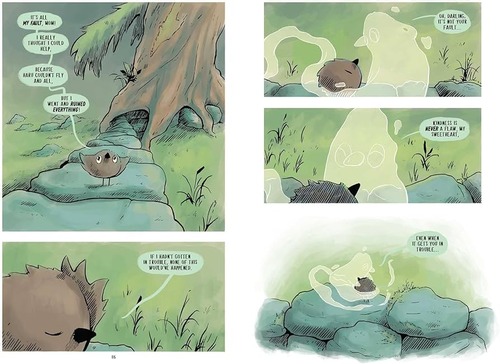
Even more remarkably, it is this kindness and thoughtfulness and care that will end the story in ways that surprise and delight, but which, when you think about it, make perfect sense; evil only stands if good people do nothing goes the old adage because it is inherently weak, made up and powered by people who are only in it for themselves.
Whereas on the side of Haru and his friends, there is selfless unity and sacrifice, but also, so impactfully, a willingness to put aside selfish concerns, not there are many of those in play at any point, and to find out what lies behind the misery and pain.
That caring selflessness turns out to be the most powerful thing of all, and while this is not the end of the story – there appears to be a gently menacing cliffhanger lurking in the final pages – souls are liberated, lands are freed and life resumes, proof that though evil had bluster and braggadocio and looks to have the winning tickets, it is love and its soul emboldening fellows that will always prevail because they are ultimately more powerful than anything that can come against them.
That’s not a greeting card sentiment but stark reality, and the beauty of Haru: Fall, quite apart from its resplendently evocative world-building art, which is both terrifying and cute all at once, is that it knows this to the core of its characters and narratives and never lets the truth of that dim for one moment in a story that is a love letter to the power of community to win against all odds, no matter how the battles on the way to final victory may fall.
Haru: Fall is out now from Andrews McMeel Publishing
(courtesy Simon & Schuster)