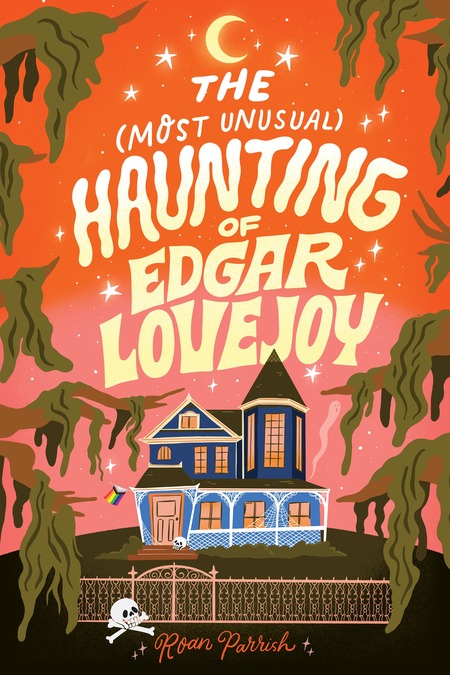
(courtesy Penguin Books Australia)
If you’re someone who has grown up on the social margins, you will be ruefully well acquainted with how isolated and alone you can feel.
While it feels like the entirety of the far more socially acceptable world, and yes, you will also wonder where those exclusionary, often bigoted rules came from in the first place, is happily skipping along to the happy beats of a song only they can hear, you are sitting there far out on the edge watching the world go by, wondering if you will ever find a home like the more mainstream sluls around you.
Hand-in-exhaustingly-alone-glove with this need to wall yourself off from hurt which seems to visit you with arbitrary callousness, is the hardening of a tough outer emotional shell which might protect you but which leaves you feeling cut off, it often feels like rightly or wrongly, from life itself.
This all especially true of queer people like this reviewer, and it’s why The (Most Unusual) Haunting of Edgar Lovejoy by Roan Parrish feels like a liberating breath of fresh air as it tells the story of one titular gay young man who has a most unusual reason for feeling the need to seal himself from the scary world around him – he sees ghosts.
Yes, ghosts; and you can forget any idea of Casper the Ghost white-sheeted friendly apparitions, thank you – in Edgar’s hermetically sealed and far-too-small universe, ghosts are mishappen, mutated, scarily twisted and lurkingly angry beings.
Edgar was worried. The truth? Forget about it. Truth made people angry and resentful. Truth made people think you were crazy. truth made everyone leave.
At least, that’s how Edgar sees them.
Hailing from a family in New Orleans who routinely see ghosts, and along among his siblings which includes sister Allie and Poe who respectively are friendly with their spectral visitors or untroubled by them, Edgar knows that admitting to seeing an untethered departed soul is social suicide of the highest order.
Honestly, being gay is the least of his issues (and not really a problem at all in a social circle full of queer and queer-friendly people, and he spends his days not going to anywhere where ghosts might be because his reaction is transparent, freaky and not the sort of thing that most people, siblings and quirky aunts aside, can handle.
Then he meets a designer of haunted houses, confident trans man Jamie, and suddenly he’s almost as worried about being vulnerable in front of his new love, the “transmasc nonbinary person of his dreams” as the back cover blurb describes his new potential love, as he is about seeing the dearly departed poking through walls and fondling his hair (which is guaranteed not to keep you at ease when you’re on a date at a lovely restaurant).
The challenge for Edgar, who is stunningly handsome and kind and sweet, throughout The (Most Unusual) Haunting of Edgar Lovejoy is you navigate your way to a free and unfettered life of love and inclusion when your entire existence has been walled off by towering ramparts that make the Berlin Wall look like leapable farm fence.
The liberatory joy of The (Most Unusual) Haunting of Edgar Lovejoy is that it not only offers Edgar, and by extension any reader similarly trapped behind protective walls of their own necessary making, a way to the kind of life he thought could never be his, but it admits in doing so that the rode to that kind of unthinkable freedom isn’t an easy one.
I mean, sorry what? What’s joyful about that, you ask, as you crave a sudden flicking of the switch from internal prison to limitless, sunrise-drenched fields?
The joy therein lies in the fact that by admitting to the difficulty of dismantling long-held protective mechanisms, The (Most Unusual) Haunting of Edgar Lovejoy doesn’t say it can’t be done; rather, it says that it can be done, fearful though it makes you and that despite setbacks and fear washing every which way around you, that you can’t find love, you can’t find a home with the person of your dreams and you can forge a future that is happy, alive and above all, free.
The story of The (Most Unusual) Haunting of Edgar Lovejoy offers hope, all in its neon-lit, high-caps glory, and that is supremely powerful because when you are neck-deep in fear and anxiety and an inability to imagine life as anything other than massively hemmed in, it can be impossible to think of things being any different.
But Jamie offers Edgar hope and a home and embracingly unconditional love, and Edgar offers his own kind of charmingly thoughtful and uplifting love right back, and its giddily beautiful to read about.
‘Are we—do we get to do it again?’
‘I think we got—‘
‘Yes,’ Jamie said, loud and clear, wide eyes fixed on Edgar. ‘We get to do it again.’
If you had asked this reviewer way back when to imagine a life where he is loved by the man of his dreams and where his gayness is simply a brilliantly acceptable part of who he is, I would have looked at you like you were a hauntingly scary spectre.
But I am living it now, as other so many queer people once pushed to the coldly exclusionary margins, and reading about how Edgar finds his own “It Gets Better” moment with all the happily inclusive and deeply loved bells and whistles, and not a few ghosts lurking where it’s simply not socially convenient, echoes what we have gone through ourselves.
But if a way of surmounting those scarily high protective walls eludes you, and you feel more made up of fear than love, then you need to read The (Most Unusual) Haunting of Edgar Lovejoy because it offers the kind of muscular, in-the-trenches hope that feels like the actual real thing rather than fairytale frippery and an endlessly unknowable pipe dream.
This shot of joy of a novel, which also embraces the difficult truths and looming obstacles of any life consigned to the edges of actively-lived life, is your ticket to a whole new outlook and world, as it you read about Edgar finding Jamie, finding his home, finding unconditionally inclusive love and finally being free to be his own ghost-seeing idiosyncratic self in all his high lovable queer glory and joy.