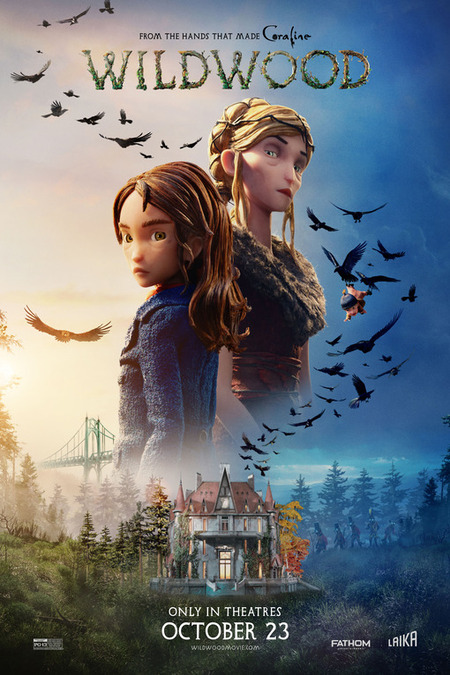
(courtesy IMP Awards)
When you look at someone’s present-day life, it’s laughably easy to think that it arrived as some fully-formed agglomeration of past thoughts and deeds, feelings and mistakes and triumphs, all of them neatly woven together by the uncomplicated passage of time.
But all of us know, at least those of us who want to admit to the searing and sometimes ugly truth of life, that is as far from the truth as it’s possible to get; rather than a tapestry of untroubled moments in time, the present, how matter how happy and idyllic it may look, is a messy, brawling, frantic, thrown-together compromise with the worst and the best of times.
It’s a state of being that Wildwood is hauntingly familiar with the artfully-realised stop-motion film (16 years in the making!), based on the book of the same name by Colin Meloy and Carson Ellis, always in touch with the fact that our present lives owe a great deal, good and bad, to that which preceded it, and that we might think we have gotten away scot-free from past mistakes and unholy choices but that they always come a-calling and they will receive the existential payment they are due.
Quite what has led to the current very happy life of Portland, Oregon teenager, 14-year-old Prue McKeel (Peyton Elizabeth Lee) must be left to the revelatory spoilers of the second half of this masterfully-told film but suffice to say they are very much in keeping with a storytelling sensibility which does not stint one bit on the graphically intense and often harsh realities of life.
In fact, one of the things that emerges quite early on in Wildwood, the latest stop-motion from Laika Studios (Coraline, The Boxtrolls, Kubo and the Two Strings, Missing Link) which is based in the wild Pacific Northwest setting of the film, is that it refuses to sugarcoat how dark and dire life can be.
Nothing in this astoundingly good and endlessly enthralling film is easily resolved or consequences-free, and while many animated films of all stripes will shrug off an alarming turn of events with a well-placed quip or bit of visual slapstick (which can be an art in itself and should not be scorned), Wildwood always follows its through its natural, emotionally distraught resting place.
Nowhere is this better illustrated that in the abduction scene of the film where Prue and her “friend” – one of the loveliest parts of Wildwood is how Prue grows and changes throughout the story, which includes how she sees the people around her – Curtis Mehlberg (Jacob Tremblay) are helpless where an ominously organic murder of crows descends on an otherwise innocuous children’s playground and abducts Prue’s toddler younger brother Mac (Arthur Knight).
Prue scrambles onto her bike – she has taken Mac outside for an afternoon of exploring the gloriously odd city of Portland where they live, quite against her parents’ emphatic demands that they do no such thing; why they do that makes much more sense later on – and sets off in desperate pursuit of the crows, a dense cloud of black who loses their pursuer as they cross into the forest known as the Impassable Wilderness on the edge of town.
It’s at this point that Prue is lost in the grief of her own poor decision-making.
She’s carelessly done something she was expressly told not to do, driven by the incipient teenage arrogance of slowly-dawning but so-far poorly-formed adulthood, and now she is paying the price with Wildwood not giving anything close to an easy out.
It speaks very much about life itself, and it’s a theme sustained throughout Wildwood which allows major characters to die, terrible battles to play out, grief to warp and destroy and mangle, most evident in the Big Bad of the piece, dowager governess Alexandra (Carey Mulligan) who loses a great deal through the film and pays hugely for it, and the world to enact a terrible price for very human longing, needs and desires.
It’s graphically real and searingly emotionally honest, and while that might seem too much for a stop-motion animated film in an age when children, and even adults to be honest, have had the harshness of life scrubbed clean in an attempt not to upset or alarm, it works perfectly.
You walk out of Wildwood, which has enough of a happy ending that you feel like good has triumphed over evil and life’s better angels have kicked the poorer ones well and truly to the kerb, all too aware that whatever happiness we have, whatever victories sit within our grasp and whatever beauty we are allowed to behold, is hard-won in ways often too awful to recount.
But while there is darkness at play here, there is also buoyant humour, beautifully fully-formed characters and animation so vividly three-dimensional and soul scouringly evocative that you are swept into this world so comprehensively that nothing else really exists for 132 minutes.
The makers of Wildwood, directed by Laika’s CEO Travis Knight, world-build with such lavish intentionality and commitment to summoning a singular sense of time and place that everything about Wildwood feels alive and real.
You rationally knows its stop-motion animation at work because you can see it and you’ve read about it, but as it sets this intensely emotional story in motion, it becomes more real than the seats and the fellow cinemagoers around you.
It’s a work of art, visually and narratively, a crowning achievement that, as many others have pointed out, shows you how human creativity will always triumph over the artificial kind (if you can even call that creativity, which is doubtful) because it appreciates the contradictory, messy and often harrowing emotions that come with being a person.
Life seems straightforward enough if you look at it on a surface level, but as Wildwood evinces again and again in ways that will wrench out your heart and soul and make you weep and laugh and marvel at the artistry in equal measure, it is rarely what you first see and this film makes a clear case for empathy, understanding and for truly appreciating how good and marvellous and difficult and challenging it is to be human in ways that you won’t soon forget.