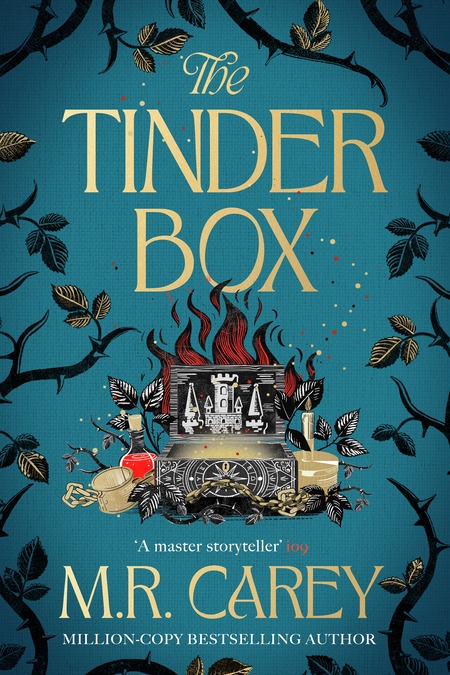
(courtesy Hachette Australia)
We are so used to everything we consume these days delivering up instant gratification vibes that when it doesn’t, we are prone to simply to see it aside and find something else that will deliver the narrative sugar hit we have been conditioned to crave.
Slow-burn anything these days is almost an anathema but what we miss out on when we forego that evident in The Tinder Box by M. R. Carey (The Girl With All the Gifts, Someone Like Me, Outlaw Planet) is the delights that come with quietly discovering where a story is going, who characters really are and how being human is always messily contradictory in ways in which the full import is readily and immediately and certainly not until often well down the track.
This reviewer will confess, even as an inveterate reader whose enduring happy place is disappearing into a book over the space of an entire unhurried day, that he was tempted to put aside The Tinder Box a few times when the story, though compelling and Carey is always compelling, seemed to be slowly going nowhere.
That’s perhaps unfair having now reached the end of this wholly bracing read because as you look back from the thrilling high points of the final act, you realise that much of what passed for uneventful in the first third of the book or so is in fact groundshakingly foundational later on.
It is proof that we must resist the current urge to have everything mean all things all at once.
When he [Magnus aka Mag] fled in the night he must have spent a great deal of his time running in the wrong direction. Still, he had his bearings now and he would not lose them again. He strode on towards the setting sun at a brisk pace. he had no money and no prospects but he was a free man again and he found that counted for much.
Set in a medieval version of Europe where one kingdom is engaged in a fruitlessly destructive war with two others who have not taken too kindly to the idea that they belong to the authoritarian king who is pulling the levers of the machines of war and killing many of his subjects as does so (no surprise that he cares not), The Tinder Box is the story of how one man, an ex-soldier called Magnus Tresti, manages to retain his inner goodness in the face of life’s violent darkness and supernatural temptation, and one woman, a reclusive widow witch called Jannae Mirchella who finds her inner long-buried humanity all over again.
Theirs, as stories of broken, fallible humans often are, is a complicated tale, one which seems reasonably simple at first until Carey, who is a master of spinning story and character together in ways that seize the imagination and emphatically impact the heart, throws in a massive spanner in the works in the form of a giant nine-foot-tall demon who falls from the sky, carrying among things a tinderbox which can be used to grant every wish imaginable and even change the course of the world.
It’s a terrifying gift, one which comes with a host of tempting possibilities and which exposes in graphically intense form how some people will only ever think of themselves, even when they have the means to think of and help others, while others, who have been much put-upon and who could justifiably take all the benefits of such a powerful item, choose instead to prioritise and work for the betterment of others.
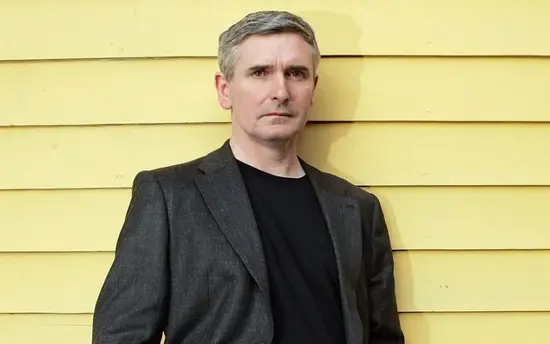
(courtesy Hachette Australia)
In many ways, The Tinder Box, while a dark fantasy with a firm eye on the geopolitical and sociopathic tendencies of humanity to enrich and advance itself no matter the harm it brings to others, is a treatise on the power of self sacrificially thinking of others.
Quite how that plays for Magnus, a discharged soldier (due to injury) who exists on the margins of society, both financially and sexually (he is gay in an age where that, among with a great many other “sins” – The Tinder Box has a huge amount of impactful fun with exposing the inherent hypocrisy of people and demons/angels alike – are frowned upon with furious intent), ventures too far into spoiler territory but suffice to say that he keeps his inner goodness alive and well even when there are host of compelling reasons for him not to.
It’s his groundedly real goodness as a person that forms the emotional core of The Tinder Box and which impels people like Jannae, who has long struggled with the moral and ethical compromises, some of them quite deadly, that she has made to get where she is in life, to take steps which help them to not only redeem themselves but to remake the worlds of earth and of heaven and hell in ways that bring lasting and meaningful change.
For his own part, now that he was come to it, mag could have waited longer. He felt as he had sometimes on the night before a battle, knowing that on the morrow morn he would be running headlong against a thousand swords and guns. This time, if all went well, he would have no fighting to do at all. But he couldn’t push down a feeling of unease. He had never yet known a battle plan that lasted long after the first shot was fired.
Theologically, The Tinder Box is thrillingly imaginative, taking standard ideas of heaven and hell and the “War in Heaven” (where Satan rebels against God which leads to a battle supposedly between good and evil) and partly turning them on their head in ways that rive home how staunchly orthodox ideas of purity and brokenness, darkness and light are not always, if ever, as straightforward as religious storytelling would have you believe.
As a child of the Church who thankfully fled it some 25 years ago to endlessly happy times since, it’s fascinating to see the demons represented as far more human and honourable that standard Christian theology would have you believe and angels seen as duplicitous and sneaky in service of the greater good.
It reinforces a recurrent theme throughout The Tinder Box which is that we love things to be neat and tidy, even when it comes to good and evil and the messy business of being human, but that life is rarely like that and that there is far more grey than we might like to admit all around and in us.
At the end, The Tinder Box is a magically alive tale of hope and possibility in the face of what seem to be prevailing odds which seem too powerful to be bested, it’s hugely imaginative and emotionally rich storyline reminding us that while the world might seem brutalistic and cruel, and it is often is, that tenderness, love and altruism are more powerful still, and can turn the tides of not only men but heaven and hell too and that is something to be valued and savoured long after the final page is turned.