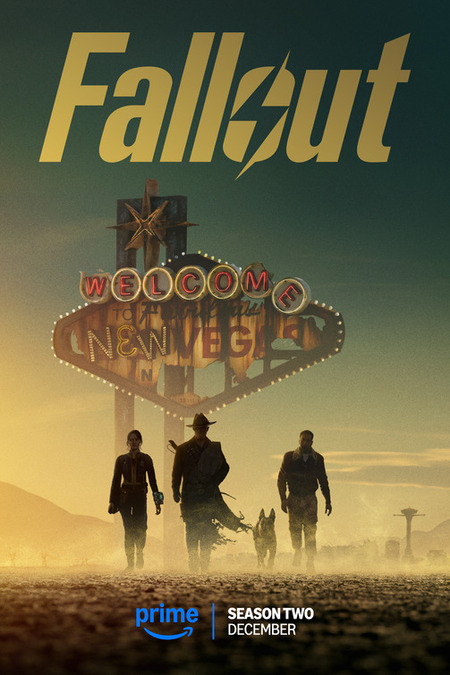
(courtesy IMP Awards)
The end of the world is generally considered to be a fairly awful, lawless, dark and terrible place where civility has died and base humanity rules in all its terrible glory.
You know it, I know it and Lucy MacLean (Ella Purnell), ex-Vault 33 Dweller and unexpected wandered of the irradiated Wastelands knows it too.
She is the heart and soul and the conscience of Fallout, the second season of which takes further into the broken world of 2296 where those caught outside the devilry of some quite evil corporate machinations, which is most of the people who are the descendants of those who survived a global nuclear war some 200 years earlier, are trapped in a hardscrabble race for survival which, not surprisingly, leaves precious little room for the niceties of life.
That doesn’t stop Lucy, helped mostly by her wholly odd couple companion, The Ghoul aka Cooper Howard (Walter Goggins), a onetime Hollywood actor who is wandering what’s left of the western states of America looking for his cryogenically frozen wife and daughter, from trying to bring some much-needed rightness to the world.
Against all odds, she believes that she can find her wayward corporate father, Hank (Kyle MacLachlan) who is not the vault dweller she thought he was – 200 years earlier, hundreds of the lucky (or unlucky) corporate employees of an alliance of companies who saw profit in nuclear war, were locked away in vaults to await out the worst of the apocalypse – but rather a man from before the war who, it turns out, answers to what is revealed to be the Big Bad of the series.
Quite who he works for must be left to the watching of the eight beautifully rendered, immaculately world-built episodes of Fallout‘s second season, but he is not a good person and Lucy, in her deliciously lovely, completely misplace naivety thinks she is the person to find him and bring him to justice.
After all, the post-bomb drop world might be messy and broken and terrible in many of its ways but surely justice still has a place there?
You’d like to think so but a you can probably guess, it really, really doesn’t.
But Lucy, who has to confront and kill – hilariously she conflictedly finds she enjoys this, her smile of delight at war with her squeaky clean inner self – Elvis-styled ghouls (those who don’t have the serum which stops the condition’s progression end up like irradiated zombies) and who finds herself addicted to drugs after almost dying at the hands of weird Roman legionnaires, wants to desperately believe it does, with her quest for justice driving much of the narrative momentum of the season.
A key feature too of the second season of Fallout is the revelation of what led to the Earth being a bombed out world of radiation zombies, depraved soldiers and religious zealots called the Brotherhood who want to purge the world of evil and restore whatever the hell of perfect system should take its place.
We are taken deep into the conspiracy which led to the bombs falling, and surprise, surprise it goes way deeper than just Vault-Tec, the originally company featured in season one of Fallout and for whom The Ghoul’s wife, Barb Howard (Frances Turner) worked.
Just how deep is a step too far into spoiler territory and the reveals are perfectly and rewardingly placed, but trust this reviewer when he says that the slowly unspooling of the powers-that-be behind nuclear war for profit paints a truly troubling picture of what a world is like when the oligarchs decided to move chess pieces simply to see how it advances their interests.
What is fascinating about Fallout is that it doesn’t reduce to the actions of these corporate players to some sort of one-note comically villainous driver of the evil in the world.
It would easy to be that simplistic, but while the show is definitely fond of the comically surreal and the hilarious twisted, ably assisted by a soundtrack in love with mid-century Americana music that adds retro musical stylings to the retro-future 1950s look and feel of the show, it is also deeply thoughtful and unwilling to be glib about corporations, left to their own devices, are capable of.
This intelligently nuanced approach to storytelling grants Fallout a narrative gravitas and emotional heft that you might not expect a videogame adaptation to have, but it also means that while the series casts a wry and askance gaze at what happens to people living, or really existing, in the shadow of centuries-old nuclear war which ruined the earth, it is also deadly serious about how broken and dark the world can be.
Lest that sound like a little too much darkness for you, Fallout clings, much like Lucy, to the idea that there is still some good out there; it’s up against some pretty huge obstacles, and some fearsomely powerful enemies, both above in the Wastelands and below the surface in the vaults which aren’t as much of a sanctuary as you might think (what some people will do to survive!), and yet somehow in the middle of all this physical and existential horror, people like Lucy and disillusioned squire of the Brotherhood, Maximus (Aaron Moten) still find some good in life.
Plenty of crap too, and good lord the final episode of the season, “The Strip” visits all kinds of sadness, loss and disappointment on a beleaguered Lucy, but as she and Maximus find each other and fall in love, you see a flicker of hope in a world that’s filled with almost none of it, save thankfully to the New California Republic who want to bring civilisation back to people starved of it, and that’s enough for these characters, and us as viewers, to wish desperately for some kind of goodness to prevail.
It may well do, but as the final scenes of the last episode make graphically clear, an ominous injunction goes out to usher in Phase 2, which seems to involve brainwashed drones and some no doubt twisted evolutionary tinkering, and so while love and hope may still be around in some form, they look like they’re going to have the fight of their life when season three releases in the neat year or so.
Fallout streams on Prime Video.