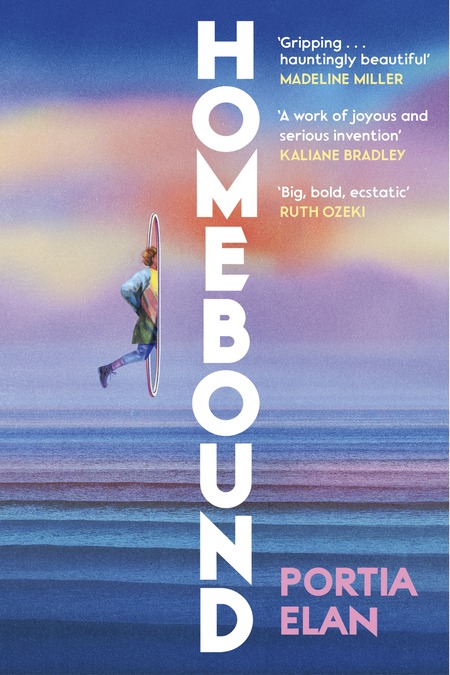
(courtesy Penguin Books Australia)
Imagination of varying degrees and intensity sits at the heart of all of the stories we read.
Somewhere, somehow, an author has had the germ of an idea, a glimmer of a character, a snippet of a plot, and through hard work and a deft use of the aforementioned imaginative inspiration, has formed it all into a cohesive, hopefully compelling and engaging story.
But not all works of imaginative intent are created equal, with some emerging fare further up the pile than others; case in point being Homebound by Portia Dean which spans multiple hundreds of years from 1983 through to 2586 and yet somehow feels like a unified piece of triumphantly told storytelling.
While anyone who has read novels like David Mitchell’s Cloud Atlas will know its fiendishly difficult to hold an array of narrative threads and that it takes mastery of the craft to have them cohere into something meaningful, which Mitchell and other like him clearly possess, the truth is that Homebound is well and truly worthy of joining their rarefied and satisfying to read club.
Elan’s work is less suggestive of things happening than Mitchell’s preferring to just come out and say it than deftly allude, but it has the same sweeping sense of history and love, of family and belonging.
And of the sense that while people change and grow over years, decades and centuries, and society morphs right along with them, the kernel of raw, heartfelt humanity always stays largely the same.
She is slipping through time, step by step moving from past to present and back again. There is nothing I can do to catch her, hold her in place—and would I want to? Tie her to the present, when you are dead? I wouldn’t want to stay here either, I didn’t have to.
Which is quite a feat because a lot happens over the course of Homebound as you’d no doubt expect.
The novel begins in Cincinnati, Ohio in 1983 where possibly aspirant computer programmer Becks, struggling with a difficult aunt and her defined place in the world, not to mention her sexuality, comes across her dead uncle Ben’s half-done video game.
He is the only one with whom she felt any sense of kinship and understanding, and she begins to appreciate that finishing the game could provide her, not just with a sense of closure, but a clearer sense of who Ben was and who she might be too.
It’s a lot to ask of one game but as Homebound continues, it begins to emerge that it is more than able to bear the load as successive generations of people, grappling with impulses with which we are familiar such as commercial demands versus pure noble intent and a world completely changed by climate change where the Andes and peaks of Scotland and Norway are the archipelagos of a slowly but emphatically drowned world, tries to find their place in the world too.
The more things change, the more etc etc … you get the idea.
But for such a universally relatable idea, Homebound emerges as something really quite special as the people who live long after Becks has been to her last punk concert and found her tribe with the lesbians who love going to them begin to find meaning and purpose in circumstances wholly different and yet familiar in expression too.
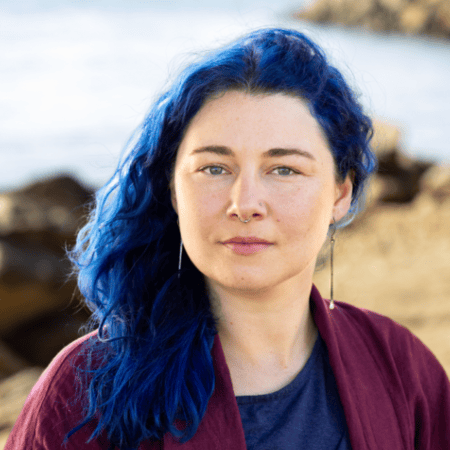
(courtesy official author site)
As we meet ideally-minded scientist and one-time academic true believer Dr Tamar Portman in the back half of the 21st century as she works to create a race of advanced artificial beings called Ayes, including one key one called Chaya, she believes will heal what we have harmed (her backers have more bottom line ideas alas), and Yesiko, captain of a rusted yet vitally important ship called Babylon which offers agency of transport and choice in the drowned world of 2586 Earth with precious little of it left, we come to appreciate that though the world can manifestly change, we do not.
That says less about lack of imagination than it does about the constancy of the human condition with all of these characters carrying an innate and often queer humanity inside them which speaks to how much of what happens in the world comes down to who we are as a species.
We may express it differently, not least because the world changes radically around us, but at the heart of our experience, we all want connection, love, meaning, purpose and family and a sense that what we do matters.
This is evident even in the fourth strand of the narrative, which sees intrepid astronaut, Lt. California Solo wake up aboard a ship which is hurtling through to work out what has happened to arkships which fled a failing planet in favour of a new life out in the stars only to grind to a halt, their crew missing and their hopeful settlers slumbering in a dream of metal and electronics going nowhere.
‘I have told her many stories …’ Root closed his eyes.
‘And she will share them,’ Chaya said. ‘She already does.’
Root smiled. ‘It’s how know who we are. We keep the stories, and the stories keep us.’
It becomes very clear that Solo is the protagonist of the very game Becks was charged with finishing, and it’s clear she not only has but that it has well and truly outlived her, with the plot and ethos of the game becoming something of a hopeful dogma for the wayward true believes of the 26th century.
They have taken role-playing fiction and turned it into a belief system which powers them and while it ultimately fails those who believe (Yesiko and her nanite-sustained crewmember and family Root not among them) in ways best left to the reading of Homebound, someone somewhere is playing the game, which takes up whole fascinating chapters and trying to carve some meaning from their actions.
These quite disparate time periods, of people who differ markedly from each other and who live lives those in the other centuries would struggle to comprehend, are joined by an impelling sense of humanity, one borne of creative intent, of the will to survive, of the need to connect and love and to have what they do mean something, both to themselves and to others.
Homebound may cover a lot of ground, and ocean and spade too to be fair, and it maybe take across a dizzyingly vast expanse of time and the human condition, but it is unified by the idea that you will find out who you are, no matter how it diverges from the norm, and that in turn you will find your people and your place in the world and that though your circumstances may vastly differ from others, your needs and desires are the same and will find expression, through stories and other means, in strangely familiar ways no matter how separated you may be.