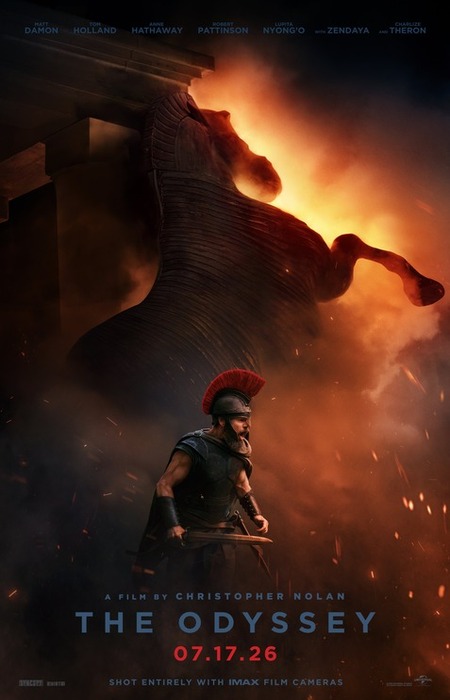
(courtesy IMP Awards)
There is an epic grandeur to the works of Homer and even if you are not a learned student of his well-known works, The Odyssey and The Illiad, you will be familiar with many of the elements.
This lends Christopher Nolan’s enthrallingly immersive adaptation of The Odyssey, a sense of both familiarity and compelling strangeness, a contradictory state of feeling and being which is complicated still further by the fact that the highly regarded director, like many a director before him, has taken some narratively understandable liberties with the original text.
As Chris Tryhorn observes in The Guardian, edits were all but inevitable when you consider the diabolical challenges of “Turning a 12,000-line poem that takes a day to read aloud into a three-hour film was always going to require some pruning.”
If you are a classicist, there’s a good chance you will find many of these edits problematic; however, if you are a casual observer and sampler of Homer’s work, like this reviewer, you will like be able to simply relax into a film which over three hours (it may seem intimidating but time flies in the best possible way) takes you on a grand multi-year, existential and mythological journey which is nothing short of spectacular.
Telling the story of the essentially titular Odysseus (Matt Damon) who faithfully follows the Greek king Agamemnon (Benny Safdie; unseen and always clothed in magnificently enigmatic helmet) into battle against Troy, The Odyssey is in many ways a grand and sprawling tale featuring towering giant warriors in armour, the cyclops Polyphemus and Circe (Samantha Morton), a witch who transforms some of Odysseus’s men into pigs to reflect, she says with much sorrow and anger, their “true nature”.
By any yardstick, the film is a big epic tale in which the goodness of men is questioned, the gods are capricious and unforgivingly demanding and the trauma of war finds itself expressed in many both violent and inexplicably lost and sad.
And yet, for all of the movie’s blockbuster-level storytelling and cinematography which is rendered with a haunting beauty so vast that you can get lost in landscapes and place and time very easily, The Odyssey is in many key ways a deeply, emotionally intimate film.
In the midst of titanic, murderously bloody battles and duplicitous warmongering – the take on the Trojan horse of legend is both inventively imaginatively and damning in the way it allows a victory which does not bring the expected satisfaction, at least for a reflective Odysseus – there are moments of such broken, sorrowful and tramautised humanity that the full effect of war comes harrowingly home.
Odysseus is away from home for almost twenty years and even when he returns home, he finds his kingdom of Ithaca besieged, in a sense, by ungratefully boorish suitors for his wife Penelope’s (Anne Hathaway) presumed widow’s hand, with many present for three years during which they drink and eat the palace dry.
Life has changed for Odysseus that much is clear; how can ten years of war, for that is what it takes to defeat Troy, and only then by deceit and trickery, however masterfully it is executed, not break a man, much as war has always scarred and ravaged the souls of those unlucky to fall into its unmerciful grip?
But what emerges time and again in The Odyssey is how war and what looks like the downfall of civilisation generally – cloaked as the consequence of failing to honour Zeus’s code of strict behavioural dictates, it’s actually an historical reference to the mysterious downfall of almost all Bronze Age powers in the Eastern Mediterranean and Near East in very tight period of time – affect life as it once was and can never be again.
While many survive the war, though not a number of key people, many of whom Odysseus meets in a grimly unsettling trip to an above ground version of the Underworld, they are not left the same and this becomes clear not just in the life of Odysseus but in that of people like Agamemnon’s brother Menelaus (Jon Bernthal) who might have had Helen of Troy (Lupita Nyong’o) returned to him, but who is grimly aware the restoration of a union does not bring back that which was sundered when she was taken to Troy.
Penelope too is struggling to ward off greedy, amoral suitors, most prominently the sneering, sociopathic menace of Antinous (Robert Pattinson), keep her son Telemachus (Tom Holland) alive to take the throne if in fact Odysseus is dead (though Penelope will not accede to that reality which, as the audience knows, is false despite what the naysayers may argue) and uphold her control of Ithaca.
While Nolan doesn’t focus on the women of the epic as much as the men, it becomes clear that they have had every bit as hard a time of it, in not worse, than the men because it is they who have had to deal with the real world, day-to-day fallout of a war which has remade society in so many key ways.
Nolan may have shaped The Odyssey as a redemptive story of a man who has been hollowed out and scarred by the loss of so many men whom he feels he has manifestly failed, and it is very much that with the gods decreeing a particular cruel form of agony for the film’s protagonist, but it is also a deeply felt story of what happens when the old world disappears, a new broken or different appears and people scarred by the transition have to make sense of what’s left.
So while Homer framed The Odyssey as a story of gods and men, of monsters and sinful consequence, what this gripping film is at heart about is the brokenness of humanity against a grandly adventurous backdrop, a story which is hugely epic and beautifully filmed and told but which in the end, comes down to what happens in the small “L” parts of life, and how we might fight wars and battle monsters and thwart those who would steal from us but in the end we have to deal with what happens when the war ends, the noise abates and we are left with the messy and not easily resolved consequences.