(courtesy IMP Awards)
I can’t recall exactly what I felt when my father was diagnosed with Focal Dystonia, a form of Parkinson’s Disease in his early-to-mid sixties, but I do know feeling worried about what it would mean for the longevity of a man who has gone through a great deal as a kid before marrying my mum and making a family of his own.
He was a man of God who lived his faith not in stridently, militaristically religious terms but in a grounded, caring way, and while he approached his diagnosis in the thoughtful way he approached most things in life, it must have struck some fear into his heart because here was a condition with no cure, medication which alleviated some symptoms but not all, and then not always all the time (just ask his contrary legs) and a finite end date.
You could argue that life for all of us has that air of finality but it’s different when you know the end date will come sooner rather than later – he lived until he was 83 for which we were all grateful though I know he hated how the disease made his life smaller and smaller as the years went on – and it’s something that the joyously nuanced storytelling of Onwards and Sideways captures perfectly, with real insight and empathy and some astonishingly measured performances from its two leads.
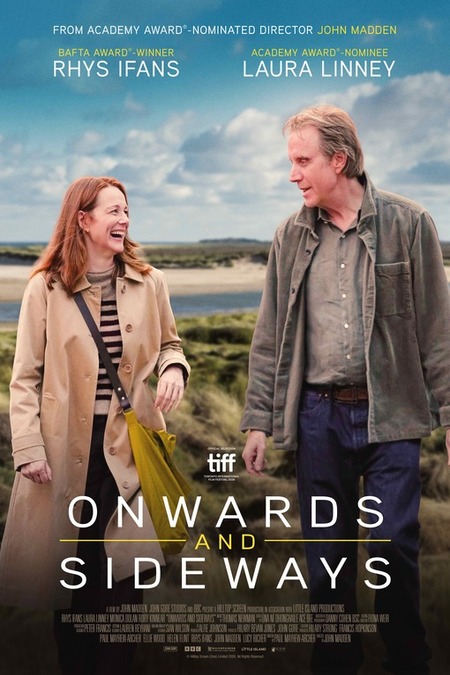
Rhys Ifans and Laura Linney star as Tony Evans and Emma Dritzen, two people at the prime of their respective careers – Tony is much-loved, highly regarded teacher at a school in rural England while Emma is renowned composer and classical musician – who are told on the same day at the same clinic that they have Parkinson’s.
It naturally completely shatters any mortal invincibility they have may have carried up to that point, and any confidence that their lives, interrupted by pain, yes (Tony’s wife died a decade or so earlier while Emma is recovering from a nasty divorce) but good nonetheless, would carry on to a well-lived end point a good number of decades hence.
What’s remarkable about Onwards and Sideways, which may be a romcom in part, but which also functions as a bleakly honest but hopeful exploration of how a terminal diagnosis completely reshapes your world and your outlook on life, is that it never pretends that facing the certainty that you will die far sooner than you thought is some sort of heroic act.
Certainly while my dad often faced his years with his disease with quiet grace and a reasonably buoyant spirit, there were also days, many days, when he felt angry at his body, the world and the hand that fate had dealt him; Onwards and Sideways brings that to the fore quite beautifully, though Emma and Tony react to their diagnoses in wholly different ways.
While Emma dives right in to tackling how she can thrive with Parkinson’s rather than simply living with it until the inevitable end comes, joining a community ballet group for those with the condition, talking to school kids about the condition and drinking two litres of water a day and exercising as recommended, Tony retreats into denial.
He doesn’t tell the school that he has been diagnosed with Parkinson’s, devising an elaborate schedule of medication imbibing to disguise his symptoms, and pushing on by ignoring all the advice that Emma, who is very much a controller of her own destiny kind of person, takes to heart and lives out to the full.
But while they take wholly different approaches at first, circumstances force them to roughly the same place and time and mindset, and together, they slowly begin to form a relationship which Tony admits, in a moment of beautiful reflective honesty, isn’t ideal since they should be with people who are able-bodied and who can cope with the future physical deterioration of their partners.
Love though doesn’t always do the sensible thing, and while the path these two follow to love, true married love, is far from smooth, and certainly not the stuff of the usual idealistically escapist romcom fare, it resonates so deeply and with affectingly grounded longevity because it happens when everything else around them is going to complete and utter sh*t.
The beauty of Onwards and Sideways is that it neither loses itself in an escapist love story unmoored from reality nor does it succumb to the hopefulness of symptoms which start to make life a challenge for both Emma and Tony.
Thanks to a thoughtfully nuanced and measured screenplay by Paul Mayhew-Archer and delicately executed direction by John Madden, Onwards and Sideways is a hopefully balanced exploration of what happens to two very different people when their worlds collapse and they are told they have “five good years” left (by a their shared doctor, Professor Ridge, played by Rory Kinnear, who undergoes his own quietly transformative journey) to make the most of what remains of their lives.
It’s a sobering and all-too-finite measure of time to be granted, and what’s remarkable about Tony and Emma is that, in their own distinctive ways, they set about making those years count while do what they can to push the envelope and defy the odds.
With a story that is neither fatally despondent nor unrealistically triumphant, Onwards and Sideways is the sort of film you want to see about people in this situation because while it offers hope and possibility and yes, even love, it’s realistic about it, acknowledging that even when good things during dark and terrible times, they will not be the panacea for all ills.
In fact, the brutally realistic and darkly harrowing storytelling of Onwards and Sideways does not let up simply because Tony and Emma fall in love, but, and this matters, the fact that these two people find each other, that they get each other and want to unconditionally support the other transforms how they react to the disease and how they handle the rest of the lives, and while it’s no magical cure, it makes all the difference in the world to them, transforming what might have been a lonely journey into something shared and profoundly, meaningfully communal.