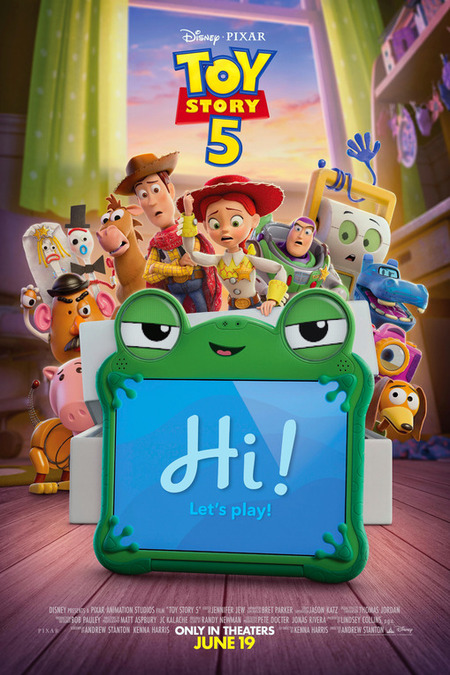
(courtesy IMP Awards)
Five instalments into any movie franchise is a point at which you might wonder if the novelty and fun of the original instalment has been lost or at least diluted beyond any meaningful recognition.
It happens to the best of long-running series but rather happily the Toy Story franchise, which kicked off the whole run of charmed Pixar films 31 years ago, doesn’t appear to be even close to exhausting the well of child-like joy, devotion and celebration of family and connection that endeared it to people everywhere back in 1955.
There are some who argue that the series peaked with Toy Story 3, and while, yes, absolutely, it is a highwater mark and one of those films that grabs your heart tightly and doesn’t left go, the fourth instalment in the franchise demonstrated that the characters are so memorable and so strong, the writing so whimsical and emotionally thoughtful and the messaging so nuanced yet impactful, that it’s possible to keep telling stories and not lose one iota of what made the films so richly alive in the first place.
It’s a tricky business honouring the beloved legacy of a franchise now three-decades-and-counting old while keeping things fresh and interesting but the newest entry, Toy Story 5, manages it with a vigorous sense of fun, it’s heart very much on its sleeve and animation that is vividly energetic when needed and sweetly soft or playfully cute when needed.
It’s honestly pretty much the perfect package, and while you could argue that the more second tier of the playroom ensemble (narratively wise, only; in our hearts, we love all the toys equally, right?) including Rex (Wallace Shawn), Hamm (John Ratzenberger), Slinky Dog (Blake Clark) and Mr. Potato Head (Jeff Bergman, replacing the much-missed Don Rickles) don’t get quite the screen time we’d all like, it’s about the only minor negative in an otherwise stellar fifth outing.
Toy Story 5 is at its heart, a Jessie (Joan Cusack) film.
The toys are all still with Bonnie (Scarlett Spears who replaces Emily Hahn and Madeleine McGraw from Toy Story 3 and Toy Story 4 respectively and still being played with in sequences that uses a gorgeously luminous pastel-ish 2D animation that beautifully contrasts with the standard 3D animation of the film.
The contrasting fuzzed-out edges of the contrasting crayon-ish animation feel much like an imagination style of play would manifest and it adds real richness to the film’s celebration of what it means to play actively with toys which is important because at the centre of the storytelling of Toy Story 5 is a big discussion, and an emotionally charged one at that, about the role technology is playing in children’s playtime and whether the age of toys is over.
We all know it’s not but it is changing, and the beauty of Toy Story 5 is that attacks what may look like a slam dunk seismic change in the way kids interact with their own minds, sense of self and the world around them with the franchise’s characteristic nuance and insight.
That doesn’t mean of course that when Lily Pad aka Lily (Greta Lee) arrives in the life of Bonnie, and by extension her toys, the lead characters of which are now Jessie and Buzz Lightyear (Tim Allen) – Woody (Tom Hanks), with an hilarious glary bald spot is back for this instalment but he’s not the main game when it comes to the day-to-days ups and down of playroom life – the film doesn’t milk for all of the narrative villainy inherent in her unwelcome and hugely disruptive presence.
Lily is presented, initially at least, as Big Bad evil, and while Toy Story 5 is far too clever in its approach to persist with such a simplistic but wholly effective piece of characterisation for long, it does have an enormous amount of fun with Lily being badass uncaring and Jessie in particular fuming at how she, and all other pieces of tech flooding kids’ bedrooms, don’t care about what really makes kids and the way they play so special.
If you’re wondering if a franchise which liberally uses cutting-edge tech is going to go all Luddite on Lily’s presence, then rest assured it’s far too sophisticated a series to fall into that vapidly deadend trap; what it does instead is ask if it’s possible for tech and tradition to share the same play space and whether there’s room for both in a world rapidly changing beyond all recognition.
The answer to that must be left to experiencing the joyous anarchy and fun of this seamlessly good film, but suffice to say, if you have loved the nuanced messaging of past Toy Story films, and the way, in most cases, that the villains have found some sort of redemption (though not always, right Lotso?), you will take what Toy Story 5 does with its initially confrontational narrative right to your heart.
Speaking of your heart, it will really go out to Jessie who in Toy Story 5 is protector, instigator, leader but also a wholly vulnerable story who is still grappling, decades later, with the fact that she was no longer wanted by her first child, Emily.
It’s been a festering source of real pain for Jessie who, really more than all the characters in the franchise, really wears her heart of her beautifully sewn sleeves; in the course of 102-minutes perfectly-judged minutes, you see her go from furious to desperate to brilliantly competent to vulnerable and then reassured and it’s one of the most affecting character arcs that Pixar have ever served up.
The ending is an unalloyed joy but it comes from very hair-raising, heartfelt and it has to be said hilariously funny places – if you have ever wondered what a mass of tech-advanced Buzz Lightyears working en masse would look like and how they could possibly matter to the toys of Bonnie’s playroom, then watch Toy Story 5 and discover just funny that is – and the sheer artistry and narrative satisfaction speaks to how well the scenes leading up to it are executed but also how consummately good Pixar is, and this especially applies to the many delightfully manic and thoughtfully quiet pieces of any Toy Story film, and Toy Story 5 is no different, at telling emotionally complicated stories with lightness, silliness and a child-like sense of buoyant fun that stay with you long after the last animatedly silly credits gag.