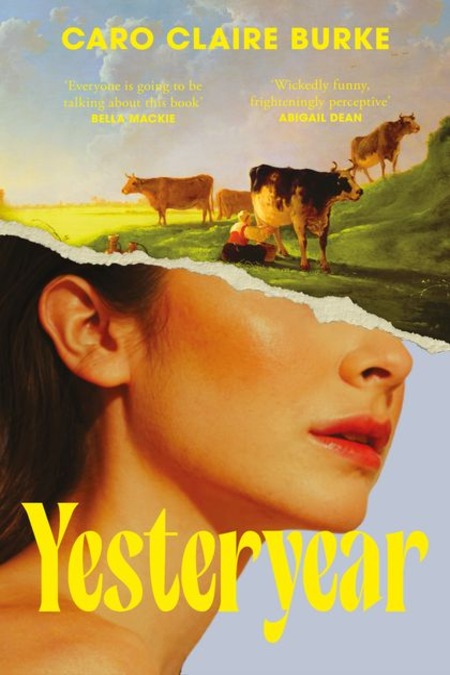
(courtesy Harper Collins Publishers Australia)
If you have even a modicum of self awareness and personal integrity, the idea of pretending to be something you’re not often doesn’t sit well with you.
The only way you can live with a fake persona and your real self sitting cheek-by-jowl is to enter some sort of permanent dissociative state where you throw everything you have, and it’s a conscious act, into being the person you have chosen to be, not who you actually are.
That could be for a host of reasons, but more often that not, it’s to escape the deep wells of ever-present, corrosive trauma, where reality is a threat and your dream self is balm of possibility and hope.
The poster child for the perils of existing permanently in a dissociative state is Natalie, the protagonist of Caro Claire Burke’s superbly incisive novel, Yesteryear, who has chosen for herself a life of Tradwife perfection where she lives in a “charming farmhouse on a working ranch” on a sprawlingly remote property in Idaho, which appears to be an epicentre of conservative Christian culture, with a “handsome cowboy” named Caleb and an ever-growing number of choildren.
It all sounds so oldey-worldy and rustically bare bones but the truth is it’s all make believe; in the background, where Natalie’s thriving Instagram followers are never allowed to go, live nannies, a content producer, farm workers and industrial scale ovens, all devoted to fabricating the person Natalie wants to be.
After I finished peeing, I stand up straight, close my eyes, organize [sic] my thoughts, and click my heels together three times.
There’s no place like home.
There’s no place like home.
There’s no place like home.I throw the door open and say, ‘Shit.’
In our truth-suspect digital world, where smiling shots on the beach disguise blowing sand and noisy crowds, and immaculate rooms push aside the detritus into a messy room next door, this kind of approach is nothing out of the ordinary.
But it’s what drives Natalie to create this slice of ersatz old time America that sets it apart from many of the other digital accounts celebrating a similar bygone era aesthetic.
She has created her fake rural idyll, which doesn’t even support itself in reality, to buttress up a very narrow world view where faith in God trumps everything else, and where imperfection of any kind, cannot be countenanced, not even for a second.
Yesteryear gives us repeated insights into the daily struggle Natalie has to keep her make-believe marriage and world ticking along in required squeaky clean and dreamily faith-filled fashion, where more than occasional bursts of fury and foul language are shoved down to keep the image of God-filled perfection alive.
If you have ever grown up in the Church, you will be well acquainted with the sleights of hand and the gaping chasms between unyielding belief and stark reality that exist when you can’t admit to a second of authentic normalcy.
Whenever Natalie’s sister, Abigail, who has the guts to do things her younger sister would never in a million years countenance (even though she desperately needs to) or her mother try to inject some sage advice or grounded perspective into Natalie’s increasingly twisted and skewed worldview, they are rejected in favour of continuing the fabrication of how Natalie needs the world to be.
Unwittingly, Natalie wanders into a world populated by MAGA-type people, the poisonous misogyny of the so-called “Manosphere”, full of conspiracy theories and horrifically warped ideas of what real men are and how the women in their lives should meekly behave, a place where all the human rights and feministic advances of the last century or more have been rolled back.
It’s a collective rejection of reality on a mass scale by a cult of thought that can’t cope, or doesn’t wish to cope, with a messy but vibrantly diverse world, and which exists only where certain very narrow parameters are met and rigorously upheld, in defiance of how out of step they might be with the real world.
Natalie doesn’t necessarily consciously buy into this mindset, but inadvertently, she is a part of it, for reasons that are wholly and brokenly her own, and Yesteryear has a field day exposing how barren and lost these people are and how far from a satisfying existence many of them are.
While this reviewer was fortunate enough to have the self-awareness to walk away from the sort of narrow Christian worldview that gave rise to MAGA etc, and never lived in a world as extreme as the one Natalie occupies, the crushing disconnect between belief and reality is disturbingly familiar, one so pervasive you can easily, as Natalie does, believe this is how the world actually is.
That’s what they’d told me to do, right? All those women who came before me? Be a mother, be a wife, and keep the household clean.
Liars. Every Christian woman I ever met had been a big fat lying bastard. Lord have mercy on their big fat lying bastard souls.
Thank god it is not because as Yesteryear builds and builds, it becomes apparent, that all is not well in Natalie’s world.
She arrogantly believes, in contravention to all evidence to the contrary (and even when she looks like she’s leaning toward a real world epiphany, she ducks and weaves around it each time), that her life is superior to those of her mother and sister and old college roommate Reena, and can’t see the warning signs building everywhere that her Instagram perfect world, which ironically depicts a bizarrely simplified Tradwife lifestyle inimically opposed to the platform used to promote it, is about to come crashing down.
Then she wakes up in what appears to the nineteenth century and readers and Natalie have to wonder if she has really travelled back in time, is she in some sort of fever dream coma or is this some sort of devastating brain snap?
Quite what it is, is revealed late in the book, and it’s even darker than you’re envisioning, but suffice to say, that Yesteryear does a brilliant job of damning this deluded way of living by a thousand cleverly insightful cuts while somehow being sympathetic, within limits, to what has driven Natalie to construct such a monstrously big though prettily served up lie.
Diving deep into how nightmarishly twisted a great deal of modern nostalgia-fuelled faith-filled life can be, and it is rotten to its very core, Yesteryear also captivatingly explores the state of modern womanhood, of people trying to find a place in a world rapidly and messily resetting itself seemingly every ten seconds or so, and how often people trade off their authentic selves, in which lies unexpected peace and power, for the pursuit of an ideal which isn’t real, which ultimately corrodes the soul and a sense of self and which ends up destroying the very things it is supposed to evoke and support to the great loss of everyone involved.