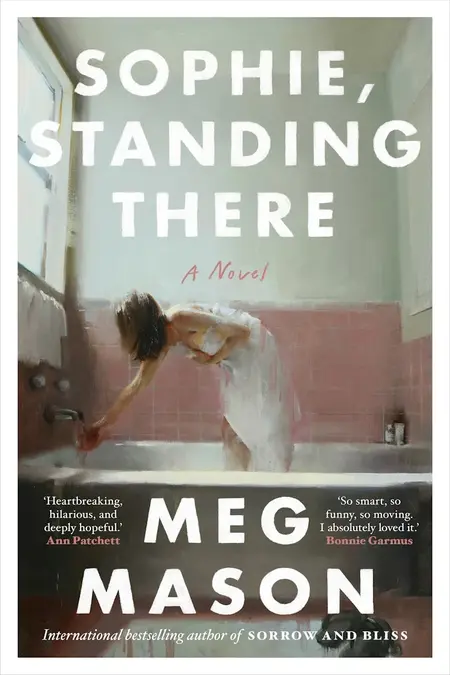
(courtesy Harper Collins Publishers Australia)
If we are to believe Hollywood’s take on grief, loss and trauma, all it takes is about an hour and a half, a montage or two and a meaningful conversation with a bestie, significant other or wisely insightful stranger for all of the pain and trouble to become a distant memory.
Alas, real life is not as easy or convenient, and never has that been more starkly and yet tenderly and thoughtfully evident than in Meg Mason’s outstandingly good novel, Sophie, Standing There.
The titular protagonist is rather wonderfully described on the back cover blurb as “such a lovely person. Warm, kind, amazingly positive” but as Mason empathetically points out, being all those good and laudable things does not, alas, inoculate against the raw and ugly vicissitudes of life.
Evidence of that is ———- SPOILER ALERT !!!!! ———- Sophie’s brutally sudden divorce from husband Paul who loved her until he suddenly didn’t – though in retrospect, Sophie realises, things were waning way before that – and whose clinically efficient and graphically unfeeling of delivering the life-changing news has shaken Sophie to her core.
She may have a bestie in Emma and good, if not close, work colleagues in her role as a freelancer sound technician at literary festivals and a hugely supportive and super close brother in Laurie, but she’s lonely.
Very, very lonely and there doesn’t seem to be any immediate way to remedy this socially corrosive state of affairs.
She [Sophie] had never been this sad. She had, but not in relation to her work. Work made her happy. Her personal life was the sad part. When both are sad, how can you call yourself a happy person?
That is until Sophie discovers Lilac Dunne, a very famous author with a social media persona and a podcast presence which is thoughtful and insightful and friendly, so friendly in fact that Sophie, an inveterate reader who has always recoiled at people who become obsessed with particular authors, finds herself becoming enamoured with her new author “friend”.
Sophie goes all in, reading all the books, scouring the interviews and loading up on all the podcasts there are to listen to, and while she knows it’s not healthy to give up sleep and sometimes work to satiate her need for all things Lilac all the time, she figures it can’t do any harm since the author will never come to the festivals where she works.
She’s far too famous, too otherworldly, too everything, really, and her literary magnificence could never slum in the confines of a mere book festival.
Until, through a stroke of happenstance, she does, and suddenly Sophie has to figure out to react to Lilac’s presence mere metres from her without becoming one of those weirdly unhinged readers who can’t separate fiction from reality.
She sort of succeeds and sort of doesn’t.
The brilliant part of Sophie, Standing There, one of many really, is that it’s gorgeously measured and restrained in the way it explores how Sophie’s Lilac obsession, which is filling the biggest of holes in her achingly sad and lonely soul, and what it really shows about where Sophie is.
It doesn’t go overboard, doesn’t slide into tacky trashability and somehow keeps it nuanced tone and perspective even when poor, lovely Sophie doesn’t.
And you will come to love Sophie.
All her reactions make perfectly grounded sense to anyone who has ever had the bottom fall out of their lives, over a long period of time or an instant and who hasn’t found it easy to find a way to navigate through the confusing feelings and life potholes that result.
Yes, Sophie loses perspective and a sense of self, and the way she gets it back and figures out how to move forward is brutal, courtesy of a particular person who shall remain nameless, but it all makes sense to you if you are, like the protagonist and this reviewer, more fallible and uncertain about how to handle life than you’d like to admit.
There is much with which to identify in Sophie, Standing There, and much of the joy of reading this beautifully written but universally emotionally accessible book is how you feel everything Sophie does.
True, she’s not always the best version of herself, which is, did we mention, really quite lovely, but who of us are, especially when life has thrown us a curveball and totally thrown us off track and we haven’t got a clue in the world how to get back out from the abyss.
Hollywood would suggest it’s easy but we know it’s not, and thank god for Sophie for showing us that it’s okay to be messy and not have the answers and that you can finally pull free of bad childhood experiences and traumatic adult ones and find somewhere new to go, even if the getting there is slow, stop-starty and not full of epiphanies and bracingly clean starts.
With a vague sigh, Lilac said, ‘Do you need me to tell you what you have?’
‘Please don’t,’ Sophie said back. She did not want to hear how her life had really sounded to Lilac.
‘You have a brother you love.’ Lilac proceeded anyway. ‘You told me you had wonderful parents. You’re an intelligent reader. You have a good job, and you are good at that job. It is perfectly likely you will have a child,’ she said to Sophie’s full annihilation. ‘ And you must have friends. Nobody is totally alone.’
Sophie, Standing There also had a lot of fun with affectionately and sometimes spikily parodying the world of literature, literary festivals and the interactions between authors, fans and those who work at the events.
Obviously an author of Mason’s standing and experience has been to festival or two in her time, and the novel has quite a lot of lived moments filling its page, all of them delivered with rigorous honesty but never in a way that cruelly or nastily skewers anyone or anything.
Much like the novel overall, these passages are based in the messy fallibility and frailty of life, and the decision by Mason to root Sophie, Standing There in a sage honesty about the fact that the act of living, no matter where or how it manifests itself, feels so refreshing and forgiving of the inevitable pitfalls and shortcomings of mortality.
Much like Sophie herself, there is a loveliness and a forgiving understanding all the way through Sophie, Standing There which acknowledges how badly we can get life wrong, especially in the aftermath of grief and trauma, but which also embraces the fact that this is not a terminal state of affairs and that we are simply being human and that’s fixable and okay and just prove to be quite wonderful as the final imaginatively rendered chapter makes delightfully clear.